
By David Berridge
In 1996 artist Ria Verhaeghe began tearing photos out of newspapers. With an existing career as a portrait painter, she considered “painting a portrait of every photo that touched [her],” [1] but the rapidly increasing number of images in the collection made this impossible. So, they were glued into notebooks covered with newspaper stock market reports and stored on shelves in her Bruges studio. She classified them by means of keywords—Human Interest, Icarus, Move, and Trümmerfrauen, amongst many others. In the daily act of selecting images, as Barbara De Coninck observes, “she survey[ed] the world as if through a paper crystal ball.” [2] For example, the pietà that was ever present in newspaper coverage of the Balkan crisis in the 1990s appears much less in the reporting of more recent conflicts.
Thirty years later, a digitized online archive of 60,000 of these images titled Provisoria can be searched by keywords, dates, colors, and groups. [3] It remains a source for Verhaeghe’s art works, such as Commemoration Works, where people in newspaper photos appear semi-abstracted in shimmering gold leaf, or Prayer Sculptures, where strips of latex-soaked newspaper are wound into strings, then wrapped in silk. When the archive itself is exhibited, Verhaeghe asks curators to choose three of her keywords to determine what images are selected. A multi-year collaboration with curator Patrick Ronse of Be-Part, Platform for Contemporary Art, in Waregem and Kortrijk, led both to an exhibition and the publication of Provisoria in book form, designed and edited with Jurgen Maelfeyt of Ghent-based publisher Art Paper Editions.
In this publication, six to eight small photos are printed in grey scale on the black background of each page. Lift the cover and in lieu of a title page a single blank recto is prelude to an unrelenting and unpaginated 500 pages. Here the fixed, linear form of the codex, with its expectations of sequential page-turning and narrative progression—as well as the convention of a reader quietly contemplating a single image—clashes with a different sense of the book as a container of uproarious multitudes, maybe best navigated by opening the book randomly again and again. I alternate between these two modes, sensing the ordering in Verhaeghe’s project, but I also give in to the sensations it prompts of being lost and overwhelmed. [4]
So I encounter page spreads of multiple caps, clocks, beach umbrellas, balloons; of shadows, destroyed buildings, people sweeping, dead bodies. Occasionally I recognize an artwork, event, country, person, or particular news photo, but more often I am horrified and adrift in space and time amongst this abundance of human life and (often) atrocity. Sometimes I cannot tell at first if what I see is an artwork or a dead person, a fashion shoot or a genocidal line up of prisoners. When I do go through the book page by page, it seems an affective dream trace of my own decades of looking at news photos since 1996. While the same images can be viewed on the Provisoria website, the form of the codex book creates a particular temporal, spatial, and sculptural experience.
This essay positions Provisoria amongst other recent publications by visual artists, graphic designers, and independent art publishers in France, Belgium, Germany, the Netherlands, and Austria (often, as in the example below, the artist-author may also be designer and publisher). Often these copy the scale and design of Verhaeghe’s book, also gathering and organizing a large number of existing photographic images, sourced from print, via the Internet or institutional archives. Some of the books discussed here are smaller and more focused—on a single object or aspect of this process of selecting and arranging photographic images—but all trouble the boundaries of a habitus. They reconfigure how knowledge, Colonialism, and power, for example, might be explored through and embodied in a codex book, albeit one that in size, format, and content often differs from the conventional trade monograph or paperback.
In Emptying the Shelves, for example, Mirelle van Tulder compiles another 500-page paperback of archival photographs, this time of exhibitions and displays at Dutch ethnographic museums. This collection begins in 1883 with images of crowded galleries and cabinets at the International Colonial and Export Exhibition of the Museumplein, Amsterdam, moving through the decades to conclude with photos of the more minimal arrangement of objects in modernist display cases at the National Museum of Ethnology, Leiden, ca.1978. In a further section, the photographs shift into color (they are stills from Being Part European, a 2024 film by van Tulder and Studio Airport) to document the closed stacks and shelves of present day museum storage facilities, where the majority of the collections represented are now housed.
As documents of exhibition rooms and display cases, individual objects are rarely identifiable throughout, and while compiling the book van Tulder constantly asked herself if she was “reproducing or undoing the colonial difference.” [5] However, her indexed and comprehensive, chronological history forensically establishes how these attitudes reproduce themselves across different fashions of museum display. As sociologist Tamarah Kerr de Haan observes in the book’s concluding essay section, these all ascribe to the objects a “rootlessness” that comes from their extraction “from the relational worlds in which they once were embedded and held meaning—be it embodied, communal, affective, spiritual or ecological.” [6] Page-turning through five hundred pages of indistinct, greyscale photographs of barely visible objects makes clear the scale of the deprivation and injustice this extraction involves. If debates about the restitution of such objects often focus on relocating objects from one nation-state to another, then the physical characteristics of this publication and its photographs materialize van Tulder’s desire to widen the debate and focus on “the object as a tangible witness to violence and as a carrier of the diasporic trajectories that continue to unfold in its aftermath.” [7]
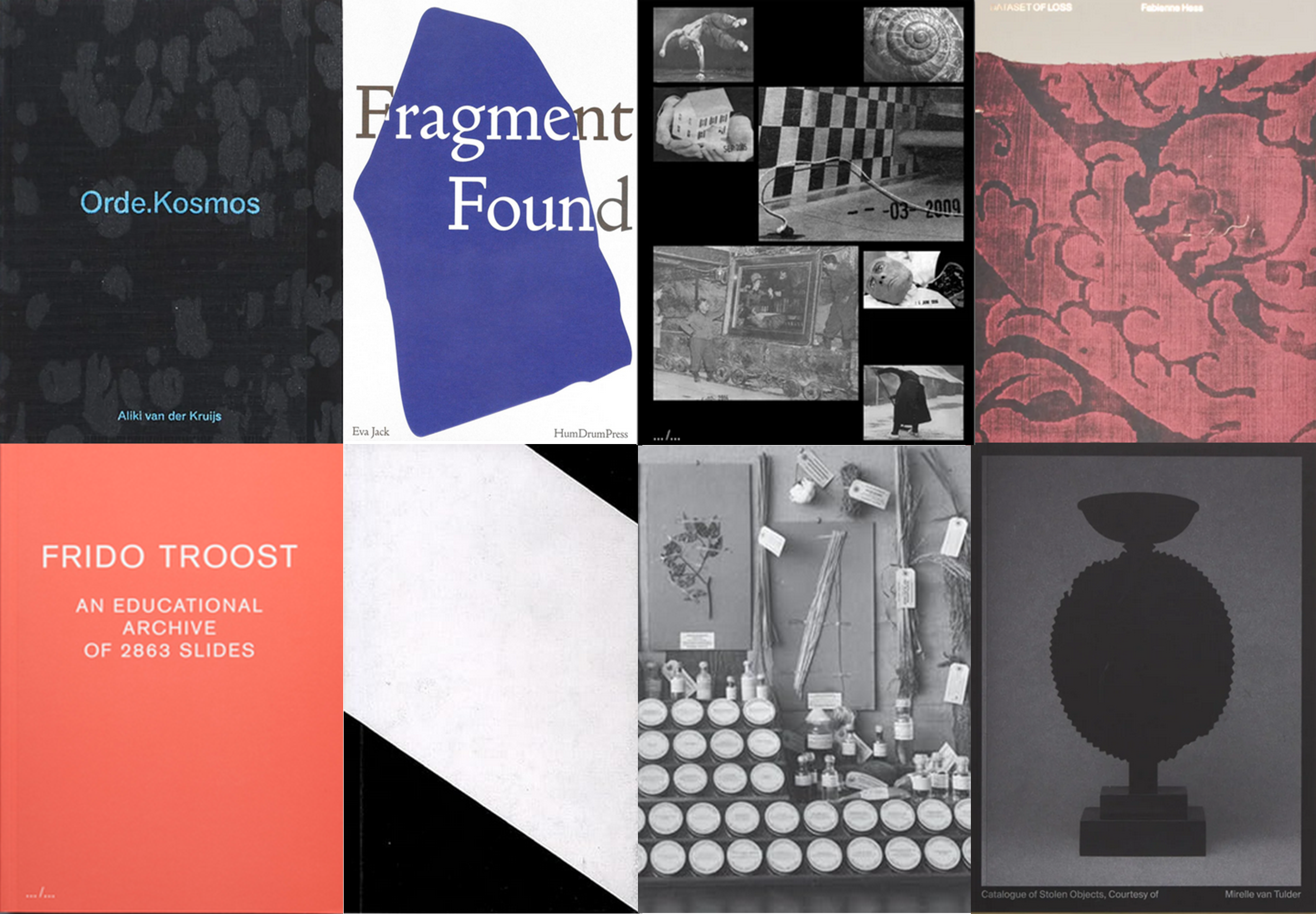
These complexities are also performed in van Tulder’s Catalogue of Stolen Objects, courtesy of, which copies the format of slim collection catalogues, gallery brochures, and magazines such as Arts d’Afrique Noire (front covers of these publications get reproduced in an index) to present an array of individual objects carefully lit and photographed as objet d’arts. In van Tulder’s Catalogue, however, the textual labels for these objects accompany white space, as if the objects had been erased, cut out from the book, or whited out by over exposure. Are the objects absent because they have been restituted to their places of origin? Have they been stolen, either from their original contexts or from public collections, to become illegal commodities? The shadows of the original photography remain, so that the white spaces appear like paper sculptures. Is this approach highlighting the space of potential that comes from foregrounding “rootlessness” rather than the further reproduction of a colonialist logic? Are readers who contain to pay attention to such objects and their labels being made aware of their ignorance? Turning the pages, all these possibilities suggest themselves.
Books such as van Tulder’s and Verhaeghe’s illuminate genealogies of art publishing, making, and thinking. The greyscale photographic reproductions on black pages of Provisoria quote the black cloth boards on which German art historian Aby Warburg arranged photographic reproductions of art and architecture for his Mnemosyne Atlas. [8] Discussion of Warburg’s project, particularly since its reconstruction, exhibition, and book publication in 2020, often involves Warburg’s concept of “Pathosformel.” As Kirstin Schankweiler and Philipp Wüschner observe, this term was used by Warburg “To describe expressive gestures of heightened affective intensity… [that become] formalised, historically in objects of art” and “can be reused again by artists in different contexts.” [9] Thus “a pathos formula enables affectivity to circulate: what has been an individual event becomes formulaic and can thus be copied and shared.” [10]
Verhaeghe’s and van Tulder’s books lack both the iconographic specificity that Warburg sought and his interest in plotting shifts from the Greek and Roman classical worlds through the European Renaissance into the present. Across their hundreds of pages, however, an “affective intensity” characterizes both their collection and presentation, as well as the often indistinct graininess of their many photographs. This intensity partially unmoors the viewer into a wandering vulnerability to pathos formulas as a method of reading, exampling a contemporary sense of the archive that, according to scholar of cultural memory Aleida Assmann, represents “a space of latency and thus a fund and background for memories that have their hour behind them, but perhaps also still ahead of them.” [11] Here, too, are distorted echoes of the typological projects from photographic history, including the studies of architectural forms by German artists Bernd and Hilla Becher [12], or the thousands of photographs that Hamburg-born artist Marianne Wex either took herself on the streets of her home city or found in magazines and books for a study of gendered body language. [13]
Other recent publications connect to an artist’s or designer’s broader practice in a manner reminiscent of the scrapbook or fabric sampler. The 500 pages of Orde.Kosmos derive from 24 folders of material in the archive of Hague-based textile designer and researcher Aliki van der Kruijs, which here become 24 chapters that evidence an “ever evolving process of reading/combining/keeping.” [14] A linear reading of such a book again feels somewhat perverse, but an index and discrete title to each page remind the reader that each folder has a particular theme: “Orde: Space and Time” begins the project, dated 01/06/1980, with the twenty-fourth chapter “Order: Yellow Yes” on 01/05/2002. The pages scan newspaper articles with yellow post-it notes added or capture sheafs of book pages and other papers with multiple images and in many different languages. These show sprawls of thread, a leaf, splashes of ink, project drawings and plans, the moon, penciled word-lists, a paper bag, and a pair of 3D glasses, to give just a tiny sample. At the bottom of each page are weather records: “Good weather,” “(last quarter),” “The Sun yes the Sun very Warm and oppressive and up to 34-35+” taken from the artist’s collection of her grandfather’s weather notebooks. If initially this seemed to be source material for the art installations and textile designs of van der Kruijs’ wider practice, page-turning through hundreds of scans soon suggests the book as a self-contained organism. This demonstrates an idiosyncratic artistic-ethnographic fieldwork with materials, locations, people and weather, forms of knowledge, texts, and photographs, in which each scanned page records, stimulates, processes, and produces simultaneously.
In repetition, repetition by Anni’s—moniker for Copenhagen-based graphic designer Anni Vestergaard—333 pages are gathered from 333 different books on visual arts, each selected for how their respective images explored systems ands grids, be it in beehives, polyhedral foam, modernist architecture, ancient Egyptian pyramids, stone circles, minimalist sculptures, or steel machine parts. The 333 pages are aligned at the right-hand corner, and the book includes only that part of pages that fits the standard paperback format, as if the book form were a template for cutting around the diversely sized source material and imposing uniformity. Sometimes this means that the collected image is partly or wholly absent, and what gets reproduced is whatever image, text, or white space occupying that corner of the page. Rather than a straightforward catalogue, repetition, repetition enacts its own systems and grids, the translations and transformations involved in reproduction and publishing.
Multiple logics of power and agency inform the selection of images in all the books discussed here. After completing Zebras, Blanks and Blobs, a 2017 artist book based on the University of Edinburgh digitized image archive [15], Swiss-born London-based artist Fabienne Hess observed her principle method of organizing images was via formal typologies and that she “had looked at the images in the collection just like a machine…[and] was really shocked by this.” [16] Hess identified the same process of image organizing across Instagram, books, the Rijkmuseum website, and the tagged object that formed the basis for the workings of algorithms. In Hess’s subsequent publication, Dataset of Loss, she sought an alternative organization path, asking “How to resist this object vision? How to look at images with ‘my entire experience’?” [17]
Although Dataset of Loss has a spine and cover, it turns out to be a cardboard folder containing five loose sheets to be held up and unfolded. Both sides of each five-sheet concertina contains five images, of which I could say: Cables on a floor. A pile of thrown out wooden drawers amongst leaves and cigarette packs by a garden fence. Broken glass on a pavement. However, rather than immediately labelling photographs by object, then arranging them by some formal typology, Hess assembles both archival and original images expressive of loss. This quality of loss cannot be located in an object-based iconography but emerges from the overall atmospheres of these images and their sequencing. The pipe or leaf is not prioritized over the asphalt on which it lays, while the fraying of a fabric is as important as its provenance.
As my attempts to describe the contents of these photographs demonstrate, it is difficult to avoid returning out of habit to an object-focused way of responding to visual images. The unwieldy format of the large concertina format contributes to disrupting these habits of viewing, as photographs come and go, and multiply and shrink as sheets are opened and closed, returned to the folder, and the next one picked up. I contemplate standing all five sheets up on the floor as a walk-around installation but instead place them all back inside the folder. Its cover reproduces a sixteenth century silk fabric from Italy (kept at the Metropolitan Museum of Art in New York). This material and the institutional way of categorizing what I am looking at go alongside this material’s frays and holes, the latter’s affects of loss that connect not to other silk fabrics but to the thrown out wooden drawers and tangled cables Hess photographs. In Dataset of Loss, the artist dramatizes how contemporary vision struggles with such competing logics.
For Glasgow-based artist Eva Jack, Fragment Found began on a walk when she was eight and her mum “pulled a strange black glassy object from the mud.” [18] Christened the “Anglo-Saxon Eagle” for reasons unknown to Jack then or now, the found object acquired a sense of importance at home while nevertheless being stored in a plastic box with dried-up pens, elastic bands, and little-used keys, before it was lost. Jack notes “it was not so much the found object itself but rather the process of finding it that was important.” [19] Decades later, Jack realized that her personal love of finding object fragments went by “official names such as mudlarking, fieldwalking, beach combing and dump digging” [21]. In 2021, she created a website [20] where she and the public can upload photos of found pottery sherds (those with printed visual images) along with data and anecdotes about where the objects were found and their possible histories.
In a recent print publication of the project, the spreads of sherd photos can be visually and leisurely contemplated. While the website is ongoing the book freezes Fragment Found at one moment in its existence, accompanying the sherds with texts that highlight their emergence from networks of kin and imagination. So teacher and archivist Dave Clarke describes the generational transition of fieldwalking skills—such as observation and the “grit to keep persevering” [22]—from his parents to himself. Today he fieldwalks with his own son, whose autism gives him an “incredible faculty in discerning patterns and shapes against broken backgrounds combined with phenomenal memory for place and positions [which] means he can wring finds from any piece of open soil or sand.” [23] For Australian writer and curator Lara Chapman, the sherds prompt short fictions written either in their own imagined voice—“I have concentrated into something new. ‘Clay’ the worms whisper as they pass through me” [24]—or those with whom they come into contact, such as The Digger, who loads the sherd-to-be onto a wagon of Dorset Clay, and The Driver, who gives the clay its first glimpse of the bottle-like chimneys of Stoke-on-Trent pottery factories. As Jack observes, the “archiving and sharing” of “little bits of forgotten history” is also an activity defined by “pure and simple joy.” [25] Unlike other books here, Fragment Found looks to pass on its enthusiasm for the sherd via the conventional, slow rhythms of perusing and reading an art book or a prose anthology.
In harmony with Jack’s project, the publisher of Fragment Found—the Rotterdam and Berlin-based HumDrumPress—has sought a publishing model that is “as communal, open-access, and multivocal as possible,” be that through “open book events, collective editing, collaborating design, logbooks, and open-access publishing” or through the positioning of books as one stage in ongoing processes of knowledge and relationship. [26] Other projects, designers, and publishers featured in this essay have used different models, but in their utilization of the codex book form they share what sound artist and scholar Salome Voegelin terms a method of “uncurating,” namely an ability “to uncurate the curatorial regime and claim to universality by troubling their own habitus and troubling their line of walking and viewing, listening and responding, becoming aware of its locality and rejecting its universality.” [27]
As I completed the research for this essay, one more new publication both developed and transformed the discussion. During an artist’s residency at the Musée du Quai Branly – Jacques Chirac in Paris, Iranian-born artist Hoda Afshar discovered the archive of French psychiatrist and photographer Gaëtan Gatian de Clérambault, who in early twentieth-century Morocco took thousands of images of veiled women and men. Early on, Afshar discovered that archival images downloaded from the museum’s website were cropped. This prompted Afshar into further image re-workings, including digital manipulation and the production of silver gelatine prints in the darkroom. In her artist book The Fold, over 960 of these images appear either as full bleed photos or as part of grids of nine images reminiscent of contact sheets or folders of archival slides.
As I turn the pages of The Fold, I notice how its many photographs explore the psychodynamics of de Clérambault’s original project, its desire and erratics of affect beyond any proclaimed documentary or scientific purpose. Simultaneously, without offering any clear typologies, Afshar goes beyond an Orientalist fascination with the veil to affirm, through its manifold forms and folds, the unique ontology of the veil, its figuring of gender, religion, politics and agency in both the France of 2025—in which her project is exhibited and published—and the post-Islamic Revolution Iran of the artist’s upbringing. Presenting hundreds of veiled men and women, Afshar’s project also suggests African-American historian Saidiya Hartman’s method of “critical fabulation” [28] and its attempt to “recuperate lives” from the limited details of the archive. [29] That said, little of individual personalities emerges in Afshar’s hundreds of images, and much of her cropping and reprinting highlights the folds and hanging of the material of the veil as autonomous from the human body that wears it. One effect of this approach is to go beyond a preoccupation with the gaze these photographs enact or imply and, in the artist’s words, to more fundamentally “confront the viewer with their own ignorance – namely, how could these images come to exist at all?” [30] This is illustrated in the design of Afshar’s book by Loose Joints Studio, where the first glimpse of a veiled subject comes from a cover half folded back, which would normally be the result of a book being dropped or damaged. For Afshar herself, the confrontation her project instigates shifts the viewer’s attention back onto Clérambault—“The investigator is investigated. The analyst becomes the analysed.” [31]
While not a comprehensive catalogue, this essay highlights a form of photography-based book project that demonstrates a particular variety of image-based practices and research paths amongst European-based artists, graphic designers, and independent publishers. Other examples include Dominique Rivard’s Florilège de Labyrinthes and Lalie Thébault Javiel’s Notre pain quotidien, where the codex book becomes a discerning container for selecting and arranging images from the proliferating internet images of their titular subjects. How such projects might expand beyond a largely visual approach is suggested by artist, curator and researcher Sarojini Lewis’s A Shift of Identity—Visuals of Migrant Women Situating the Archive Through A Contemporary Lens. This 582-page book connects contemporary artistic practices of Indo-Caribbean artists based, like Lewis, in the Netherlands, with oral histories from the author’s Afro-Surinamese relatives, while also highlighting archival material emanating from previous generations of Bhojpuri women migrants who went as indentured labor to Mauritius and Suriname.
While many of the books reviewed here contain a large number of images, even the thickest of them presents only a fragment of the possible. These books demonstrate the making of a container and an order, even if they overwhelm, seem without typology, and cannot be read from start to finish or pursued leisurely as might be expected of novels or monographs. Instead, we have something akin to what sound artist and writer Ella Finer observes of the Cultural History Frieze that occupies the entrance way of The Cosmic House, designed by Charles and Maggie Jencks in West London in the early 1980s. Here, in a gesture somewhat akin to the gathering of photographic images, historical figures including Thomas Jefferson, Hannah Arendt, Imhotep, and John Donne are painted conversing and reflecting. However, Finer is less concerned with the specifics of each figure than with the “cacophonous energies” [32] of the whole, which asks each viewer:
What is at stake in models of existence which makes space for certain bodies and their stories of the world? What kinds of knowledge of experience fall out of a created symbolic order? With what singular or collective impulses are such models made? What networks of collaboration, conscious or otherwise? [33]
Books by Verhaeghe, Afshar, Ness, van Tulder, and others discussed here never had the fixed focus on distinct human figures of the Cultural History Frieze. However, they chart the shift from the individual photograph to the reckoning with the “cacophonous energy” of our historical and contemporary image worlds. Finer’s essay about the Frieze is punctuated by what she calls “sleep songs.” These are gatherings of quotes and notes from Finer’s research that become re-arranged as rhythmic lines and stanzas that then go through three musical movements of repetition and metamorphosis, attentive to the page space and a gestural quality of language as both image and sound, score and response. Finer equates this language to “the obscure, peripheral and incomplete” character of night and sleep as forms of knowledge to be valued as much as “what is granted the light and legibility of recognition, what appears.” [34] This somewhat altered consciousness is a state of mind I experienced as I looked and turned my way through these books, and I also imagine it applying to the Bruges studio of Ria Verhaeghe, where gatherings of news print become delicately transformed by gold leaf, dipped in latex and twisted in string, or mapped in video works by webs of colored lines that resemble telephone cables.
David Berridge is a writer and researcher on artists’ books and art writing.
[1] De Coninck (2025, unpaginated).
[2] De Coninck (2025, unpaginated).
[3] https://www.provisoria.net/. Accessed 10/12/25.
[4] In suggesting Provisoria and other books discussed here require particular methods of handling and page-turning in their approach to narrative and the codex, I draw on Lockemann’s (2022) discussion of the photobook, and the theoretical ideas she cites, including Sekula’s differentiation of “series” and “sequence” (1998, p.11) where the sequence is fixed in content and order, while the images and order of the series can be varied. However, Lockemann’s photobook is defined in relation to monographs of usually single-authored photographs, which differs from the books discussed in this essay.
[5] van Tulder (2025b, p.495).
[6] Kerr de Haan (2025, p.609, italics in original).
[7] van Tulder (2025b p.496).
[8] Ohrt and Heil (2020).
[9] Schankweiler and Wüschner (2019, p.220).
[10] Schankweiler and Wüschner (2019, p.221).
[11] Assmann (2023, p.34).
[12] Graziani and Bas (2024) discuss the Bechers’ work alongside a number of other related projects in contemporary photography..
[13] Wex (1979).
[14] Miller (2025, unpaginated). Quoted from an email to Miller, van der Kruijs is describing artist Marlene Dumas’ archive of source material kept in thick black blinders on a book shelf, which provides ongoing inspiration for her own collections.
[15] https://www.trg.ed.ac.uk/project/fabienne-hess. Accessed 10/12/25.
[16] Hess (2024b, p.1).
[17] Hess (2024b, p.2).
[18] Jack (2025, p.11).
[19] Jack (2025, p.12).
[20] Jack (2025), p.12).
[21] https://www.fragmentfound.com/. Accessed 10/12/25.
[22] Clarke (2025, pp.249).
[23] Clarke (2025, pp.249-50).
[24] Chapman (2025, p.171).
[25] Jack (2025, p.15).
[26] Colophon in Jack (2025, p.259). See also the open document “a living, breathing, manifesto, for publishing the humdrum way” at https://humdrumpress.com/manifesto. Accessed 10/12/25.
[27] Voegelin (2025, p.15).
[28] Hartman (2008, p.11).
[29] Specifically, in relation to the slave trade in North America, Hartman’s aim is to “recuperate lives entangled with and impossible to differentiate from the terrible utterances that condemned them to death” (Hartman, 2008, p.3).
[30] Afshar (2025b, unpaginated).
[31] Afshar (2025b, unpaginated).
[32] Finer (2025, p.iii).
[33] Finer (2025, p.iv).
[34] Finer (2025, p.iv).
References
Afshar, Hodar. 2025a. The Fold. Marseille: Loose Joints.
Afshar, Hodar. 2025b. “Hoda Afshar in Conversation with Taous Dahmani” in The Fold, by Hodar Ashar. Marseille: Loose Joints, unpaginated,
Anni’s, repetition repetition. 2023. Berlin: Bom Dia Boa Tarde Boa Noite.
Assmann, Aleida. 2023.“The Archive as a Laboratory of the New: Where Remembering and Forgetting Meet” in Productive Archiving: Artistic Strategies, Future Memories and Fluid Identities, edited by Ernst van Alphen. Amsterdam: Valiz, 30-34.
Chapman, Lara. 2025. “Fragments of a Fragment: A Possible History” in Fragment Found, edited by Eva Jack. Rotterdam and Berlin: HumDrumPress, pp.168-176.
Clark, Dave. 2025. “Walking with Archie” in Fragment Found, edited by Eva Jack. Rotterdam and Berlin: HumDrumPress, pp.246-251.
De Coninck, Barbara. 2025. “Why are we blind to the suffering of others?” in Provisoria by Ria Verhaeghe. Ghent: Art Paper Editions, unpaginated.
Finer, Ella. 2025. The Cosmic Oval. London: Spiral House.
Graziani, Stafano and Prince, Bas. 2024. The Lives of Documents – Photography as Project. Montréal: Canadian Centre for Architecture.
Hartman, Saidiya. 2008. “Venus in Two Acts”. Small Axe (26), 1-14.
Hess, Fabienne. 2024a. Dataset of Loss. Zurich: edition fink
Hess, Fabienne. 2024b. “Introduction to Dataset of Loss”, downloadable PDF at http://fabiennehess.com/. Accessed 10/12/25.
Jack, Eva. 2025. Fragment Found. Rotterdam and Berlin: HumDrumPress.
Javiel, Lalie Thébault. 2022. Notre pain quotidien. Paris: September Books.
Kerr de Haan, Tamarah. 2025. “Summoned From Obscurity: Reflections on the Colonial Depot” in Emptying the Shelves, edited by Mirelle van Tulder. Amsterdam: Roots to Fruits, 500-515.
Lewis, Sarojini. 2025. A Shift of Identity – Visuals of Migrant Women Situating the Archive Through A Contemporary Lens. Prinsenbeek: Jap Sam Books.
Lockemann, Bettina. 2022. Thinking the Photobook: A Practical Guide. Berlin: Hatje Cantz.
Miller, Meg. 2025. “To Meander Through” in Orde.Kosmos by Aliki van der Kruijs. Paris: Ness Books.
Ohrt, Roberto and Heil, Alex, eds. 2020. Aby Warburg Der Blideratlas Mnemosyne – The Original. Berlin: Hatje Cantz Verlag.
Rivard, Dominique. 2023. Florilège de Labyrinthes. Glasgow: Brise-glace Glasgow.
Sekula, Allan. 1998. “Dismal Science: An Interview with Allan Sequel by Frits Goerstberg” in Allan Sekula: Dead Letter Office, exh. cat. Rotterdam: Nederlands Fotoinstituut, 5-6.
Schankweiler, Kirstin and Wüschen, Philipp. 2019. “Pathosformel (pathos formula)” in Affective Societies: Key Concepts, edited by Jan Slaby and Christian von Scheve. London and New York: Routledge, 220-230.
van der Kruijs, Aliki. 2025. Orde.Kosmos. Paris: Ness Books.
van Tulder, Mirelle. 2025a. Catalogue of Stolen Objects, Courtesy of. Amsterdam: Roots to Fruits.
van Tulder, Mirelle. 2025b. Emptying the Shelves. Amsterdam: Roots to Fruits.
Verhaeghe, Ria. Provisoria. Ghent: Art Paper Editions, 2025.
Voegelin, Salome. 2025. “Five Ways to Unperform the Curatorial.” Ecoes (7): 8-23.
Wex, Marianne. 1979. Let’s Take Back our Space: “Female” and “Male” Body Language as a Result of Patriarchal Structures. Berlin: Frauenliteraturverlag Hermine Fees.
