
Translated from the German by Tristram Wolff and Jefferson Chase.
He pulls me along at his pace, and whistling and skipping we arrive in Saint-Tropez, where the harbor is full of sails flapping like flags; we end up at a little restaurant with gaily checked curtains, tablecloths and plates. Because of the hour, we’ll get only whatever they have left. Wolf says it’s fine by him. We sit, and then receive a gigantic platter of garlic sausages, ham, olives, pâté, sardines, anchovies, sliced tomatoes and onions and hard-boiled eggs all piled together, a copious and piquant first course, harbinger of things to come. It’s much too late for the French to be eating, so we’re all alone; nearby in the tiny kitchen they’re washing up, flies are buzzing, it’s dark, cool and quiet.
‘You do look tired. Bad sleep?’
I confess I didn’t sleep well. But it’s more than just that. ‘If I really stop and think about it, this past week felt like being shoved through a meat-grinder by some divine, inexorable hand. And it’s only now that I’m starting to get my life back together, in a foggy and back-to-front way—not an uplifting feeling.’
Wolf ’s got a mouthful of gristly sausage, he swallows carefully, then he looks at me and says: ‘You seem like you’re holding on to some overwhelming pain. You’ve been chewing it over and over and over, you should just spit this thing out and stick it under the table.’ And then he pushes his straw hat from the right to the left ear—he never takes it off, otherwise he would leave it somewhere and risk sunstroke—it looks absurd, and I have to laugh, but he looks at me again with a straight face and says emphatically: ‘Life is magnificent. And so is this sausage, by the way. So eat.’
It’s doing me good, infinite good, not being alone. Some guardian angel must have lined up Erich and Wolf on my
path, like relay stations on a grueling journey. I really feel as if I’ve been saved, rescued by life itself. I smile at Wolf, who’s silently devouring his sausage; a pretty waitress arrives with our first serious course, a tureen aromatic with herbs. She gives us both large portions, places them on the table proudly, and at once the whole scene disintegrates, the smiles, the safety, the first foray, the fresh confidence. I sit in front of my dish and inhale the rising scent of saffron and seafood, unbearably it transports me to another noonday meal. Enchanted, I look back into the past through the steaming bouillabaisse; like the smoke from a sacrificial fire its color and fragrance call up your voice and face, everything I’ve blotted out or wanted to, then they irrevocably summon still more: the bliss of proximity, of contented harmony, unmixed devotion, floating on air without so much as the beat of a wing.
Yes, here I am, a comical figure, bewildered and crying a torrent of tears into my soup plate, unashamed.
‘There now, let’s not over-salt such a good soup,’ says Wolf. But he says it very gently, and he takes the unlucky plate from me and the tureen too, removing all evidence from the room with care. And he stays discreetly out of sight long enough for me to blow my nose and fix up my face, the clean-up after the storm.
And then we go on eating. You should always keep eating. Food has a calming power. Life will always reel you back in.
Wolf will do no such thing, however. He drags me afterward to the café. Beneath the canopy sits the handsome old pirate with his silver-braceleted slave. ‘Hi!’ says Wolf, before bringing me over to their table. The pirate is uncharacteristically forthcoming for an Englishman, he welcomes me gregariously, even treats me to coffee. We sit, a tired and lazy foursome in the sun, we make a kind of family, what ties us together is the only worthy bond: love, love of the same thing, love that can’t degenerate into envy, because it is for Saint-Tropez alone.
The girl’s name is Marianne and she’s from Vienna. After half an hour I know her life story. How little money she has, that her mother is dead and that she’s not welcome at her father’s and that’s why she has to travel cheaply, that she loves the old pirate ardently and jealously in spite of his missing teeth.
‘You can’t imagine the power of attraction he has over women.’ I nod, in fact I can easily imagine it. I squeeze
Marianne’s hand and think: ‘Under all that colorful plumage she’s just like me.’
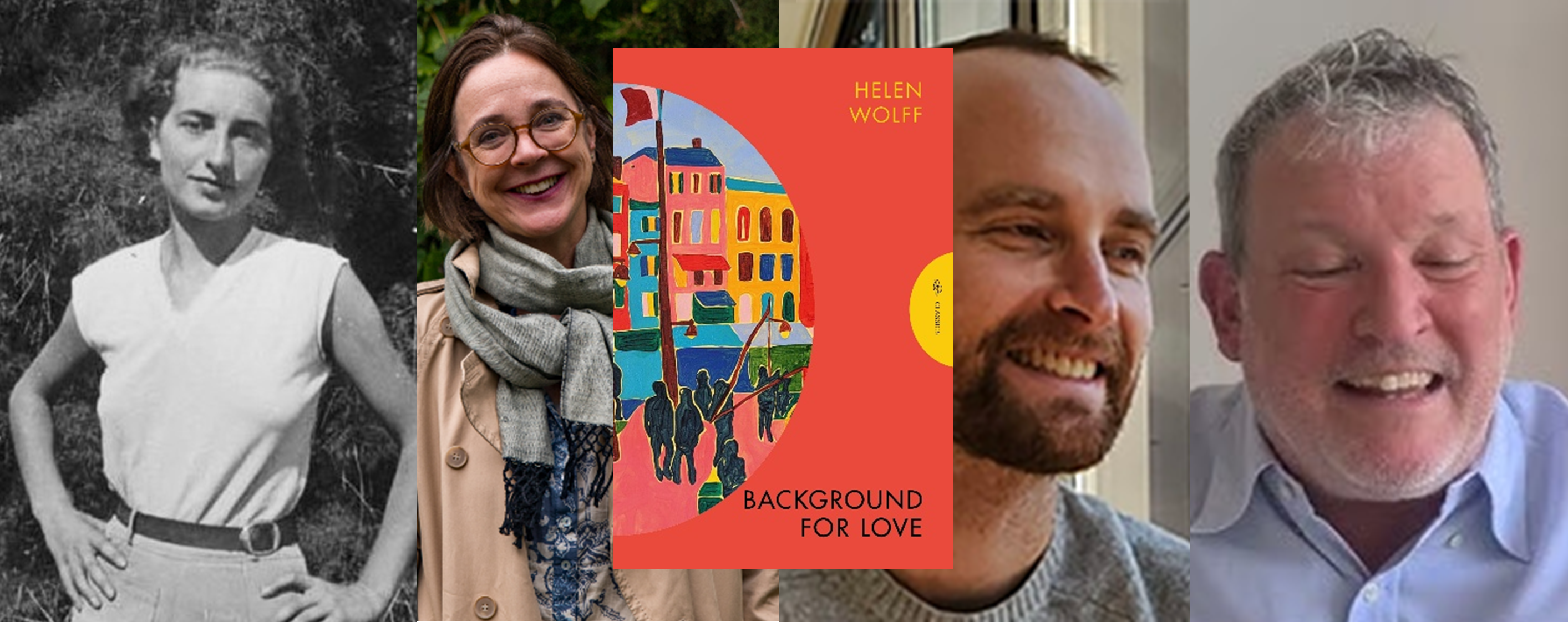
Helen Wolff (1906-1994) was born in Macedonia to a German father and Austro-Hungarian mother. At twenty-one, she went to Munich to apprentice at Kurt Wolff Verlag, now remembered as Kafka’s original publisher. She began an affair with Kurt Wolff, whom she would go on to marry. The couple fled Nazi Germany first for France and eventually for the United States, where they arrived almost penniless in 1941. The Wolffs founded a new imprint of Pantheon Books there in 1942. Helen, a gifted linguist who could read in four European languages, published a wide range of significant works by writers including Italo Calvino, Umberto Eco, Georges Simenon, and Boris Pasternak. She wrote fiction and plays but always kept her own writing private. Background for Love was first published in Germany in 2020 to wide acclaim.
Marion Detjen is a historian at Bard College Berlin, where she teaches migration history and is director of the Program for International Education and Social Change, a scholarship program for displaced students. She lives in Berlin.
Tristram Wolff writes and teaches English and comparative literature at Northwestern University.
Jefferson Chase is the translator of some 40 books from German, including works by Thomas Mann, Volker Ullrich, and Wolfgang Schivelbusch. He lives in Berlin.
This excerpt from BACKGROUND FOR LOVE is published by permission of Pushkin Press. Copyright © 2022 The Estate of Helen Wolff and © 2025 Marion Detjen. Translation copyright © 2025 Tristram Wolff and Jefferson Chase.
