
By Dominique Lutringer


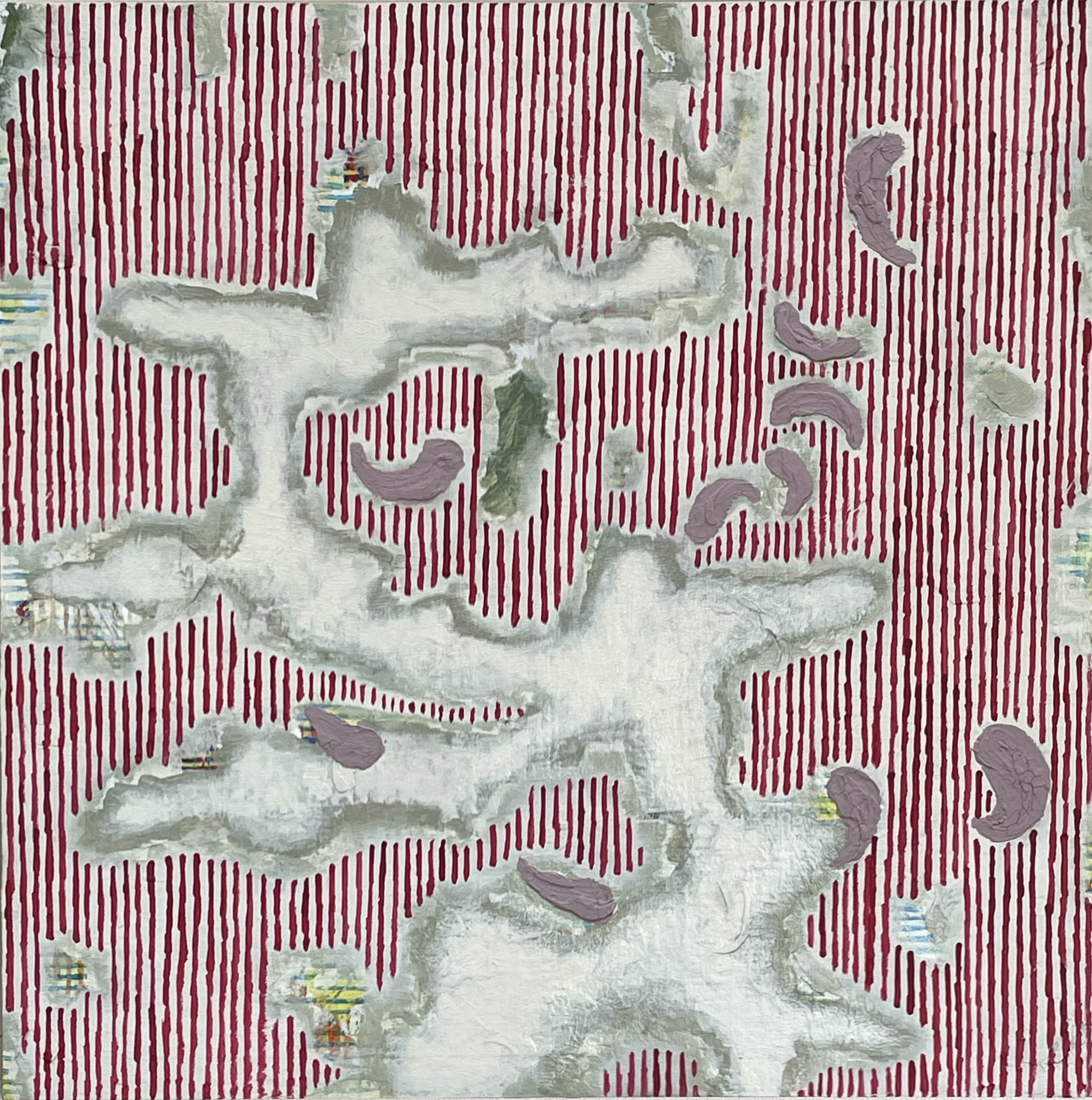
Dominique Lutringer’s work unfolds slowly, between surface and depth. At the core of his practice lies a sustained exploration of layering and transparency—not as decorative effects, but as structural tools that reveal tension, transition, and the passage of time. Through restrained modulations of color and line, he constructs pictorial spaces where light drifts, shadows hesitate, and the viewer is invited into a quiet, attentive form of looking.
Originally trained in performance and puppetry before fully committing to visual art, Lutringer has long been interested in the relationship between gesture and structure, presence and absence. His paintings evolve through a process that is both methodical and intuitive. Each layer of pigment—sometimes barely perceptible—accumulates into a visual history. Control is present, but never absolute. The material responds, resists, and occasionally surprises him, and these moments are not corrected but retained.
Repetition forms the foundation of this work. Many paintings begin with a simple, deliberate action: drawing vertical or horizontal lines, establishing a grid, repeating a gesture across the surface. Influenced by architectural structures and modernist principles, particularly the Bauhaus, the grid functions not as a rigid system but as a permeable framework—one that allows layers to pass through, shift, and dissolve. Alongside large-format works, Lutringer regularly develops series of small-format paintings, most often square. These intimate works are conceived for restrained spaces and echo the scale and simplicity of Japanese interiors. Rather than functioning as studies, they form a parallel body of work—quiet, concentrated, and deliberate. Their reduced format encourages proximity and slow looking, preserving a sense of intimacy that resonates with the understated balance and calm of domestic spaces in Japan. Alternating between expansive surfaces and small, contained formats allows the work to move between openness and closeness, between presence and discretion.
Living in Japan has had a profound influence on his visual language. Architectural elements such as shoji screens, sliding doors, and layered interior spaces resonate strongly in his work. Seasonal shifts, muted materials, and the careful use of emptiness inform his approach—not as direct references, but as ways of structuring space and attention. Alongside this, his regular practice of the Japanese tea ceremony has quietly infused his artistic process. The discipline of the ritual, its emphasis on presence, precision of gesture, and acceptance of imperfection have played a significant role in the evolution of his pictorial language.
Dominique Lutringer is a French visual artist based in Japan. Born in Strasbourg, France, with both French and German origins, he earned his Bachelor of Fine Arts at the École Nationale Supérieure d’Art d’Aix-en-Provence. In his early thirties, his artistic journey took a decisive turn when he moved to Japan, inspired by Yukio Mishima’s The Golden Pavilion and a fascination with Japanese culture that began in his adolescence. His practice explores repetition, layering, and transparency through painting and ceramics, drawing on architectural structures, modernist principles, and daily life in Japan. He is exhibited internationally in the United States, Singapore, France, and Japan, and currently works between Tokyo, Osaka, and France, where he develops exhibitions, public projects, and commissioned works. His work is featured in prestigious hotels and resorts worldwide, including the Ritz-Carlton, Westin, and Four Seasons, among others. Alongside his studio practice, he maintains a long-term commitment to transmission, developing art workshops for young audiences that encourage curiosity, hands-on making, and sustained attention in an increasingly digital environment. More about his work can be found here.
All images with permission of the artist © Dominique Lutringer
