
By Grigori Khislavski
Is Russia Fascist?
In recent research on Russia’s war of aggression against Ukraine and the applicable Russian state ideology, studies are accumulating that explicitly describe Russia as fascist.[1] Even as early as shortly after Russia’s annexation of Crimea, political scientist Alexander Motyl referred to Russia as a fascist state.[2] Philosopher and fascism researcher Jason Stanley went so far as to directly compare Russia with Nazi Germany and fascist Italy.[3] Depending on their respective foci, quite a few researchers have attempted to specify the concept of fascism in relation to Russia by adding qualifying elements. As a result, various neologisms have been coined to refer to Russia, such as proto-fascism,[4] post-fascism,[5] and schizo-fascism.[6] When taking as a starting point the famous definitions of fascism by Roger Griffin and Robert O. Paxton, it is striking that the concept of fascism refers only to a political system and is used within the framework of political science terminology. Indeed, while Griffin defines fascism as a political ideology,[7] Paxton speaks of political practice[8] or political behavior.[9] Likewise, Motyl focuses exclusively on Russia’s political system in his attempts to synthesize the numerous, sometimes disparate definitions of the term “fascism,” develop a precise concept of fascism from these definitions, and apply that concept to modern Russia.
However, while Motyl defines fascism simply as a political system,[10] the semiotician and medievalist Umberto Eco takes a step further toward the metalevel. Although his Ur-Fascism refers to his personal experiences as a child in fascist Italy, it also goes beyond the political. According to Eco, fascism is characterized by, among other things, a cult of tradition and a strong eclecticism that tolerates contradictions and combines disparate elements.[11] These characteristics most accurately describe the diffuse, eclectic, and dynamic ideology that is emerging in Russia today. Moreover, on closer inspection, the metabolism of this ideology appears to be a work in progress, so that its final form cannot yet be defined at this stage. In its evolution, this ideology has recently taken on strong religious traits, which manifest themselves in theologically styled language, through the increased use of terms that do not fit with the common manifestations and associated definitions of fascism.
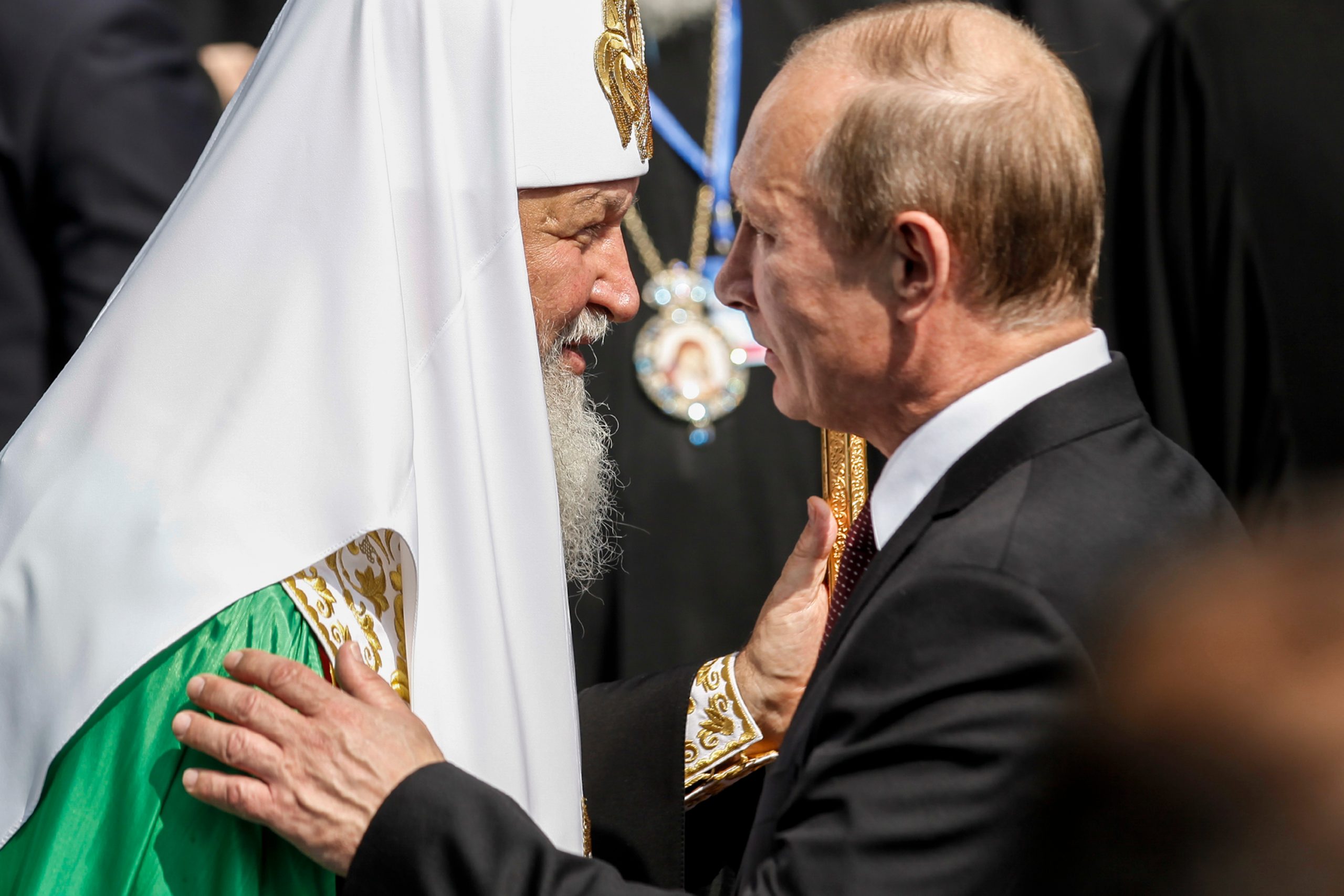
References to theological narratives span a broad spectrum of political communication in today’s Russia.[12] First, Patriarch Kirill I increasingly speaks of Russia as the Katechon, that is, the restrainer of the Antichrist in the Second Epistle of Paul to the Thessalonians.[13] Second, Russian leader Vladimir Putin himself has increasingly adopted a vocabulary, particularly in his official speeches since 2014, that features theological elements and phrases such as the Sermon on the Mount, false prophets, martyrs, Satanism, Byzantium, and the Temple Mount.[14] Finally, the Russian Constitution itself includes the belief in God, now enshrined in the constitutional amendments of July 4, 2020.[15] In this conceptual environment, Russia is assigned the role of Katechon, literally supposed to write salvation history. This new semantic context thus seems to make it methodologically inaccurate to speak of Russian fascism. Instead, rather than the conventional concept of fascism, other terms may better reflect what is currently happening in Russia in relation to the expansion of ideology.
Putin’s Regime and the Reconciliation of Reds and Whites: Byzantine Narrative and Popular Religion
In the run-up to and aftermath of the annexation of Crimea, Putin’s rhetoric featured new vocabulary that drew on theological imagery. Speaking at the Valdai Forum on September 19, 2013, Putin lamented that the “Euro-Atlantic countries” were rejecting their Christian roots—the foundation of Western civilization—and also negating “moral principles and all traditional identities: national, cultural, religious, and even sexual.” In doing so, he drew a parallel between “same-sex partnerships” and a “belief in Satan.”[16] The Russians, in turn, would differ from the West in their “belief in God.” This rhetoric continued after the annexation of Crimea. Indeed, the Russian leader has invoked Christianity as “a powerful spiritual unifying force” in the creation of a Russian nation. According to this narrative, which refers to the Russian Primary Chronicle (c. 1113), the Scandinavian prince Vladimir of the Rurikid dynasty was baptized in the Byzantine rite in 988 in order to marry the Byzantine princess Anna. Vladimir had requested that she be sent to him after he conquered Chersonesus. As he wanted to plunder Chersonesus, Anna’s brother—Emperor Basil II—delivered her to appease him. Vladimir’s blackmailing of the Byzantines is left out of Putin’s narrative. Instead, Crimea is equated with Byzantine Chersonesus and declared a sacred place for Russians, as sacred as the Temple Mount in Jerusalem is for Jews and Muslims.[17]
The habitus of a Christian ruler, which Putin had already adopted once after the annexation of Crimea, reappeared at the Valdai Forum in October 2018. This time, Putin touched on the likelihood of a nuclear war with the West and Russia’s intentions in this eventuality. In a pastoral tone, the Russian dictator indicated that Russians would ascend to heaven as martyrs, while their enemies in the West, who are in fact godless, would perish without repentance.[18] This eschatologically styled rhetoric ultimately found its way into the Constitution of the Russian Federation via constitutional amendments.[19] This belief in God correlates with the preservation of historical truth, which is also prescribed in the Constitution.[20] The latter opens up an exceptionally broad and flexible scope for the regime to reinterpret and combine any historical narratives it wishes. Preserving historical truth from attacks by globalism, which in this new pseudo-Christian rhetoric correlates with Satanism, is thus glorified as a pseudo-religious act. On September 5, 2022, this act was staged in the form of a ceremony marking the incorporation of the conquered Ukrainian territories of Donetsk, Luhansk, Zaporizhzhia, and Kherson. During the ceremony, Putin referred to the Sermon on the Mount—a key text of the Christian doctrine handed down in the Gospel of Matthew, which defines the moral principles of Christianity and denounces false beliefs—equating what he calls the dictatorship of Western elites with the Satanism of false messiahs.[21] Putin’s pseudo-Christian attitude culminated two months later in his executive order mandating the protection of Russia’s traditional spiritual and moral values—the Ukaz No. 809. This order, officially named “Protection of Russia’s traditional spiritual and moral values, culture, and historical memory,” states, among other things, that the primacy of the spiritual over the material and the cultivation of historical memory are essential elements to prioritize in the national strategy.[22] In other words, the Putin regime now draws on a new aesthetics, language, and performativity that transcend politics and exhibit traits of religious fundamentalism in terms of three characteristics: cognitive flexibility, openness, and religiosity.[23]
To delve into who is behind the new ideology, this article proposes to counter the claim, often made, that the Russian philosopher and co-founder of the National Bolshevik Party, Alexander Dugin is “Putin’s brain.”[24] Dugin has referred to the USSR as the “red Katechon” and “red Byzantium.”[25] But the Deputy President of the World Russian People’s Council (WRPC), Alexander Shchipkov, is considered here instead, as he draws on Dugin’s narratives but develops them further. Moreover, thanks to his official position in the Russian state apparatus—he is also rector of St. John’s University in Moscow and advisor to Duma Chairman Vyacheslav Volodin[26]—he has been able to influence the political leadership much more effectively. One of Shchipkov’s most important projects is the development of a hybrid or synthetic popular religion aimed at creating a complete social consensus in a divided Russian society.[27] His key goal is for Russia to cultivate a Russian-Byzantine identity that is fundamentally non-Western. According to him, it is important for Russia to draw not only on its Orthodox but also Soviet heritage.
The consensus in Russia over the annexation of Crimea lends itself best to this approach.[28] According to Shchipkov, this annexation succeeded in uniting under the umbrella of an eschatological project Reds and Whites , i.e., supporters of the USSR, who sympathize with communism, and proponents of the Russian Tsarist Empire, who are enthusiastic about the idea of Holy Rus and Moscow as the Third Rome. The different cultural codes present in Russia—Orthodox, Soviet, and post-Soviet—are being synthesized into this holistic Russian discourse, where the concept of fascism, which has negative connotations in Russians’ communicative and cultural memory, is unsurprisingly not allowed to appear..[29] In spite of the negative connotation, the concept of fascism remains highly ambiguous in the Russian tradition, so that it has to be entirely omitted from the new discourse.
Do Russians Call Themselves Fascists?
In the established political language of Russia, the term fascism exists on two semantic levels: On the one hand, it is used in attempts at othering opponents—be it the US or Ukraine—and in this way carries a stigma and negative connotation. On the other hand, it serves as an element in Russia’s positive self-identification since it won over fascism in WWII. In both cases, fascism is used in a pejorative way. Historically, fascism became a source of dishonor in the course of the Moscow show trials of 1936-38.[30] During those trials, Bolsheviks such as Leon Trotsky (convicted in absentia because living in exile from 1929 on), Grigory Zinoviev, Lev Kamenev, or Nikolai Bukharin were branded as “the vile Trotskyite fascist gang” (podlaia trotskistsko-fashistskaia banda)[31] and accused of espionage. Also called the “Trotskyite-Bukharinite gang of German-Japanese Fascism agents” (trotskistsko-bukharinskaia banda agentov nemetsko-japonskogo fashizma), these characters were notably accused of spying for Nazi Germany and Japan.[32] After the invasion of the USSR by Nazi Germany on June 22, 1941, the attribute “fascist” became a fixed element in the designation of the enemy, for instance as “German Fascist Invaders” (nemetsko-fashistskie zakhvatchiki).[33] After the USSR’s victory over Nazi Germany, the term became an integral part of Soviets’ positive self-identification as defeaters of fascism.[34] In 1965, however, the concept started to partially transform: Celebrations on Victory Day (May 9) became an occasion to denounce not Nazi Germany alone but also “imperialists” led by the US. Today, anti-Americanism provides an essential semantic framework for Russia’s defamation of Ukraine’s political system as a Nazi regime,[35] with Ukraine, which is claimed to be part of Russia, being decried as a satellite of the US.[36] Hence, Russia, like during WWII, is able to present itself as a defense against global fascism.[37]
In terms of self-identification, it is rare to see political factions today in Russia refer to themselves as fascist. Those that do are considered to have negligible political influence, such as the Russian National Unity (Russkoe natsional’noe edinstvo, or RNE), the National (People’s) Socialist Initiative (Natsional’naia (narodnaia) sotsialisticheskaia initsiativa, or NSI),[38] or the National Bolshevik Party (Natsional-bol’shevistskaia partiia, or NBP). However, in the 1920s and 1930s, Russians commonly self-identified as fascist, not in the Russian-Soviet heartland, but abroad, where between 1917 and 1923 over a million Russian émigrés fled.[39] Scholars have spoken of “Russian fascism in exile”[40] and shown that these émigrés used the term differently than it is used today under the Putin regime. In fact, during that time, fascist parties were founded in the very heterogeneous milieu of Russian emigrants in various locations in and outside Europe.[41] As a rule, these were not mass movements that gathered strong support.[42] One exception is the powerful 5,000-men fascist party in Harbin, China—which changed its name three times[43]—popular among the 127,000 Russians present there, especially the youth.[44] In contrast, other Russian fascist parties were marginal groupings with a very small following,[45] as exemplified by those created in the German Third Reich and the US. In both places, the number of fascist party members fluctuated between 1000 and 2000,[46] which does not mean that National Socialism was not popular among Russian emigrants holding anti-communist and monarchist views. As a matter of fact, in an essay published in 1933, Russian immigrant and philosopher Ivan Ilyin (1883-1954) celebrated the victory of the National Socialist German Workers’ Party (NSDAP) and the appointment of Adolph Hitler as Reich Chancellor as a great moment in the fight against the Bolshevik plague (“zaraza bol’shevizma”).[47] At the same time, it should be emphasized that despite the sympathy for National Socialism among Russian emigrants, which was particularly significant before the Soviet Union entered the war in 1941, the popularity of Russian fascist organizations in the milieu of White Émigrés was consistently low.[48] In Germany, Russian fascists believed in a Jewish world conspiracy but rejected racial theories, which proved incompatible with the National Socialists’ rhetoric about Russia. For them, Russia was to be liberated through a campaign against “Jewish Bolsheviks,” but the subsequent plan of Hitler’s Russian supporters was to establish a new Russian empire, which thwarted Hitler’s plans to conquer Russia as part of his “Drang nach Osten.”[49]
Unlike in Germany or the US, in Harbin (China), the Russian Fascist Party—founded by students in 1931 and initially led by General Vladimir Dmitrievich Kosmin (1884-1950), then Konstantin Rodzaevsky (1907-1946)—was able to become a political force, although its influence remained limited and dependent on the benevolence of the Japanese government in Manchukuo. The party’s program was based on an anti-Semitic world view, documented in the so-called Azbuka fashizma, the ABC of Fascism, in 1935.[50] This text spoke of the Russian people and the enslavement of Russia by Jews.[51] The party did not limit itself to abstract anti-Semitic agitation. For example, it used its newspaper, Nash put’, to organize anti-Jewish pogroms, which were daily occurrences in Harbin.[52]
Anti-Semitism in Harbin went hand in hand with Russian emigrants portraying themselves as part of an orthodox movement, in many cases referring to “orthodox fascism.” Japan even saw Harbin’s Russian emigrants as potential soldiers for the fight against the Soviets[53] and expected the Russian Fascist Party to support the formation of a Russian unit in the Japanese army, which became known as the Asano Brigade (after Colonel Asano Takashi) in 1936.[54] After the Red Army invaded Manchuria in August 1945, Rodzaevsky surrendered to the Soviets. Shortly before, he had written a letter to Stalin praising him as the ideal leader and Stalinism as the ideal form of Russian fascism.[55] This “fascist” chapter in Russian history does not fit in today’s ideology and is therefore not remembered. As much as some monarchists in today’s Russia sympathize with the White Army (which fought against the Bolsheviks), they cannot invoke the relevant fascist heritage of the white émigrés, because it is not compatible with the recent state ideology that promotes the USSR’s heritage as the defeater of fascism in the Great Patriotic War—also valued by those same Russian monarchists. The majority of the population in Russia considers fascism to be evil and thus is not nostalgic about the fascist parties of the white émigrés. At the same time, the Byzantine narrative, as Shchipkov calls it, aims to unite Reds and Whites under the banner of the Katechon, or Holy Russia. The integrative potential of this narrative lies in the formula “Moscow—the Third Rome.” On the one hand, this formula refers to Tsarist Russia, for which the Whites fought against the Reds. On the other hand, it brings a new meaning to Byzantium as a historical model for the Soviet Union, which in his discourse Dugin calls the red Byzantium or red Katechon. Shchipkov has used this broad and eclectic semantics in the development of his popular religion.[56]
Byzantium and the Third Rome: Ideologemes for a United Russia
The evaluation of whether the current Russian regime is fascist can be done at both the political and scholarly level. In both cases, the designation of Russia as a fascist state is controversial. On the one hand, on 14 April 2022, the Ukrainian parliament (Verkhovna Rada) officially recognized Russia as a fascist regime and Ruscism as a kind of Russian neo-Nazism.[57] However, other states have not (yet) followed suit. The political modus operandi regarding qualifying Russia as fascist therefore remains unclear. The Committee of the Verkhovna Rada on Humanitarian and Information Policy has proposed a link between the political and scholarly use of the term “Ruscism” and “Russian fascism.” In doing so, the Rada referred to relevant research by Ukrainian political scientists and legal scholars who have studied and defined “Ruscism.”[58] There are some indications that “Ruscism” has already established itself in academic discourse,[59] which nonetheless remains ambivalent in categorizing Russia as fascist.
In their substantive discussions, academics rarely address methodological issues, ignoring the plurality of the concept of fascism.[60] In recent discourse, reference is occasionally made to Griffin’s definition of fascism,[61] according to which fascism is characterized by the “myth of regenerated nation,” whereby a nation is reborn in the act of war and supposed to find a new greatness.[62] Accordingly, historian Marlène Laruelle doubts the adequacy of the concept to describe Russia.[63] Rather, she posits that the Russian regime should be seen as a totalitarian dictatorship that makes use of numerous narratives from both the Soviet era and the Tsarist period. For her, the genocide in Ukraine is not a unique feature stemming from fascism.[64] For Timothy Snyder, on the other hand, there is no doubt that the Putin regime exposed itself as fascist when it invaded Ukraine on February 24, 2024. Scholars point to the symbols of war used by Putin’s regime that show many parallels with those of Hitler’s Nazi regime. As Russia perceives and stages itself as the victor over fascism, in line with Soviet narratives, Snyder speaks of Russian “schizofascism,” which is discharged in war propaganda and Ukrainophobia. According to this view, Russia is a fascist regime that stigmatizes others, including its victims, as fascist themselves, all the while stylizing itself as precisely anti-fascist.[65]
Notably, previous research on Russian fascism paid little attention to the theological and eschatological concept of Russkiy Mir—a concept based on the idea of a Holy Russia that was popular in the nineteenth century. Russkiy Mir’s historical mission is both salvific and eschatological. According to this ideology, Russia is to fulfill God’s plan of salvation and become and remain a great Christian empire.[66] The idea that the Russians are God’s chosen people echoes the concept of Russian fascism developed by Ilyin[67] as an order of knights on the one hand and a Christian movement that was to liberate Russia from the godlessness of Bolshevism on the other. For him, Russian fascism meant nothing other than the “White Movement.”[68] Yet, Ilyin’s Russian fascism does not feature in recent Russian ideology, so as not to provoke the “Reds.”
The sacralization and, along with it, the de-secularization of Russia can also be found in Dugin’s conceptualization of fascism, which correlates with Shchipkov’s Byzantine and Katechon narrative. Dugin too sees Russia as an apocalyptic power, referred to in Orthodox theology as Katechon. As the Katechon, Russia is supposed to halt the arrival of the Antichrist, who is embodied by the US and the West.[69] This eschatological world view has de-tabooed the necessity of a nuclear war of annihilation against Satan, i.e., against the West.[70] The Katechon has become a central concept in the new Russian ideology,[71] gaining great popularity in conservative circles close to Patriarch Kirill but also in Putin’s immediate entourage since the outbreak of the Russian war of aggression against Ukraine.[72]
The Katechon has a long and complex conceptual history that extends far beyond the oeuvre of Dugin and Shchipkov, and it already had semantic breadth in the early Church. The term is nonetheless ambiguous (ὁ κατέχων, τὸ κατέχον) and thus has been interpreted differently. Already in the works of the Church Fathers and Doctors, that is even before the emergence of the so-called Byzantine imperial eschatology, the Katechon could be interpreted as the Roman Empire, the Church, the Emperor Basileus, or even the Holy Spirit.[73] In the Russian tradition, the concept gained significance at the end of the nineteenth century, appearing in marginal Christian Orthodox circles in the form of anti-Semitic discourse and used to refer to the Tsar or the Holy Rus.[74] From a twentieth century historical perspective, the Katechon has gained significance as a central concept in Carl Schmitt’s political theology.[75] In modern times, it has become increasingly prevalent in monarchist, National Bolshevik, and communist circles.[76] Until a few years ago, however, it was not used as an official term by either the state or the church in Russia.
The warlike rhetoric of Russia’s political leadership has undergone a remarkable re-semantization since the annexation of the Crimean Peninsula.[77] At the same time, the new semantics of war are accompanied by a new vocabulary that is atypical of the war rhetoric used before 2014. The shift towards theological or theologically based as well as theologically pictured thought and action is crystallizing.[78] According to this logic, the war against Ukraine is a war against Evil,[79] which is embodied by the “global West”—or Satan. In this imagination of the ”corpus diaboli,” Ukraine is seen as a vassal of the United States—the Devil.[80] In fact, at the 25th World Russian People’s Council on March 27-28, 2024, the Russian Orthodox Church (ROC) decided that Russia’s “Special Military Operation” in Ukraine should be given the status of “Holy War,”[81] since Russia is understood as waging war not against Ukraine alone but against Evil in general. Thus, “Holy Russia” appears in the role of the Katechon (2 Thessalonians 2:6-7) and fits in a narrative of salvation history linked to the expectation of the Last Days and the Doctrine of the Last Day, or eschatology.
Although no research has been conducted on how the original early Christian Katechon concept entered the ROC’s vocabulary, there has been extensive research on the roots of the term Katechon in modern Russian usage. However, these studies have taken disparate paths. While the majority of Western experts recognize the intense influence of Carl Schmitt’s concept of the Katechon on Russian ideology, particularly in Dugin’s work, Russian experts have focused on the influence of the anti-Semitic tradition on part of the Russian Orthodox milieu.[82] Regardless of how this eschatological concept found its way into recent Russian war rhetoric, its potential to broaden the discourse and complicate analysis is clearly enormous. It brings this rhetoric much closer to religious fundamentalism—akin to radical Islamism—than to fascism. It is thus necessary to seek alternative terms that go beyond the conventional concept of fascism to explain the aggressive and murderous regime established in Russia and that now poses a threat to Europe as a whole, beyond Ukraine.
Beyond the Political: Why Eschatology Appeals to the Russian Regime
The Russian regime’s self-branding and language are undergoing dynamic change. A key feature of this process is the adaptation of religious language that no longer corresponds to the norms of political communication in the secular political cultures characteristic of the West. This new language is eschatologically determined, as it declares Russia and its war against Ukraine to be holy. Moreover, as the Katechon, Russia is understood as having a divine mission to stop the Antichrist—i.e., the globalist West. This megalomaniacal self-presentation arises out of a heterogeneous society that has a substantial Muslim minority and continues to sympathize with the legacy of the USSR. The danger posed to the world by Russia as a nuclear superpower is in no way inferior to that posed by regimes that are described as fascist. However, the Russian regime behaves differently. It claims a divine mission that transcends politics. Consequently, terms other than fascism must be used to describe and designate this regime. When researching recent ideology in Russia, exploring religious fundamentalism—which some scholars are already doing[83]—and reconciling religious studies, history, and political theory in an interdisciplinary approach would be useful. Let this article be a plea for this effort.
Grigori Khislavski (Orcid: 0000-0003-3348-5844) is a visiting scholar affiliated with the Chair of Medieval History at the University of Erfurt, the Chair of East and Southeast European History at the University of Leipzig, and the Chair of Political Theory and Intellectual History at Chemnitz University of Technology. He is currently working on a postdoctoral project on Russian war propaganda and its connections to the New Right in Europe.
[1] See most recently Ian Garner and Taras Kuzio (eds.), Russia and Modern Fascism: New Perspectives on the Kremlin’s War Against Ukraine, Hannover and Stuttgart: ibidem, 2025.
[2] Alexander J. Motyl, “Putin’s Russia as a fascist political system,” Communist and Post-Communist Studies 49, 1 (2016): 25-26.
[3] Anton Semyzhenko and Kateryna Kobernyk, Yale University professor Jason Stanley has been researching fascism for years. He assures that modern Russia is very similar to Nazi Germany, only the basis of its ideology isnʼt race, but language and culture. An interview (https://babel.ua/en/texts/97131-yale-university-professor-jason-stanley-has-been-researching-fascism-for-years-he-assures-that-modern-russia-is-very-similar-to-nazi-germany-only-the-basis-of-its-ideology-isn-t-race-but-language-and-, accessed September 3, 2025).
[4] Marlene Laruelle, Is Russia Fascist? Unraveling Propaganda East and West, Ithaca: Cornell University Press, 2022, 21-22.
[5] Elena Davlikanova, Fascism Has Won in Russia Decades After WWII (https://www.themoscowtimes.com/2024/05/09/fascism-has-won-in-russia-decades-after-wwii-a85083, accessed September 23, 2025).
[6] Mikhail Epstein, “Schizophrenic fascism: on Russia’s war in Ukraine,” Studies in East European Thought 74, 4 (2022): 475-481.
[7] Roger Griffin, The Nature of Fascism, London and New York: Routledge, 1993, 26.
[8] Robert O. Paxton, “The five stages of fascism,” Journal of Modern History 70, 1 (1998): 4.
[9] Robert O. Paxton, The Anatomy of Fascism, London: Allen Lane, 2004, 218.
[10] Alexander J. Motyl, “Putin’s Russia as a Fascist Political System: Deconstructing and Reconstructing a Contentious Concept,” in: Ian Garner and Taras Kuzio (eds.), Russia and Modern Fascism: New Perspectives on the Kremlin’s War Against Ukraine, Hannover and Stuttgart: Ibidem, 2025, 61.
[11] Umberto Eco, “Ur-Fascism,” in: The New York Review of Books, June 22, 1995.
[12] Bojidar Kolov, (Re)Constructing Sacred Statehood. The Orthodox Church and Great Power in Contemporary Russia. PhD Thesis: University of Oslo, 2023.
[13] Vitali Petrenko, “A Dangerous Servant. A Critical Analysis of the Speeches of Patriarch Kirill of Moscow during the First Year of the War of Russia against Ukraine (2022-2023),” European Journal of Theology 34,2 (2025): 317-338.
[14] Niels Drost, “Putin and the Third Rome. Imperial-Eschatological Motives as a Usable Past,” Journal of Applied History 4 (2022): 28-45.
[15] Lauri Mälksoo, “Current Developments. International Law and the 2020 Amendments to the Russian Constitution,” American Journal of International Law 115,1 (2021): 79.
[16] Russian Presidency, Meeting of the Valdai International Discussion Club, September 19, 2013.
[17] Russian Presidency, Presidential Address to the Federal Assembly, December 4, 2014.
[18] Russian Presidency, Meeting of the Valdai International Discussion Club, October 18, 2018 (http://en.kremlin.ru/events/president/news/58848, accessed September 2, 2025).
[19] The Ministry of Foreign Affairs of the Russian Federation, The Constitution of the Russian Federation. The text of Constitution of the Russian Federation adopted by popular vote on 12 December 1993, with amendments approved by all-Russian vote on 1 July 2020.
[20] Jakub Sadowski, “Amendments of 2020 to the Russian Constitution as an Update to Its Symbolic and Identity Programme,” International Journal for the Semiotics of Law 35 (2021): 729-730.
[21] Russian Presidency, Signing of treaties on accession of Donetsk and Lugansk people’s republics and
Zaporozhye and Kherson regions to Russia, September 30, 2022 ( http://en.kremlin.ru/events/president/news/69465, accessed September 5, 2025).
[22] Russian Presidency, Executive order approving fundamentals of state policy for preservation and strengthening of traditional Russian spiritual and moral values, November 9, 2022 (http://en.kremlin.ru/acts/news/69810, accessed September 6, 2025).
[23] Wanting Zhong, Irene Cristofori, Joseph Bulbulia, Frank Krueger, and Jordan Grafman, “Biological and cognitive underpinnings of religious fundamentalism,” Neuropsychologia 100 (2017): 19-20.
[24] Michael Millerman, Inside “Putin’s Brain”: The Political Philosophy of Alexander Dugin, Montreal, QC: Millerman School, 2022.
[25] Alexander Dugin, “Absoljut Vizantizma,” in: Alexander Dugin (ed.), Russkaya Veshch. Ocherki nacional’noy filosofii, Moscow: Arktogeya, 2001, 69-76.
[26] World Russian People’s Council, Members of the Presidium of the WRPC (https://vrns.ru/o-vrns/prezidium.php, accessed September 11, 2025).
[27] Alexander V. Shchipkov, “The Ideology of Social Traditionalism (Social Tradition),“ Orthodoxia 2 (2022): 31-39.
[28] Shchipkov, “The Ideology”, 31.
[29] Shchipkov, “The Ideology”, 32-33.
[30] William Chase, “Stalin as producer: the Moscow show trials and the construction of mortal threats,” in: Sarah Davies and James Harris (eds.), Stalin. A New History, Cambridge: Cambridge University Press, 2005, 226-248.
[31] Anonymous, “Novaia opposiciia,” Bol’shaia sovetskaia enciklopediia 42 (1939): 204.
[32] Anonymous, “Novaia opposiciia,” 204.
[33] This expression first appeared in the so-called 1941 October Revolution Parade Speech, which Joseph Stalin addressed on November 7, 1941. See the exact wording of the speech in Joseph Stalin, Sochineniia, vol. 15, Moscow: Rabochii Universitet, 1997, 84.
[34] Oleksii Polegkyi, “Soviet Mythology and Memory of World War II as Instruments of Russian Propaganda,” Warsaw East European Review 6 (2016): 80, 82.
[35] Grigori Khislavski, “Russische Kriegssemantik zwischen GULAG-Trauma und Antiamerikanismus,” Soziale Systeme 28, 2 (2023): 393-397.
[36] Grigori Khislavski, “Weaponizing History. Russia’s War in Ukraine and the Role of Historical Narratives,” Journal of Applied History 4, 1-2 (2022): 123-125.
[37] Georgi Verbeeck, “The Return of History as Travesty. The ‘Struggle against Fascism’ in the Russian-Ukrainian War,” Journal of Applied History 4, 1-2 (2022): 76-84.
[38] Sofia Tipaldou, “The extreme right fringe of Russian nationalism and the Ukraine conflict: The National Socialist Initiative,” in: Pål Kolstø and Helge Blakkisrud (eds.), Russia Before and After Crimea: Nationalism and Identity, 2010-17, Edinburgh: Edinburgh University Press, 2018), 191-199.
[39] Turkan Olcay, “The Cultural Heritage of the White Russian Emigration in Istanbul,” Quaestio Rossica 15, 4 (2022): 1318.
[40] Susanne Hohler, “Russian Fascism in Exile. A Historical and Phenomenological Perspective on Transnational Fascism,” Fascism 2 (2013): 121-140.
[41] John J. Stephan, The Russian Fascists. Tragedy and Farce in Exile, 1925-1945, New York: Harper & Row Publishers, 1978.
[42] Hohler, “Russian Fascism in Exile”, 122-123.
[43] Stephan, Russian Fascists, 89.
[44] Susanne Hohler, Fascism in Manchuria. The Soviet-China Encounter in the 1930s, London: I.B. Tauris, 2017.
[45] Stephan, Russian Fascists, 251-253. See also Erwin Oberländer, “The All-Russian Fascist Party,” Journal of Contemporary History 1 (1966): 158-173.
[46] Denis Jdanoff, “Russische Faschisten: Der nationalsozialistische Flügel der russischen Emigration im Dritten Reich,” (Master Thesis Humboldt-Universität zu Berlin, 2003, 66-67.
[47] Ivan Ilyin, “Natsional-Sotsialism: 1. Novyi Duh” (Национал-Социализм: 1. Новый дух/National Socialism: A New Spirit), Vozrozhdenie (The Revival), 17.5.1933, no. 2906.
[48] Zbyněk Vydra and Tomáš Jiránek, “Between Monarchism and Nazism: the career of General Vasily Biskupsky in exile (1919-1945),” Slavonic Review 110, 1 (2024): 159-204.
[49] Jdanoff, “Russische Faschisten,” 91-95.
[50] Konstantin Rodzaevsky, Gennadii Taradanov, and Vladimir Kibardin, Azbuka fashizma (ABC of Fascism), Harbin: Nash Put’, 1935.
[51] Rodzaevsky/Taradanov/Kibardin, Azbuka fashizma, 1.
[52] Hohler, Fascism in Manchuria, 65-71.
[53] Sabine Breuillard, “General V.A. Kislitsin: From Russian Monarchism to the Spirit of Bushido,” South Atlantic Quarterly 99, 1 (2000): 125-127.
[54] Sergei Smirnov, “The Russian Officer Corps of the Manchukuo Army,” The Journal of Slavic Military Studies 28, 3 (2015): 556-566.
[55] “Pis’mo K.V. Rodzaevskogo I.V. Stalinu” (Letter from Rodzaevskii to Stalin), in: A. F. Kiselev (ed.), Politicheskaia istoria russkoi emigratsii, 1920-1940gg.: Dokumenty I Materialy (Political History of the Russian Emigration 1920-1940: Documents and Materials), Moscow: VLADOS, 1999, 318-328.
[56] Grigori Khislavski, “Kaktusartiges Orchideenfach – Die Stunde der Byzantinistik,“ INDES. Zeitschrift für Politik und Gesellschaft 13,4 (2025) [Page count still unknown, to be published in early 2026].
[57] Verkhovna Rada of Ukraine. Official Web Portal of the Parliament of Ukraine, Верховна Рада приняла закон про заборону пропаганди російського неонацистського тоталітарного режиму, акту агресії проти України з боку Російскої Федерацїї як держави–терориста, символики, яка використовується збройними та іншими воєнними формуваннями Російскої Федерацїї у війні проти України, 14.4.2022 (Verkhovna Rada Adopted the Law Prohibiting Propaganda of the Russian Neo-Nazi Totalitarian Regime, the Act of Aggression Against Ukraine Committed by the Russian Federation as a Terrorist State, and the Symbols Used by the Armed and Other Military Formations of the Russian Federation in the War Against Ukraine, April 14, 2022) (https://rada.gov.ua/news/razom/221769.html, accessed July 30, 2025).
[58] Verkhovna Rada of Ukraine. Official Web Portal of the Parliament of Ukraine, Комітет з питань гуманітарної та інформаційної політики закликає журналістів та медіаорганізації до повноцінного і частого вживання слова «рашизм» та похідних від нього, 12.5.2022 (The Committee on Humanitarian and Information Policy calls on journalists and media organizations to make full and frequent use of the word “Rashism” and its derivatives, May 12, 2022) (https://www.rada.gov.ua/news/razom/222804.html, accessed May 31, 2025).
[59] Nazar Rudyi, “Ruscism as a variant of the fascist form of state-legal regime,” Social & Legal Studios 6, 2 (2023): 55-60.
[60] Wolfgang Wippermann, Faschismus. Eine Weltgeschichte vom 19. Jahrhundert bis heute, Darmstadt: Primus Verlag, 2009, 7-14.
[61] Marlene Laruelle, “So, Is Russia Fascist Now? Labels and Policy Implications,” The Washington Quarterly 45, 2 (2022): 150.
[62] Roger Griffin, “Studying Fascism in a Postfascist Age: From New Consensus to New Wave?,” Fascism: Journal of Comparative Fascist Studies 1, 1 (2012): 1.
[63] Marlene Laruelle, “Accusing Russia of Fascism. Polemics around Russia’s Belonging to Europe,” Russia in Global Affairs 18, 4 (2020): 100-123.
[64] Laruelle, “So, Is Russia Fascist Now?,” 159-160.
[65] Timothy Snyder, The Road to Unfreedom: Russia, Europe, America, New York: Tim Duggan Books, 2018, 146-148, 184-185.
[66] Michał Wawrzonek, “”Russkiy Mir”: A Conceptual Model of the “Orthodox Civilization” ,” in: Michał Wawrzonek, Nelly Bekus and Mirella Korzeniewska-Wiszniewska (eds.), Orthodoxy Versus Post-Communism?: Belarus, Serbia, Ukraine and the Russkiy Mir, Cambridge: Cambridge University Press, 2016, 37-70.
[67] Ivan Ilyin, “O russkom fashizme” (On Russian Fascism), Russkii kolokol. Zhurnal volevoi idei 3 (1928): 54-64.
[68] Ilyin, “O russkom fashizme,” 56-58.
[69] Victor Shnirelman, “Alexander Dugin: Between Eschatology, Esotericism, and Conspiracy Theory,” in: Asbjørn Dyrendal, David G. Robertson, and Egil Asprem (eds.), Handbook of Conspiracy Theory and Contemporary Religion, Leiden and Boston: Brill, 2018, 448-456.
[70] Dmitri Adamsky, Russian Nuclear Orthodoxy: Religion, Politics, and Strategy, Stanford: Stanford University Press, 2019.
[71] Herfried Münkler, Welt in Aufruhr. Die Ordnung der Mächte im 21. Jahrhundert, Berlin: Rowohlt Verlag, 2025, 256.
[72]Maria Engström, “Contemporary Russian Messianism and New Russian Foreign Policy,” Contemporary Security Policy 35,3 (2014): 356-379.
[73] Bert Jan Lietaert Peerbolte, “The KATÉXON/KATÉXΩN of 2 Thess. 2: 6-7,” Novum Testamentum, 39, 2 (1997): 138-150.
[74] Victor Shnirelman, ““To Take the Katechon Out of the Milieu.” The Murder of Czar Nicholas II and its Interpretation by Russian Orthodox Fundamentalists,” Antisemitism Studies, 4, 2 (2020): 326-370.
[75] Felix Grossheutschi, Carl Schmitt und die Lehre vom Katechon, Berlin: Duncker & Humblot, 1996.
[76] Victor Shnirelman, Удерживающий. От Апокалипсиса к конспирологии (The Restrainer. From Apocalypse to Conspiracy Theory), Moscow and Saint Petersburg: Нестор-История, 2022.
[77] Marlene Laruelle, Ideology and Meaning-Making under the Putin Regime, Stanford, California: Stanford University Press, 2025.
[78] Stefan Rohdewald, ““Katechon”, “Third Rome“, and “Holy War”: “Russian” and “Serbian World(s)” as Eschatological Geopolitical Exceptionalisms,” in: Sebastian Rimestad and Emil Hilton Saggau (eds.), Fault Lines in the Orthodox World. Geopolitics, Theology, and Diplomacy in Light of the War in Ukraine, Cham, Switzerland: Palgrave Macmillan, 2025, 109-146.
[79] Jüri Saar, “The Russian Holy War and military statehood,” TRAMES, 27(77/72) (2023): 3-20.
[80] Pål Kolstø, and Bojidar Kolov, “The Religious Component in Contemporary Russian Imperialism,” Religions 15, 9 (2024): 1138.
[81] Alar Kilp, and Jerry G. Pankhurst, “The Mandate of the World Russian People’s Council and the Russian Political Imagination: Scripture, Politics and War,” Religions 16, 4 (2025): 466.
[82] Shnirelman, Удерживающий, 55-60.
[83] Oleksii Petriaiev, “Russian Orthodox Fundamentalism as an Element of Hybrid Warfare,” European Political and Law Discourse 8,5 (2021): 102-109.
