
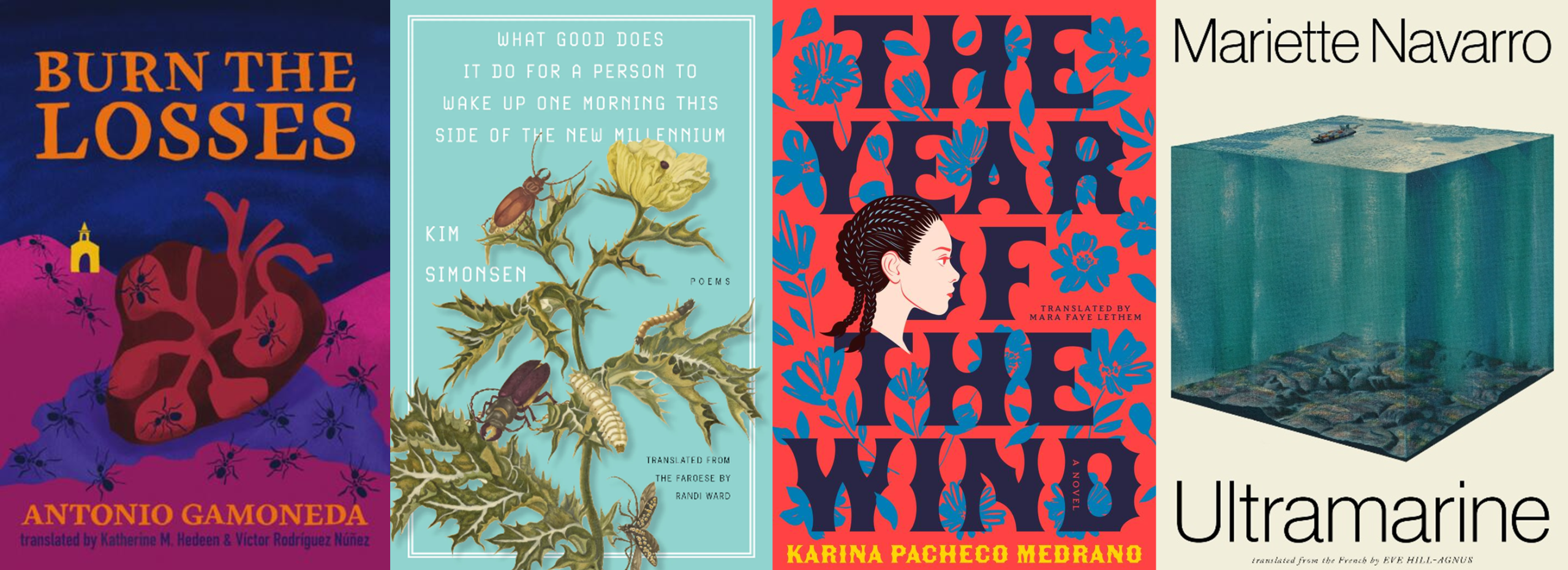
It is this time of year! GlobalEurope looks back and picks its favorite literary translations published in 2025 and not already featured in issues.

By Karina Pacheco Medrano
Translated from the Spanish by Mara Faye Lethem
Publisher: Graywolf Press
Nina, a Peruvian writer in Spain on the eve of the pandemic, is pulled back into her nation’s fraught history after a fleeting encounter with a woman who is a doppelgänger of Bárbara, a cousin lost to time. The games, the candor, and the secrets of her youth come alive again, but these memories are tinged with disquiet, and what unfolds takes Nina back to a village nestled in the Andes where she must confront the terrors that stalked Peru in the early 1980s.

By Wiesław Myśliwski
Translated from the Polish by Bill Johnson
Publisher: Archipelago Books
In a Polish village, a young man watches an old man trip and fall down a flight of stairs. From this singular event arises a cascade of memories, regrets, and longings: the buried sensations of a whole lifetime, condensed and released. We hear of life during occupation, the scarcities of a childhood lived under the sign of war—and fragments of a home’s sounds and scents.

By Antonio Gamoneda
Translated from the Spanish by Katherine M. Hedeen and Victor Rodríguez Núñez
Publisher: ActionBooks
Shaped by a childhood during the Spanish Civil War and a youth under the censorious Franco dictatorship, Antonio Gamoneda’s poetry chronicles both memory and oblivion with an intensity and strangeness that pushes back against all oppressive forces that seek to flatten and reduce our experiences, our language.

By Anjet Daanje
Translated from the Dutch by David McKay
Publisher: New Vessel Press
An extraordinary love story and a captivating novel about the power of memory and imagination. Flanders 1922. After serving as a soldier in the Great War, Noon Merckem has lost his memory and lives in a psychiatric asylum. Countless women, responding to a newspaper ad, visit him there in the hope of finding their spouse who vanished in battle. One day a woman, Julienne, appears and recognizes Noon as her husband, the photographer Amand Coppens, and takes him home against medical advice.

What Good Does It Do For a Person to Wake Up One Morning This Side of The New Millennium
By Kim Simonsen
Translated from the Faroese by Randi Ward
Publisher: Deep Vellum
Simonsen asks: as a species among species, all composed of the matter of the universe, how has our compulsion to classify everything hierarchically estranged us from ourselves, each other, and Earth’s ecosystems? Simonsen challenges our anthropocentric pursuit of knowledge, exploring humankind’s relationship with itself as an element of the natural world.

By Ana Paula Pacheco
Translated from the Portuguese by Julia Sanches
Publisher: Transit Books
Ana, a literature professor, plans her remote classes while confined to her apartment during lockdown. Her lover, Alice, has died of Covid. In her place are a series of animals that demand Ana’s care and attention: an overbearing pangolin, a swarm of insects, a giant bat.

By Gaëlle Bélem
Translated from the French by Hildegarde Serle
Publisher: Europa Editions
Born into slavery, orphaned at an early age, and raised by a passionate botanist on Réunion Island, Edmond Albius will defy the expectations of his time and, with his extraordinary natural talent for botany, revolutionize global culinary culture by discovering the secret life of vanilla orchids.

By Anna Pazos
Translated from the Catalan by Laura McGloughlin and Charlotte Coombe
Publisher: Foundry Editions
We are taken on a journey from the “Mediterranean mediocrity” of bourgeois Barcelona life, through Anna’s unstructured Erasmus days in Thessaloniki, her first steps in journalism in Jerusalem, her sail across the Atlantic with an unsuitable lover, and to post-MeToo, pre-pandemic New York.

The Last House Before The Sea: One Year On the Ebro Delta
By Gabi Martínez
Translated from the Spanish by Ezra E. Fitz
Publisher: Restless Books
The magnificent account of a year lived on Buda, a rural island in northern Spain, The Last House Before the Sea contemplates sprawling coastal marshes, flocks of nesting seabirds, and a relentless Atlantic horizon. Author and journalist Gabi Martínez stitches scenes of the natural world alongside the day-to-day lives of the island’s residents, many of whose families have called Buda home for generations. But something is beginning to imperil the age-old rhythms of eel fishing, rice farming, and the Ebro River’s flow to the coast.

By Mariette Navarro
Translated from the French by Eve Hill-Agnus
Publisher: Deep Vellum
A female captain in a male-dominated field, the unnamed narrator of Ultramarine has secured her success through strict adherence to protocol; she now manages a crew of twenty men and helms her own vessel. Uncharacteristically, one day, she allows her crew to cut the engines and swim in the deep open water. Returning from this moment of leisure, the crew of mariners no longer totals twenty men: now, they are twenty-one.

By Krisztina Tóth
Translated from the Hungarian by Ottilie Mulzet
Publisher: Seven Stories Press
The book begins in the wake of a devastating civil war that led to the formation of the United Regency, an autocracy in an unnamed European country. The ravages of war are sweeping, and the populace has been divided into segregated zones, where the well-off are under mass surveillance and the poor are phantom presences, confined and ghettoized. On the verge of a nervous breakdown after being followed by a young man for weeks, Giselle, a history professor at the New University, seeks the help of Dr. Mihály Kreutzer, a psychiatrist who is navigating divorce and the recent death of his mother.

By Juan José Saer
Translated from the Spanish by Helen R. Lane
Publisher: Open Letter Books
Blanco the Magician is renowned across Europe for his astonishing telepathic feats, dazzling audiences with the power of his mind. But when a ruthless conspiracy exposes him as a fraud, his carefully constructed world shatters. Fleeing disgrace, Blanco escapes to the remote corners of Argentina, where he begins a new life in obscurity with the beguiling and enigmatic Gina. As Blanco struggles to rebuild his identity, he finds himself entangled in a series of events that blur the line between illusion and reality.

By Giorgio Agamben
Translated from the Italian by Kevin Attell
Publisher: Seagull Books
An erudite exploration of transgressive language from the Renaissance by one of Europe’s greatest living philosophers, providing historical insight into today’s debates on the politics of language. Giants—Morgante and Gargantua, Fracasso and Pantagruel—make their appearance in European literature between the end of the fifteenth and middle of the sixteenth centuries. The excessive size of their bodies goes hand in hand with another, no less impressive profligacy: that of their language. This book explores how early modern authors broke linguistic boundaries, creating new words and languages that challenged traditional grammar and lexicon.
