
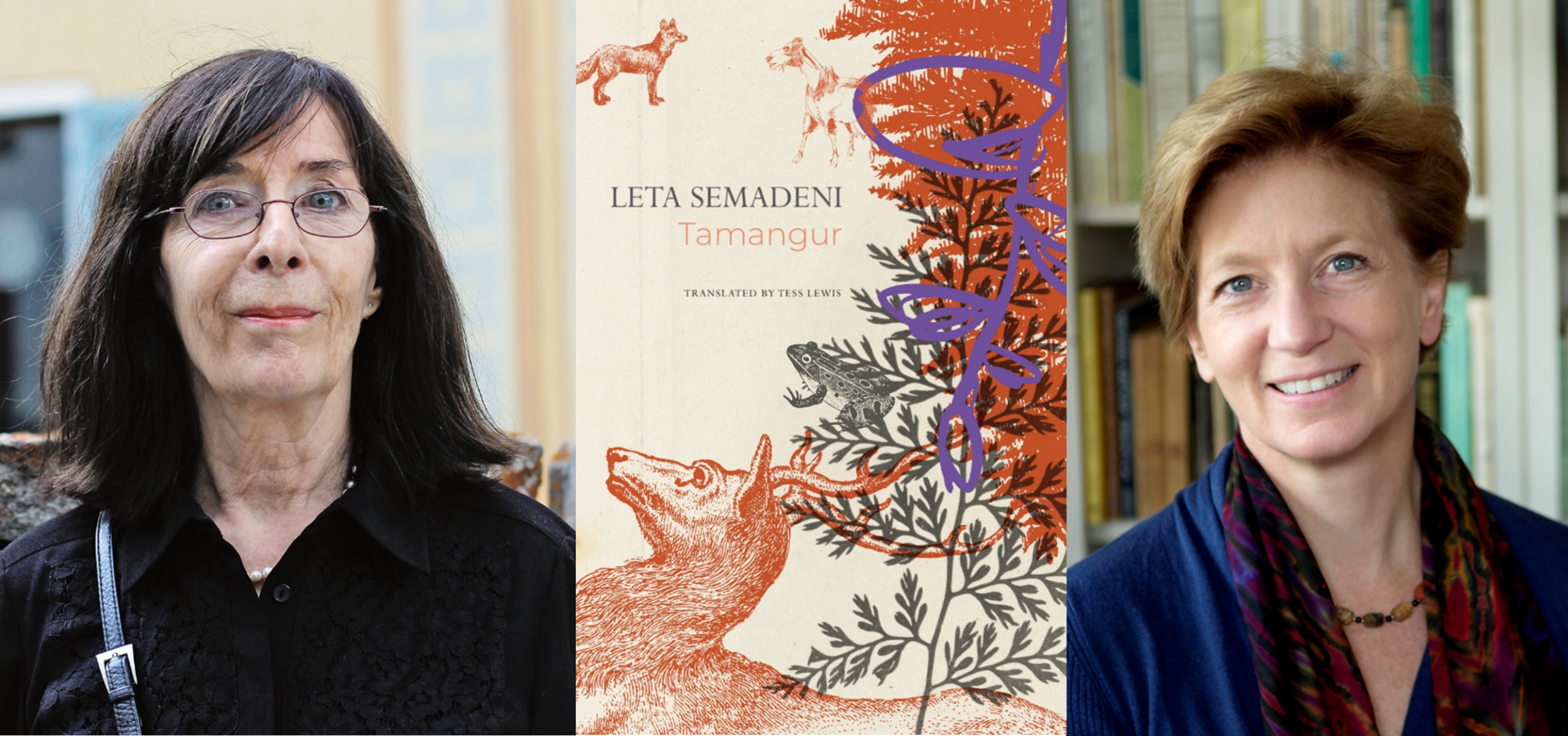
Translated from the German by Tess Lewis.
Below, in the river, there was a boulder called the Elephant, round,
with its light-coloured belly facing up. Horsetails swayed on the
bank, stretching their heads toward the water and behind them, bar-
berries glowed on the hedge through the dark tree trunks.
It was late summer. The splendour floated silently past in the
shimmering heat.
Grandfather sat on the Elephant, his ears filled with humming.
The shadow of a thick cloud suddenly spread over the bank,
where the dog hungrily stuck his snout in the earth to fill his mouth
with a cold rat, as flies flew in all directions.
The child climbed up to Grandfather. They sat together in silence for
a time, staring at the water, the fishing rod and the bobber. No fish
had bitten yet. The Elephant was an enchanted place that you some-
times had to seek out, even against your own will.
Sometimes a void opened up there, a hole that grew bigger and
deeper with every blink of an eye, and it was clear: if no one jumped
in and filled the hole, it could swallow everything.
It didn’t take long for the water to reveal this time, too, what it
had to reveal.
Small and still, growing ever smaller, her little brother floated
out on the sparkling river until he was nothing but a tiny speck, until
a wave finally took him under this time too.
And like it did every time, the child’s heart started beating again
like a drumroll.
Grandfather had caught a trout.
The child scrambled down the Elephant quick as a flash to escape
the water and the struggling fish. But the shore was also dangerous
terrain.
The pool at the foot of the alder tree was dry, the croaking
hushed, but loud croaking still filled child’s ears. She clamped her
hands over them and ran quickly toward the house.
***
It’s still early, it’s summer. Grandmother takes the coffee from the
cabinet. She longs for snow.
The cheerful drifts, she says. She loves this other silence.
When she wakes in the morning, much too early because she
couldn’t think the previous day through to the end, then she wishes
it would snow.
We need to go to the seamstress, she tells the child, be sure to
come straight home from school.
The crocodile, the child replies with a smirk.
Sh-sh-sh, Grandmother hisses, grabs the child by the arm and
presses her thumb, as rough as sandpaper, on the child’s face, first on
the left corner of the girl’s mouth, then on the right, smearing the
jam all the way to her earlobes. Grandmother calls this washing your
mouth.
But you’re right, she says to the child, the seamstress does have
eyes like a crocodile. Every time I see her, I think of this. The way it
looked at me, the monster. That was somewhere in Cuba. Behind the
hostel was a sluggish river where it lurked and suddenly it sloshed
onto land like a heavy, wet package. Those alert, beady eyes!
When you’re angry, your eyes get beady too, the child says.
The girl always feels naked when she’s standing in front of the
seamstress, when she pulls out her measuring tape to take the girl’s
measurements.
But I don’t smell like the crocodile, Grandmother says and laughs.
No one else can make blouses and such pretty dresses for the
child out of old shirts.
***
It’s not easy to escape Grandmother. The child’s skin is covered with
imprints from her sandpaper thumbs.
When she takes the child’s hand to drag her somewhere she
doesn’t want to go, she presses her thumbs on the inside of the child’s
wrists and thrusts her here and there, driven by the child’s heartbeat.
Or is it the other way round? Does the child’s heart beat because
Grandmother’s thumb makes it beat? The child wants to pull away
but doesn’t dare. Her heart might stop beating. Grandmother is in
the child’s heart, she has lodged herself in there and boxes the cham-
bers with her broad, rough thumb.
At these times the child hates her grandmother, but there’s no
need for her to have a guilty conscious. Grandmother knows hatred.
It’s a feeling that warms like fire, she says. She doesn’t understand
why hatred has a bad reputation. It sharpens the senses, gets the
blood flowing and simply does one good, she says. Talking about
hatred gives her a pleasant feeling. What would humans be without
hatred! she says. We would be incapable of suffering and loving, we
could not hope for anything better if we are so satisfied and at one with
the world. There would be no art, no books, no discussions, no good
roast, no reconciliation, no arguments and no peace. Only harmony.
Good heavens, she says, can you possibly imagine a more boring
world? Harmony makes you fat and lazy. A little hate is the spice of
life! There is time enough later for cloud cuckoo land. Besides, maybe
that’s just another name for Hell, she says, her face glowing. She
wants the luxury of feeling a little hatred once in a while.
That’s why the child doesn’t have a bad conscience when she
hates and is warmed by her hatred.
But you must save your hatred for important people and things,
Grandmother says, for the rest, it’s not worth the effort. And so, the
child tries hard not to hate the neighbour. She just looks the neigh-
bour in the face, as if she weren’t even there, and doesn’t answer. No
matter how saccharine sweetly the neighbour smiles or complains
to Grandmother that the child is obstinate.
The neighbour is a woman who never means what she says the
way it sounds, Grandmother says. She digs her claws into the super-
ficial as if there were an abyss beneath it. She has two children and
looks as if she still hasn’t ever sniffed a man.
Grandmother, on the other hand, needs the naked truth. She
trusts her own soul absolutely.
Why does the neighbour have a hunchback? the child asks.
That’s because her heart hopped into her back and is no longer
in the right place.
***
It’s different with the crow. She’s distantly related to Grandmother
and so the child is allowed to hate her a little. Before, the crow would
often come into the house and hog Grandfather for hours with her
tales of murder.
Year-in, year-out she wears black dresses and lives in the rust-red
building above the village, but only in summer. In the winter, she
flies to Italy where she has earnings from a bakery.
Murderers stalk the crow. They climb down from the attic and
she is always on guard in and around the house that the beasts don’t
catch her.
She often has to go to hospital in the city when the murderers
have got hold of her and afterwards she would visit Grandfather so
that he could comfort her.
She doesn’t come any more because Grandfather is in Tamangur
and Grandmother doesn’t want to comfort her.
The murderers have never properly caught the crow, only made
her ill, just like the piano teacher who lives in the same building and
comes from Russia, where Siberia is and it’s freezing all year round.
And where people say ‘my heart rattles like a Kalashnikov,’ instead of
‘my heart beats.’
When you sit on a bench in Siberia, you have to get up before
long and go away, otherwise you’ll freeze to it and turn into an icicle.
It’s often very cold in the village, too. Once, when the cat lay in wait
too long for a mouse, its tail froze to the floor and the cat screamed
the way her little brother screamed when he was hungry. And now
the cat has only half a tail.
Leta Semadeni was born in Scuol, Engadin in 1944. She studied languages at the University of Zurich and worked as a teacher in Zurich and Engadin. She has held residencies in Latin America, Paris, Zug, Berlin, and New York. Since 2005, she has lived in Lavin as a freelance writer. Writing poetry in Romansch and German, her collections have won multiple awards, including the 2011 Literature Prize of the Canton Graubünden. Her debut novel, Tamangur, earned the 2016 Swiss Literature Prize and has been translated into several languages. In 2023, she received the Grand Prix for Literature, the most prestigious Swiss literary prize.
Tess Lewis translates from French and German, including works by Peter Handke, Jean-Luc Benoziglio, Klaus Merz, Hans Magnus Enzensberger, and Pascal Bruckner.
This excerpt from TAMANGUR was published by permission of Seagull Books. Copyright © 2015 Leta Semadeni; translation copyright © 2025 Tess Lewis. Photo credit Leda Semadeni: Georg Luzzi.
