
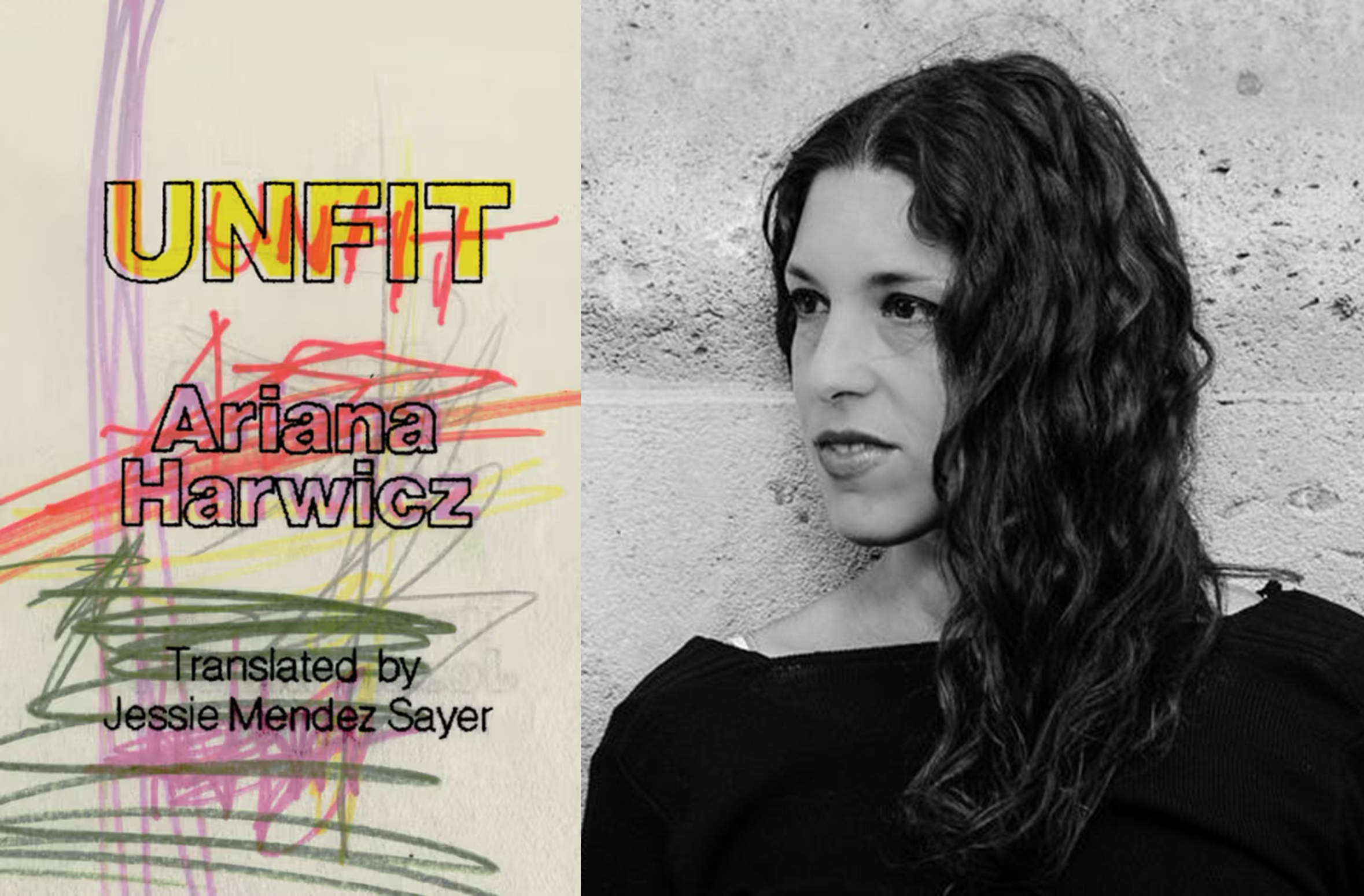
Translated from the Spanish by Jessie Mendez Sayer.
The boys look up and laugh. Coucou, I hide, they see me and laugh. The law is wrong, if a baby is on the outside during an attack, it’s homicide, if the baby is on the inside, as a fetus, there’s nobody to blame. If its heart beats even once outside the body, it’s murdering a person, but if it was born dead, then there was no murder, clean as a whistle, the executioner can go home or to a reeducation camp. I take the highway towards the northeast. The whole way there’s the same yellow sign: Danger: don’t fall asleep. We recommend you install the antidrowsiness device that monitors your heartbeat: at the first sign, it vibrates, the second, the alarm goes off and gets louder. The village is behind us, on a miniature scale. A nineteenth century village for the chronically insane where they did experiments that they didn’t dare to try in Paris. A large psychiatric ward with beds, farms, alfalfa, and chicken coops. The disturbed graze, gather nuts, and look up at the stars. It’s going to be a long night, I have to keep my eyes wide open so I don’t nod off, fix my gaze on a particular point along the night tunnel and keep moving towards Finistère. Seaside towns are more antisocial, more hesitant to change, there’s less gossip. Nobody can say, not even the local authorities, or the neighbors with their houses they passed down for several generations, what goes on inside the fortresses facing the breakwater. Everything takes place with the strictest discretion when the sea levels rise, hangings, stranglings, etc. I drive in silence, signs with blinking arrows shimmer on one side and indicate that we must merge to the right. I slow down as I pass, a police officer waves me through, he looks at my license plates as though he was going to make a note: CW339TX. I’m driving a white Dacia Logan, an adult woman, with her sleeping twins, I don’t see what could possibly raise any suspicion. I don’t know why I’m so nervous, I could open the trunk for them, turn on the lights in the back, show them what’s in the glove compartment, I would even let those drug-sniffing Belgian shepherds in. There are no speed cameras, at the roundabout I take the first exit and continue along the D26 and the Grande Rue, I pass through a construction zone. The first circuit of stage one is complete. It must seem like I’m lurching along, without any sense of direction, Auzits aux Monts d’Aubrac passing through Salles-la-Source, Sébazac and Bozouls before descending into Vallon. This isn’t going to just stop, I told him so, so many times. Not even with more children or if we escaped together? And we’d return to the tunnel, our underground love, to the scenes that we kept reliving for hours. What did we say to each other? I can’t remember, insults and threats on a loop. I want us to have a joint savings account for our old age and retirement and one for the twins, five euros a day is enough so that when they’re twenty they can rent an apartment in the suburbs. This isn’t going to last much longer, not at all, this blanket of denial. Life doesn’t offer even the smallest hint. You rewind the tape with people on a bus, people going to bed on a Friday afternoon, one breath before the carnage and you can’t see anything, and just a few hours afterwards, the children’s beds are covered in blood. Life is a flat field, there are no pythons, no grenades, no sky with its lightning, just corn and wheat, I park in an orange emergency 112 call point.
Ariana Harwicz (b. 1977, Argentina) is a fiercely independent writer and thinker who studied comparative literature at the Sorbonne. The author of Die, My Love, Feebleminded, and Precious, Harwicz has been translated into more than 20 languages, and Die, My Love was longlisted for the Booker International Prize.
Jessie Mendez Sayer is a British/Venezuelan translator who has been living and working in Mexico City since 2017. Her translations include The Untameable by Guillermo Arriaga and The Last Days of El Comandante by Alberto Barrera Tyszka.
Excerpt by Ariana Harwicz, translated by Jessie Mendez-Sayer, from UNFIT, copyright © 2024 by Ariana Harwicz, translation copyright © 2025 by Jessie Mendez Sayer. Reprinted by permission of New Directions Publishing Corp.
Photo Ariana Harwicz by Hugo Passerello Luna.
