

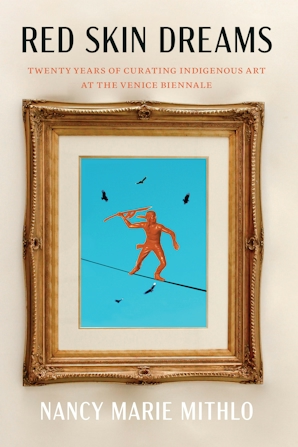

Red Skin Dreams: Twenty Years of Curating Indigenous Art at the Venice Biennale
By Nancy Marie Mithlo (Nebraska University Press)
Recommended by HÉLÈNE B. DUCROS
In her fascinating and also moving book, Red Skin Dreams: Twenty Years of Curating Indigenous Art at the Venice Biennale, Nancy Marie Mithlo, a member of the Fort Sill Chiricahua Warm Springs Apache tribe, splendidly chronicles her two decades (1997 – 2017) of bringing American Native art exhibitions to the world’s oldest and largest venue for contemporary art: the renowned and elitist Venice Biennale. The book is as much about her personal story navigating the changing politics of the Biennale as about the artists who fill the pages of her narrative, also present in photographs throughout the volume, which gives the reader an immediate feeling of proximity and relationship. Mithlo describes her tribulations negotiating a global arts system that has offered her both success and failure, excitement and disappointment. Through her nine curated shows she calls “strategically subversive, endlessly creative, and generative,” she was able to bring together community storytelling and the visual arts and link the Old World with the so-called New World. Drawing attention to networks of art consumption in an international contemporary art market plagued with corruption, appropriation, patriarchalism, and nationalist dynamics, she also operates a parallel between the Biennale and the imperial project of past essentializing world’s fairs (is the Biennale an “outgrowth of imperialism?” she asks). She further laments the limited role of curators and scholars in the circulation of artworks, as dealers and collectors hoard market power in institutional arrangements that decontextualize art, often excluding plural Indigenous knowledge, participatory practices, and collective—albeit sometimes divided—action.
Mithlo envisages her mission as a way to disenclave Indigenous arts from the US Southwest saturated and localized art scene. Her effort challenges a global artistic community that has alienated Native arts and artists, rendering them irrelevant, geographically assigned, and unseen because by nature non-individualistic and based on kinship values. As she shakes up the international arts exhibition sphere, she questions Indigeneity itself, in all its diversity, sensibilities, positionings, lineages, dreamings, and unique land-based histories. She considers what it means to be at the same time seemingly included (present at the Biennale) and excluded (invisibilized) from arts circles, and by extension from a dominant global society. Her quest for Native arts to be recognized in Venice stands as an inspiration for transnational Indigenous aesthetics to expand in spite of a system that spurs commercial dispossession. Engaging with notions of authenticity, authentication, essentialized identity, transnationalism, objectification, and agency, she reveals a normed globalized relational web that has shaped an external gaze onto American Natives, locking them into a geographically and temporally static situatedness. In contrast, she makes them into global citizens, creating pathways for future generations of Indigenous artists, from America and elsewhere, to continue to instill an ideology of belonging and build collective strength in an international art conversation that needs refreshing. No need to be an art specialist or a scholar of Indigeneity or museography to appreciate Mithlo’s evocative writing, which draws the reader into the intimate stories of the artists-protagonists, although the book will naturally appeal to researchers in museum studies, Indigenous studies, cultural geography, or anthropology.
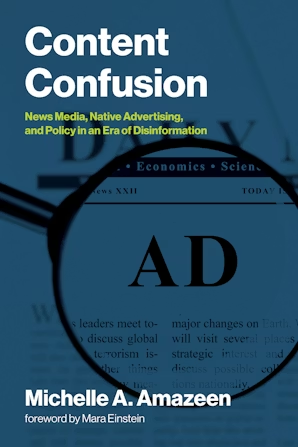
Content Confusion: News Media, Native Advertising, and Policy in an Era of Disinformation
By Michelle A. Amazeen (The MIT Press)
Recommended by EDINA PALEVIQ
In today’s media landscape, where even reputable news outlets blur the line between facts and promotion, Michelle A. Amazeen’s Content Confusion offers a much-needed dose of clarity. It examines a quiet but deeply consequential crisis in journalism: the rise of “native advertising.” This entails paid messages meticulously designed to look, feel, and sound exactly like the pieces of journalism surrounding them. As Amazeen shows, these deceptive forms of content are fundamentally reshaping our information environment. At the heart of Amazeen’s argument is a sobering question: What happens to a society when readers can no longer distinguish between independent journalism and paid marketing?
Drawing on ten years of original research, she reveals how corporations, public relations (PR) agencies, and even fossil fuel companies have “colonized” the news, to the point of shaping the narratives being delivered there. In many cases, news organizations themselves are complicit, producing ad-like stories through in-house “content studios” that mimic legitimate journalism with alarming accuracy. One especially telling example comes from Amazeen’s own classroom. Several of her university students cited a Wall Street Journal article in their assignments, unaware it was actually a paid promotion by the private company Deloitte. These students were not naive readers but digitally literate young adults. That event captures the book’s thesis: The confusion is real, widespread, and intentionally manufactured. Amazeen goes even further as she exposes how fossil-fuel giants use these “stealth” tactics to greenwash their images and how “pink slime” sites mimic local news to seed biased narratives. Her data shows that 75 percent of readers cannot distinguish these ads from real reporting. What sets this book apart from other books exploring news production and delivery is its balance. Amazeen writes with scholarly precision but in a language that is crisp, clear, and accessible. She makes complex issues understandable to any reader, and, more importantly, she offers solutions. Her “content confusion mitigation framework” lays out a practical path forward: stronger policies, smarter regulation, and urgent media literacy reforms. If we want journalism to serve the public instead of private power, transparency must no longer be optional.

Empires of Labor: Coercion and the Making of the Modern World
By Alessandro Stanziani (Cambridge University Press)
Recommended by OKSANA ERMOLAEVA
Recent scholarship on forced labor has increasingly embraced a comparative framework to capture diverse forms of exploitation and systemic exclusion across both neoliberal and communist regimes. This development reflects a wider historiographical shift that increasingly understands forced labor—slavery and other types of bondage—not as a marginal aberration but as a central element of state-building aiming at population management, economic profit, ideological indoctrination, and political legitimation in colonial empires and modern liberal democracies. Alessandro Stanziani’s Empires of Labor: Coercion and the Making of the Modern World situates itself within this body of literature, as it probes into the role forced labor played in the making and transformation of empires—continental and maritime—from the mid-sixteenth century to the outbreak of WWI. In Stanziani’s account, forced labor emerged as a formative force that shaped local political and social hierarchies while structuring economic dynamics in the French, Anglo-American, and Russian empires. The investigation uncovers striking continuities in labor regimes across these spaces and unsettles the conventional dichotomy between ancien régime societies (including Russia and pre-modern France) and the so-called “modern” world.
Through the lens of “aristocratic capitalism” and a nuanced examination of legal, social, and economic technologies of coercion, the book dissolves rigid distinctions between capitalism and bondage and between free, wage-driven, and unfree labor, revealing instead a spectrum of interwoven practices that underpinned European expansion. The volume further invites a comparison between the Russian empire’s regime of forced labor and that of its Western European counterparts, helping to understand how the revolutionary break of 1917 transformed imperial Russia’s large-scale coercive labor regimes into the Soviet system of extermination. Positioned within what the author calls the “New History of Capitalism,” the book challenges existing interpretations of labor—Marxist, Weberian, and liberal. By arguing that modern capitalism is inextricably and unconditionally bound to various forms of forced labor and slavery, Stanziani challenges the democratic foundations of European civilization, revisiting the meaning of colonialism through a cross-imperial, cross-civilizational perspective on labor regulation, away from dominant interpretations of colonial rule and Eurocentric narratives of modernity.
