
By John Pickles
No Longer a Dull Affair
Only two and a half years ago, the Bulgarian academic and commentator Dimitar Bechev (2023) commented that until recently “Bulgarian politics appeared a rather dull affair. All an outsider needed to know was a single name: Boyko Borisov (sic). The leader of the center-right Citizens for European Development of Bulgaria (GERB) ran the country for the better part of the 2009-2021 period.” The political landscape changed quickly in late November and early December 2025 when, under banners such as “Continue the Change,” “Don’t Feed the Pig With Your Money,” and “You angered the wrong generation!” protesters surrounded the Subranie (parliament building) in Sofia, then other key sites of government in the capital and towns across the country. In just two weeks, young Bulgarians and student groups, along with new centrist‑liberal groups and parts of the political left, swelled the ranks of street protests rejecting the centralization of power, corruption in government contracting, nepotism in state employment practices, and general malaise about future opportunities with mass protests. Organizers estimated that between 150,000 and 250,000 people took part in demonstrations across the country on the day gathering the largest demonstrations, 10 December 2025.
The immediate political effect was the dramatic resignation of the prime minister, Rosen Zhelyazkov, and the fall of his government on 11 December. Over the years, Bechev has been a careful reader of these political shifts, documenting the democratic struggles and state responses, diagnosing that “mistrust is the basic idiom of Bulgarian politics” (Bechev 2013a), and seeing—early on—the important role played by students in exposing “the bankruptcy of an entire political system in desperate need of renewal” (Bechev 2013b).
Protesting the draft 2026 budget, corruption, and deteriorating life chances, the demonstrators articulated demands for “Change to Come,” as Gen-Z and their families sought profound political change and a break with Bulgaria’s post‑1989 oligarchic order. This was not a question of whether Bulgaria needs “yet another election” but a series of demands for deeper political restructuring and renovation (Kulbaczewska-Figat 2023; Detev and Kirkova 2025; Ivanov 2025). At the core of this desire for transformation was a fundamental demographic challenge, revolving around the kind of future young Bulgarians could hope for—one that did not depend on a sense that they had to leave the country for opportunities elsewhere. It was time to shape a government that worked not for its own enrichment but to create conditions for young people to stay in or return to the country.
Central to this anger and days of action were several new actors and symbols that warrant serious attention, particularly because the protests were both effective in their goals of dislodging the government and its recent policies, and because of the ways in which popular sentiment was constructed around legitimate expressions of civic pride. Even in his resignation announcement in parliament, Prime Minister Zhelyazkov said: “We hear the voice of the citizens, we must rise to the demands. Both the young and the old raised their voices in favour of resignation. This civic position must be encouraged” and its “demonstration of values” recognized (Reuters 2025; BBC 2025).
When Young People Organize, the World Can Turn!
Opposition to elected governments in Bulgaria has deep roots and has faced many failures across the years since 1989, with recent governments lasting on average little more than six months. But this year several issues and groups aligned around a particular conjuncture. The longer tradition of opposition to state capture and its consequences has been complemented by a much wider mobilization of civic activists, journalists, and analysts around formations such as “Continuing the Change – Democratic Bulgaria” and other independent initiatives that frame the crisis as one of a “captured state” and stalled democratization. For these formations, “revolution” means a decisive break with the dominant political parties around the GERB-led coalition (ГЕРБ) (Citizens for European Development of Bulgaria/Граждани за европейско развитие на България/Grazhdani za evropeysko razvitie na Bŭlgaria) and the dismantling of networks of patronage and politicizing of institutions. Radical left and nationalist‑Eurosceptic groups, such as the 23 September movement,[1] also joined the protests calling for a revolution against the Eurozone (which Bulgaria joined in January 2026), the EU, NATO, and local oligarchies. In their view, creating sustainable local futures for young Bulgarians will entail systemic reform of the wider neoliberal integration model of recent decades, which the EU symbolizes (23 September movement, 2025).
But by far the most important and dynamic force in this mobilization was youth action and concern about the kind of future they see for themselves in the country, as they called not only for a new Bulgaria but one oriented to the EU and a wider Europe. Coinciding with anxiety about the financial consequences of the January 2026 entry into the Eurozone, recent surveys show that around three‑quarters of young Bulgarians are considering leaving the country (Hristova and Zografova 2022; Radio Bulgaria 2025). The result has been a Gen Z mobilization of school pupils, university students, and early‑career professionals as the most active in the recent street protests in Sofia and other cities (Detev and Kirkova 2025). For many young people, the combination of low wages, weak public services, and pervasive corruption has made staying in Bulgaria seem irrational compared with a future elsewhere in the EU. Corruption scandals, politicized institutions, and precarious professional prospects were among the primary motives for wanting to leave—not only wage differentials. But for many of these Gen Z activists this is not a demand for policy adjustment only but also for a fundamental change in how politics is done—with more transparency, accountability, and generational renewal—which they present as a precondition for reversing demographic decline.
The immediate political effect of the emergence of a mobilized youth movement has been dramatic: after weeks of protests, the prime minister resigned and the government fell, prompting both domestic and international media to credit Gen Z with toppling the cabinet. Commentators stressed that what began as a budget controversy quickly became a referendum on the legitimacy of a governing class widely seen as corrupt and indifferent to the precarity driving young people abroad. For some, Bulgaria’s entrenched political‑economic elite cannot be dislodged or reformed without also a repositioning of Bulgaria’s embeddedness in the wider European project. For others, youth emigration is tied to a lack of domestic opportunities, economic conditions built around dependence on foreign capital, an on-going EU‑peripheral status, and past governments’ normalization of various forms of stealing the state.
Bulgaria has cycled through multiple elections and short‑lived governments in recent years. In this context, long-serving governmental officials and deeply rooted patronage networks will be difficult to dislodge. But there is a difference in these protests; while young people have previously been associated with cynicism and apathy, this current politicization is different. Gen Z mobilization has gathered a broad spectrum of support, including “young professionals, students, entrepreneurs, IT workers, pensioners, and even some public servants” organized around a widespread discontent with clientelism (Alimpijević 2025). The result is a potential new electoral force pushing for democratic renewal to redress unmet expectations and reverse the emigration of young Bulgarians.
The Protests and the Protesters
As far as we know, the anti‑government protests of December had no central coordinating organization. Earlier protests had mobilized employers and workers against aspects of the 2026 budget, but the December protests had various organizational forms and no direct central planning committee. Instead, the protests were a loosely coordinated effort by several overlapping organizers and leading groups. The initial initiative for the nationwide mobilization is most associated with the opposition coalition “We Continue the Change – Democratic Bulgaria” (PP-DB), which called the large 1 December protest in Sofia and then repeatedly announced new “national protests” against the 2026 budget, corruption, and the government. Parties such as Yes, Bulgaria! endorsed and helped organize the actions (Mitrakas 2025).
Interestingly, parallel or issue‑specific protests were organized within the same wave, variously by far‑right party Revival (Vŭzrazhdane)—holding its own rallies in cities like Haskovo and Smolyan—the civic NGO Boets—organizing protests outside the Interior Ministry in Sofia and demanding the minister’s resignation—the small party Velichie—organizing protests outside the Bankya residence of Boyko Borissov (the leader of the center-right populist party, Citizens for the European Development of Bulgaria, GERB), and the civic platform Justice for All—leading a demonstration against acting Prosecutor General Borislav Sarafov and then encouraging supporters to join the PP-DB protest on 18 December to demand judicial reform and fair elections (Reuters 2025).
Trade unions and professional organizations have been present around the protests, but so far they have mostly acted in parallel rather than as primary street organizers. In this regard, the country’s largest labor federation—the Confederation of Independent Trade Unions in Bulgaria (CITUB/KNSB)—has been the main union actor (Petkova 2025), organizing its own protest in front of Parliament on 24 November 2025, “NO to the division of workers! YES to higher incomes!” while in mid-December it declared readiness to launch “national, sectoral and regional protests, as well as strikes” in response to Parliament’s failure to adopt the 2026 budget and social‑insurance bills (Malakchiev and Dimitrova 2025; Petkova 2025). Accusing members of parliament (MPs) of “political impotence,” CITUB called the planned extension of the 2025 budget “a direct attack on the living standards of hundreds of thousands of working Bulgarians in the public sector,” explicitly listing secondary and higher education, healthcare, public administration, agriculture, the environment, transport, culture, defense, security, and postal services (Malakchiev and Dimitrova 2025).
While Boyko Borissov and MP Delyan Peevski, the leader of the Movement for Rights and Freedoms – New Beginning (MRF-NN), both tried to blame the first large protests over the draft 2026 budget as being organized by the Association of Industrial Capital in Bulgaria (AICB), an employers’ organization they claimed operated as a kind of “capitalist trade union” of large firms (21 September), in practice both employer organizations and trade unions denounced the draft budget as “the worst budget in 30 years,” further helping legitimize the growing support for mass protests (Detev and Kirkova 2025).
Several public sector workers have also been actively supportive of the demonstrations. Doctors’ and health‑sector organizations warned that the budget perpetuated the dire conditions of underfunding in public health and was “pushing young and experienced doctors to migrate,” further expanding the growing central motif of mass emigration of skilled professionals in health, education, culture, and other public‑sector work, whose wages and conditions were seen to be threatened by the budget stand‑off and by a potential for further inflation fueled by the January 2026 entry into the Eurozone (Malakchiev and Dimitrova 2025).
Movement Composition and Organizers
The movement’s organizational ecology included a formal opposition initiative, civic and professional groups, and loosely networked Gen Z influencers, with the street presence often described as “the biggest in years” and among the largest since 1989. Briefly, the main factions making up the movement were:
Formal opposition and civic coalitions: The initial large protest of 26 November was called by the reformist opposition coalition “We Continue the Change – Democratic Bulgaria” (PP-DB), which then organized the mass 1 December rally and subsequent “national” protests once the budget controversy escalated into a demand for government resignation. Civic organizations such as “Justice for All” mobilized around judicial independence and joined forces with PP-DB in the 18 December protest targeting the acting Prosecutor General Borislav Sarafov and calling for the restoration of machine voting, which had become an important flashpoint following the December 2022 “paper coalition’s” overturning of the popular 2021 decision to implement compulsory voting machines in an effort to reduce the unusually high number of invalid ballots and vote buying.
Gen Z influencers, artists, and first‑time protesters: Generation Z activists, social‑media influencers, and artists played a central role in convening demonstrations and turning followers into marchers and memes into mobilizing frames; in Sofia on 1 December, between 50,000 and 100,000 people turned out, with Gen Z protesters forming the bulk of participants. Reports stressed that many were protesting for the first time, motivated by anger over corruption, low wages, and the emigration of doctors and professionals, as well as a desire to “have a reason to stay” in Bulgaria. This last motivator has become a particularly important aspect of youth politics, expressing young people’s concern not only about their personal economic opportunities but also about the uncertainty of their collective ability to palliate the economic and demographic malaise of recent decades.
Cross‑party and cross‑ideological support: The protests were also notable for attracting backing from far‑right and nationalist groups, as well as a Turkish minority interests coalition, the Alliance for Rights and Freedoms (MRF – Ahmed Dogan), even where these actors did not control the protest agenda. Parallel protests and counter‑protests by parties such as Revival, Velichie, MRF-New Beginning (Deyan Peevski), and Citizens for the European Development of Bulgaria (GERB), as well as trade unions and employer organizations, created a crowded field of street politics. This assemblage complicates simple readings of the mobilization as either a partisan “color revolution” or a purely horizontal youth uprising: the symbolic politics of Gen Z and anti‑mafia/anti‑oligarch discourse sit atop a heterogeneous coalition with competing projects for state transformation and anti‑corruption.
Specific Demands and Initiatives
Across the December cycle, protesters advanced both immediate and medium‑term demands, ranging from budget withdrawal to deeper institutional changes in electoral administration and the judiciary. These too were important aspects of not only the political goals of the movement but the rhetorical framing of the movement itself.
The demand for the withdrawal of the 2026 budget and government resignation triggered demonstrations that began after the government proposed the new budget that raised social security and pension contributions, which employer organizations called “the worst budget in the last 30 years” and protesters denounced as funding privileged officials and security institutions rather than social programs. Even after the government suspended and then officially withdrew the budget proposal, protest demands escalated to insist on the resignation of the Zhelyazkov cabinet and the organization of snap elections, with President Rumen Radev publicly echoing calls for a new mandate.
The protests also aimed at judicial reform and the implementation of an anti‑corruption architecture. A central initiative in the later phase was to link street pressure to specific institutional reforms. Demonstrations on 18 December demanded the removal of acting Prosecutor General Borislav Sarafov, the restoration of full machine voting, and the removal of special security privileges for MPs, the latter being framed as protecting impunity. Protesters and commentators repeatedly targeted Peevski and Borissov as emblematic oligarchic figures, highlighting the need for a genuinely independent judiciary capable of prosecuting high‑level corruption cases rather than shielding “mafia” networks.
Budgetary justice and social rights were additional claims advanced by protesters. While corruption and state capture provided the dominant frame, movement discourse also foregrounded the exodus of doctors and young professionals, underfunded healthcare, low wages, and precarious futures, arguing that a different political order is a precondition for making Bulgaria livable for young people. Employer organizations and unions negotiated revisions to the budget, but youth protesters often treated these concessions as insufficient without a broader reset of who governs and how. The government’s eventual resignation on 11 December, explicitly justified by reference to “the voice of the people,” represented the most immediate success of this wave of contentious politics, while debates overextending the 2025 budget and the fate of the 2026 proposal underscored how fiscal policy has become a key terrain of post‑resignation struggle.
Who Are the Gen Z Leaders?
Throughout the demonstrations, national and international reporting increasingly figured the role of Gen Z‑led or youth‑led protesters, with university students in Sofia and younger activists being given main speaking roles (Toshkov 2025). Events were effectively promoted and then led on the ground by Generation Z activists and social media influencers. TikTok and Instagram campaigns, supported by prominent singers, actors, and vloggers seem to have been central (Mimeta 2025; Ivanov 2025).
There seems to have been no single, clearly defined “leader” of Bulgaria’s Gen Z protests, but the protests have been far from spontaneous. Mobilization and organization seem to have been carried out around a loose constellation of students, young professionals, social media influencers, artists, and first‑time activists operating with a kind of horizontal politics of reaction. It remains too early to fully assess the nature of the protests and any implications for a wider understanding of youth movements and horizontal political organizing. Most current coverage stresses precisely this lack of formal hierarchy, describing a youth‑driven, social media‑coordinated mobilization rather than a classic organization with named leaders (Ivanov 2025; Gurri, 2025; Iliev 2025); but perhaps most significantly the demonstrations have mobilized as a movement among young Bulgarians who formerly could not vote or were generally thought to be disenchanted, low-level voters. Bulgaria certainly has a varied radical, perhaps minority, history of anarchist and autonomist political movements, maybe most clearly visible in the role of the environmental political movement EcoGlasnost, which led to the removal from power of the Todor Zhivkov regime in 1989.
A Free Press essay on “Generation Z tearing down entire nations” suggests that Bulgaria is an important case where youth protests have emerged in more decentralized ways that traditionally might have been the case. With a “lack of leaders, clever social media, online communities, memes, fast organization and disorganization,” a politics of the street—mobilized rather than organized, a 1968-style rather than 1989-style politics—may have emerged, making the “organization” much more difficult to predict, control, or capture (Gurri 2025).
Seeking a traditional concept of leader, The New York Times (NYT) highlighted 24‑year‑old Sofia marketing professional Konstantin Tuzharov and young political influencer Mimi Shishkova as emblematic of the new Gen Z organizers. Surprised by his own success, Tuzharov is said to have commented: “Did we actually make that happen?” (New York Times 2025). But the NYT further pointed out the unusual, disseminated coalitional nature of the protesters. Deutsche Welle (DW) and France 24 similarly emphasized the novelty of the roles played by TikTok and Instagram creators, contrasted with the roles of traditional demonstration actors from party youth wings (Ivanov 2025).
Culture and identity clearly played an important role for this youth element. Golden Globe-nominated actor Mariya Bakalova returned to Bulgaria and posted Instagram stories from the Sofia protests, openly aligning herself with demonstrators. Pop singer Mihaela Fileva shared videos and reflections on being moved by the scale and energy of the rallies, while actors Naum Shopov, Ralitsa Paskaleva, Filip Bukov, and Alek Alexiev were visible participants at the mass rally. And singer Veniamin Dimitrov and the musical duo Mолец (Molec) also participated in the protests (Mimeta 2025). In parallel, lifestyle and entertainment influencers, such as Andrea Banda Banda, played an important role in pivoting from pop‑culture content to an explanation of the budget, at the same time urging followers to join protests in central Sofia (Mimeta 2025). Social media, particularly those of figures like vloggers Emil Conrad and Izabela Ovcharova were important to getting young people out to the protests with clips such as “get ready with me for the protest,” live streams, and explanatory videos about the budget and corruption. These individuals and media forms seem to have operated as decentralized information hubs, issuing calls to action and sharing logistics in formats legible to Gen Z audiences (Gurri 2025; Mimeta 2025).
Symbolic Politics: Flags, Memes, Slogans, and “Pink Pigs”
While the December 2025 protests were, at their core, visibly a youth‑led, anti‑corruption uprising, they combined generational politics with a distinctive symbolic politics that mobilized a repertoire of symbols, memes, and targeted institutional demands to reclaim the state from the “mafia” while keeping open the space for public participation. In lodging Generation Z as a crucial political subject, the movement lay claim to national and EU symbols, including anime and meme culture, street theater, and anti‑oligarch slogans, in ways that remained open and inclusive (Przybylak 2025; Euronews 2025). A striking feature of the protests was the dense layering of national and generational symbolism through which participants framed the struggle as one for a “normal European state” against a corrupt post‑1989 order associated above all with Boyko Borissov and Delyan Peevski (Nikolova and Kothé 2025).
National and European flags both had their place. Bulgarian flags were the dominant visual motif in Sofia and other cities, signaling what one observer called a demand to “reclaim control over the state,” while EU flags appeared as both a claim on European rule-of-law values and, for some, an implicit critique of how EU integration had stabilized domestic oligarchic arrangements. By waving both Bulgarian and EU flags protesters claimed they were showing that anti‑corruption and the rule of law are core to Bulgaria’s belonging in Europe.
Posters and banners with slogans such as “Gen Z is coming,” “Gen Z won’t stay silent!” “You have angered the wrong generation,” and “Young Bulgaria without the mafia” articulated the protests as a generational insurrection that refuses the emigration‑as‑exit script. Commentators underlined that these phrases marked a shift from “Gen Z is coming” to “Gen Z is here,” insisting that a new cohort had already entered the political arena and would not retreat (Nikolova and Kothé 2025), as it mobilizes social media such as Instagram to both convey these messages and coordinate street protests.[2]
Some particularly important shouted slogans and laser projections included “Resignation,” “Mafia out,” “Borissov and Peevski, go!” “For fair elections” and named specific elites while also gesturing to a more systemic “mafia‑state” model. Letters “Д” and “Б” (the Cyrillic initials of Delyan Peevski and Boyko Borissov) were displayed crossed out on placards, while caricatures of pigs lampooned “heavy‑set oligarchs,” visually coding corruption in embodied, classed terms (Khan 2025). Protesters also appropriated global popular culture, most notably the Straw Hat Pirates’ Jolly Roger from the anime series One Piece as a recurrent emblem, fusing a pirate crew’s rebellion against corrupt power with local anti‑mafia narratives. Placards and signs written in English were common, as they have been recently across many demonstrations globally. Large screens in Sofia’s main square looped political memes, videos, and humorous edits of politicians, while flash mobs and influencer appearances turned the protest into what one report called a youthful energy-driven festival of dissent (Mimeta 2025).
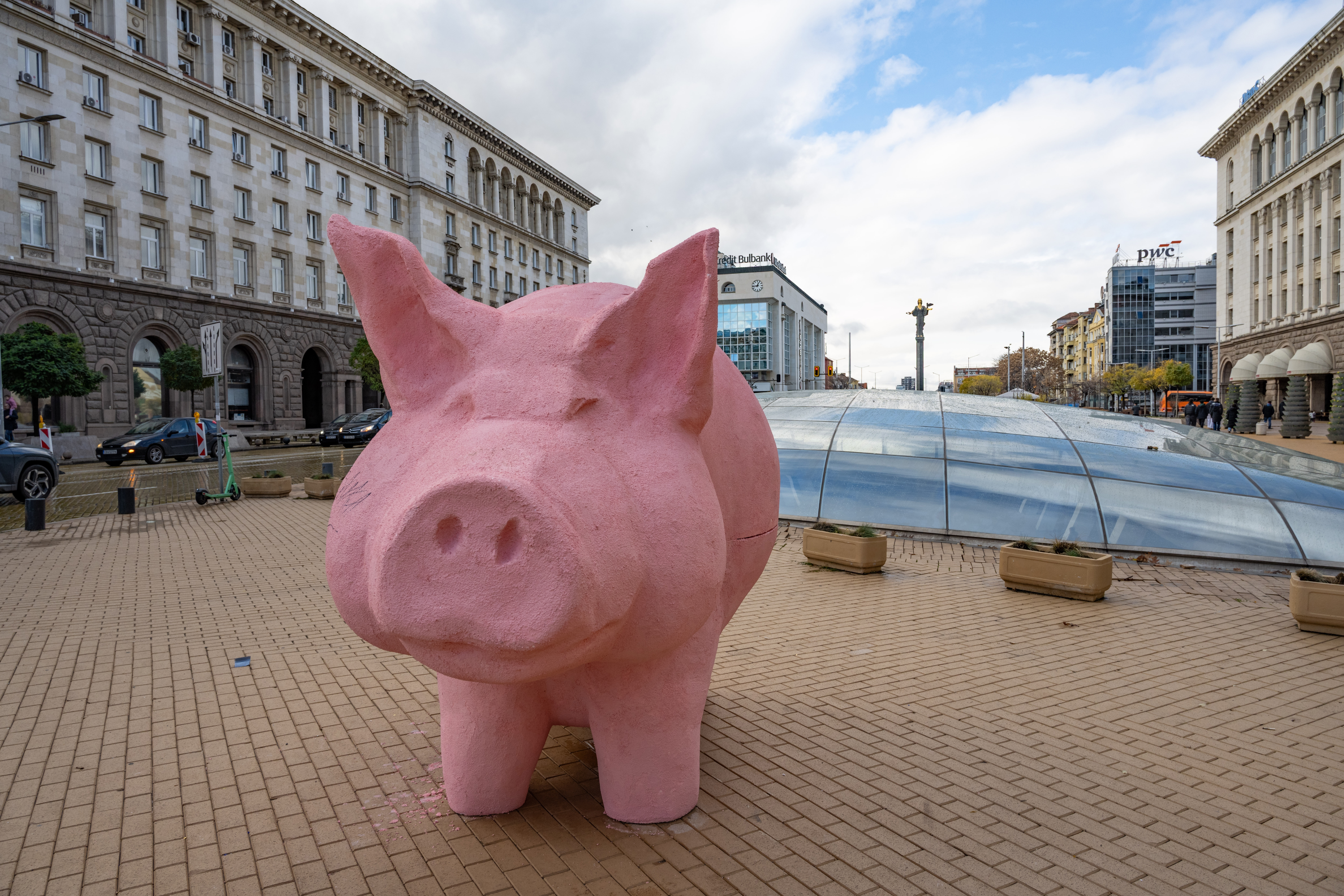
Through the slogans “Mafia out!” and “Don’t feed the pig (with your money),” protesters signaled their anger at what they see as state capture: control of institutions, legislation, and public finance by those tied to the bipartite ruling elite (Kirkov 2025). The pink pig images and slogans had several origins and targets, perhaps attaching to more issues as the protest days extended and numbers increased. One target of the “Don’t feed the pig (with your money)” was the state budget and proposals for the new budget, which were widely seen as being treated as a “piggy bank” stuffed with citizens’ money to be used by elites. More specifically, the pink pig was aimed at Delyan Peevski, leader of the DPS-New Beginning party and part of the GERB-led coalition, who is widely regarded as a symbol of oligarchic power and corruption. Plastic pig noses and masks became a common trope each night. The image and slogans around the pig were extended as demonstrator branding was encouraged.
Images and political posters proliferated, in which many mobilized the pigs, statues, masks, and wider imagery, encouraging the sharing of them with friends and family. Saloni Khanna’s Facebook/Instagram post illustrates the visual power of these images. As Mimeta (2025) pointed out:
This aesthetic infrastructure extends into the movement’s symbolism. The now‑iconic “Don’t feed the pig” slogan condensed anger at corruption into a single striking image: a pink “pig” representing politicians gorging on public money, paired with QR‑code stickers that linked to protest information and petitions. Alongside this, phrases such as “You have angered the wrong generation” and “Gen Z won’t stay silent” travelled from cardboard signs to TikTok overlays and Instagram captions. These elements are not mere decoration; they make the protests legible, emotionally resonant and exportable beyond Bulgaria’s borders in the form of images and clips…. Artists, musicians and influencers didn’t just “support” demonstrations in Bulgaria, they translated anger into action, made protests visible, and spoke Gen Z’s language. When an Instagram story, a meme or a drone shot can help move thousands into the streets, cultural workers are no longer on the sidelines of politics, they’re on the frontline, often at real personal risk.
Diagnosing an Organic Crisis
The complex structure of the feeling that drove popular protest among young and old in December cannot be reduced to a single dimension or cause. There are many reasons for a political revolt, and the complexity of any particular crisis demands complex analysis. But there are also some crucial determining aspects of any political rupture.
First, and most obviously in Bulgaria, are the economic conditions people face and the past and projected policies of the government. Bulgarian National Statistical Institute data for 2025 show GDP growth of 3.2 percent, an employment rate of 71.4 percent, and annual inflation of 5.2 percent. Recent policies and proposed programs for 2026 onwards have compounded general anxiety about the economy, and these anxieties have shown themselves particularly among students about to or recently entering the job market.
Second, and related, is the effect Bulgaria’s recent demographic history has had on the current protests. The jouissance of street revolt and the symbolic and affective politics of anger, despair, and joy have been both clear and effective. But there is a second politics that tells a story that every one of the demonstrators will understand and know personally, whether through family history or school group dynamics, and that is the longer-term story of population change.
The population of Bulgaria peaked in 1988 at 8,981,446 and has declined every year but one since then (Figure 1). As of December 31, 2024, the population was 6,437,360, and the one year that did not experience decline was 2024, the first year since 1988 with a population increase (2.67 percent). In 2025 the population of Bulgaria was 6,656,190.[3] Based on her study of over 300 political and social movements between 1990 and 2006, Erica Chenoweth (2012) argued that when 3.5 percent of a population has engaged in sustained nonviolent resistance, it has never failed to bring about change in government. While Chenoweth suggested in 2020 that new research indicated that there were exceptions to these findings, she remained confident that such levels of street protests, overall, indeed resulted in government change. Using the protester estimate of 250,000, that means that 3.8 percent of the population in Bulgaria was part of the December 2025 street protests.

Source: World Development Indicators (12/19/2025 update)
Total population has declined systematically since 1989, with some years experiencing steep declines (e.g., 1989 -1.17%, 1990 -1.8%, 2001 -1.99%, 2002 -2.17%) and recent years—with the exception of years seeing post-COVID returns—exhibiting a particularly large series of losses (2022 -3.47%; 2023 -3.01%, 2025) (Figure 2).

Source: https://www.macrotrends.net/global-metrics/countries/bgr/bulgaria/population
Data for 2024 primarily reflect the number of returnees following the COVID-19 epidemic.
Rural population has been particularly impacted, declining every year since 1960. Driven initially by agricultural collectivization and forced urbanization, rural population has been decimated by a combination of collective farm closure, the collapse of rural industries, an exodus to the cities and other countries, and resulting declines in birth rates. The number of inhabitants in rural areas declined from nearly five million in 1960 (62.9 percent of the population) to 1.5 million in 2023 (23.3 percent of the population). No year failed to experience an absolute and relative decline in the rural population. 2022 and 2023 were particularly catastrophic in rural population collapse, with 4.89 percent and 4.45 percent decline respectively. The result is an aging rural population and deteriorating social infrastructures in the villages with attendant consequences for the rising costs of remaining (albeit low quality) public services.
One result of this transition has been the growing labor market dependence on urban jobs. Until 1988, the urban population had grown every year since 1960, but from a high in 1988 of 5,861,908 the urban population has declined relatively slowly year over year, but with increased declines between 2021 (5,228,804) and 2023 (4,944,604). While aggregate opportunities for those entering the labor market in urban areas have increased marginally, the cost of maintaining public services and rising inflation have had negative overall effects on outlooks for the future. These dynamics and the continued exodus of younger people for study or work have drastically changed the demographic profile of the country, particularly during the population’s most economically active years, in turn leading to the growing demographic burden of an aging population. The population pyramid in Figure 3 illustrates this demographic situation particularly clearly. Organized in five-year age cohorts (indicated on the Y—vertical—axis) with males on the left and females on the right, the population pyramid shows a rapidly aging population and the declining numbers and proportions of those in, or soon to be in, their most economically active years.

Original Data Source: https://www.populationpyramid.net/bulgaria/2025/
An increase in expatriate returns resulting from growing economic and social problems in Europe and the US (the primary destination areas for students and expatriates) may well have contributed to the discourses of change and desire among young (and older) people. This is particularly the case with Erasmus scholars who, after funded study programs in another EU country, must return to their home country with their international experiences and the additional skepticism of Bulgarian futures this might bring. Facing a continued population decline and increasing burden on a shrinking workforce, government policies, such as those proposed in the autumn, simply do not address sufficiently—or at all—this wider social anxiety about collective and individual futures.
Identity, Belonging, and the Future of Bulgarian Politics
Since the 1994 Zapatista uprising and the Seattle 2000 protests, symbolic politics of youth have figured in more general political unrest, and in many cases youth politics have emerged in a leadership role. So, what is different about these protests, if anything? Perhaps one answer is nothing…. But perhaps another answer can be given. The Bulgarian December Revolt was built on an existential concern not only for economic well-being and social justice but a claim for identity and belonging. Young Bulgarians have asked: “Who are we?” “What will be our place in a country that has come to settle for us leaving, even encouraging us to leave?” And “what do we leave behind when we leave, and to what can we return if we do leave?”
This claim on belonging is a different way of telling each other stories of political shame and possibility. It unveils the failures of government action beyond mere policy debates and locates the challenge to future governments to take seriously not only measures of GDP, European integration, political stability, and nominal financial credibility, but also the claims of millions—although perhaps not millions for much longer—of young people below 25 or 30 years of age. These are the demands of the future population! These complex economic and demographic challenges present an organic crisis that has toppled the government and must now see a reconfiguration of state policies for the future.
John Pickles is Distinguished Professor Emeritus of Geography and International Studies at the University of North Carolina Chapel Hill. His research focuses on global value changes, regional economic development, and social theory. He has carried out research in Bulgaria since 1989 and currently serves as the Editor-in-Chief of the Journal of the Bulgarian Geographical Society. He lives in Chapel Hill, North Carolina.
References
Alimpijević, Vladan. 2025. “Large Protests in the Neighborhood: Winter of Bulgarian Discontent.” NIN Online, December 10. https://www.nin.rs/english/news/97777/large-protests-in-the-neighborhood-a-winter-of-bulgarian-discontent
BBC News. 2025. “Bulgarian PM and Government Resign after Mass Protests.” BBC News, December 1. https://www.bbc.com/news/articles/cn09g640659o
Bechev, Dimitar. 2013a. “Bulgaria’s Anger: The Real Source.” Eurozine, March 20. https://www.eurozine.com/bulgarias-anger-the-real-source/
Bechev, Dimitar. 2013b. “Bulgaria: Students to the Rescue.” European Council on Foreign Relations (ECFR), Commentary, November 20. https://ecfr.eu/article/commentary_bulgaria_students_to_the_rescue225/
Bechev, Dimitar. 2023. “How many elections would it take to end the crisis in Bulgaria?” Aljazeera, April 4. https://www.aljazeera.com/opinions/2023/4/4/how-many-elections-would-it-take-to-end-the-crisis-in-bulgaria
Chenoweth, Erica. 2012. Why Civil Resistance Works: The Strategic Logic of Nonviolent Conflict. Columbia Studies in Terrorism and Irregular Warfare. New York: Columbia University Press.
Chenoweth, Erica. 2020. Questions, Answers, and Some Cautionary Updates Regarding the 3.5% Rule. Discussion Paper 2020-005, Carr Center for Human Rights Policy. Cambridge, MA: Harvard Kennedy School, Spring. https://www.hks.harvard.edu/sites/default/files/2024-05/Erica%20Chenoweth_2020-005.pdf
Dempsey, Judy. 2021. “Bulgaria’s Election: The EU’s Negligence of Corruption and Its Values.” Carnegie Europe, April 6. https://carnegieendowment.org/europe/strategic-europe/2021/04/bulgarias-election-the-eus-negligence-of-corruption-and-its-values?lang=en
Detev, Alexandar, and Mina Kirkova. 2025. “Bulgaria protests: ‘Gen Z won’t stay silent!’” Deutsche Welle, December 3. https://www.dw.com/en/bulgaria-anti-government-anti-graft-protests-gen-z-wont-stay-silent-borissov-and-peevski/a-74999252
Euronews. 2025. “Bulgarian government resigns after mass anti-corruption protests.” Euronews, December 12. https://www.euronews.com/2025/12/11/bulgarians-demand-government-resign-in-mass-protests-over-corruption
Gurri, Martin. 2025. “Generation Z Is Tearing Down Entire Nations.” The Free Press, December 16. https://www.thefp.com/p/generation-z-is-tearing-down-entire
Hristova, Antonaneta, and Yolanda Zografova. 2023. “Attitudes towards Emigration among Young Citizens in Bulgaria.” Anthropological Researches and Studies, 12. http://doi.org/10.26758/12.1.11 https://www.journalstudiesanthropology.ro/en/attitudes-towards-emigration-among-young-citizens-in-bulgaria/
Iliev, Kai. 2025. “How Gen Z Made Bulgaria’s Government Resign.” The European Correspondent, December 15. https://europeancorrespondent.com/en/r/how-gen-z-made-bulgarias-government-resign
India Today Instagram. 2025. December 11. https://www.instagram.com/reel/DSH9t86jdgz/
Ivanov, Mihail. 2025. “Bulgaria Protests: Why did Gen Z turn out in record numbers?” Deutsche Welle, December 10. https://www.dw.com/en/bulgaria-protests-why-did-gen-z-turn-out-in-record-numbers/a-75093957
Jakes, Lara, and Boryana Dzhambazova. 2025. “Bulgaria’s Prime Minister Resigns in the Face of Mass Protests.” The New York Times, December 11. https://www.nytimes.com/2025/12/11/world/europe/bulgaria-prime-minister-resigns-protests.html
Junes, Tom. 2013. “Students Take Bulgaria’s Protests to the Next Level. Can They Break the Political Stalemate?” Transit Online. https://www.iwm.at/transit-online/students-take-bulgarias-protests-to-the-next-level-can-they-break-the
Khan, Sana. 2025. “Thousands Rally in Bulgaria Demanding Government Resignation.” Modern Diplomacy, December 11. https://moderndiplomacy.eu/2025/12/11/thousands-rally-in-bulgaria-demanding-government-resignation/
Kirkov, Nikola. 2025. “Don’t Feed the Pig: Bulgaria’s 2026 Eurozone Budget Uprisings Explained.” European Careers Association Maastricht, December 10. https://ecamaastricht.org/blueandyellow-zoomingin/government-affairs-the-current-political-climate-in-slovakia-part-2-dhmaj-983sx-ck4ck-cbtdr-mmpkl-kp7n6-ewxz6-rnl7x-8d4ga-t426d-nzg6t-6mf6z-8wpjn-my6ns-h3g3x
Klawans, Justin. 2025. “How Bulgaria’s government fell amid mass protests.” The Week (US), December 15. https://theweek.com/world-news/bulgaria-latest-government-mass-protests
Kulbaczewska-Figat, Małgorzata. 2023. “Bulgaria: waiting for a change (not) to come.” Cross-border Talks, April 25. https://www.crossbordertalks.eu/2023/04/25/bulgaria-waiting-for-a-change-not-to-come/
Malakchiev, Atanas, and Iona Dimitrova. 2025. “CITUB Ready to Hold Protests, Strikes over Parliament Not Adopting 2026 State Budget, Social Bills.” Bulgarian Telegraph Agency, December 19. https://www.bta.bg/en/news/economy/1031338-citub-ready-to-hold-protests-strikes-over-parliament-not-adopting-2026-state-bu
Mimeta. 2025. “How Artists and Influencers Mobilised Bulgaria’s Youth Protests.” Mimeta, December 16. https://www.mimeta.org/mimeta-news-on-censorship-in-art/2025/12/16/bulgarias-gen-z-uprising-artists-and-influencers-at-the-front-line
Mimeta. 2025. “Artists And Influencers Power Bulgaria’s Protests.” Mimeta, December 16. https://www.mimeta.org/mimeta-news-on-censorship-in-art/2025/12/16/bulgarias-gen-z-uprising-artists-and-influencers-at-the-front-line
Mitrakas, Dimitris. 2025. “Bulgaria: Mass Demonstrations Lead to Budget Withdrawal, Government Resignation and New Political Situation.” Internationalist Standpoint, December 12. https://www.internationaliststandpoint.org/bulgaria-mass-demonstrations-lead-to-budget-withdrawal-government-resignation-and-new-political-crisis/ also published in Ξεκίνημα, December 12, 2025. https://xekinima.org/bulgaria-mass-demonstrations-lead-to-budget-withdrawal-government-resignation-and-new-political-crisis/
New York Times. 2025. “‘Did We Do That?’ Gen Z Protesters Help Tip Balance Against Bulgaria’s Leaders.” New York Times, December 1. https://www.nytimes.com/2025/12/12/world/europe/bulgaria-young-protesters-gen-z.html
Ndunga, Kevin. 2025. “Bulgaria PM resigns amid mass protests days before Euro switch.” Daily Sabah, December 11. https://www.dailysabah.com/world/europe/bulgaria-pm-resigns-amid-mass-protests-days-before-euro-switch
Nikolova, Margarite, and Matin Kothé. 2025. “Bulgaria’s Government Has Resigned: Gen Z Isn’t Coming – Gen Z Is Here.” Friedrich Naumann Foundation, December 15. https://www.freiheit.org/east-and-southeast-europe/bulgarias-government-has-resigned
Petkova, R. 2025. “Bulgaria’s largest union CITUB declares readiness for strikes over 2026 Budget.” Bulgarian Telegraph Agency, December 19. https://bnrnews.bg/en/post/404058/bulgarias-largest-union-citub-declares-readiness-for-strikes-over-2026-budget
Przybylak, Adrian. 2025. “Why Bulgaria’s protests show that ‘pro-European’ no longer means ‘pro-EU’.” Brussels Signal, December 19. https://brusselssignal.eu/2025/12/why-bulgarias-protests-show-that-pro-european-no-longer-means-pro-eu/
Radio Bulgaria (BNR). 2025. “74 Percent of Young People Are Thinking about Emigrating, over 20 Percent Are Ready to Leave Bulgaria.” Radio Bulgaria, March 19. https://old-news.bnr.bg/en/post/102131673/74-percent-of-young-people-are-thinking-about-emigrating-over-20-are-ready-to-leave-bulgaria
reneweurope. 2025. “Instagram Post.” December 11. https://www.instagram.com/reel/DSHzujYjd1k/
Reuters. 2025a. “Bulgarian Government Resigns after Weeks of Street Protests.” Reuters, December 11. https://www.reuters.com/world/europe/bulgarian-government-resigns-after-weeks-street-protests-2025-12-11/
Reuters. 2025b. “Thousands Rally Again in Bulgaria to Demand Government’s Resignation.” Reuters, December 18, 2025. https://www.reuters.com/world/thousands-rally-bulgaria-against-corruption-call-judicial-reform-2025-12-18/
Simeonova, Maria, and Vessela Tcherneva. 2025. “On Sofia’s streets: How protests are highlighting an Orbanist turn in Bulgaria.” European Council on Foreign Relations, December 9. https://ecfr.eu/article/on-sofias-streets-how-protests-are-highlighting-an-orbanist-turn-in-bulgaria/
The Times Instagram. GenZ outrage sparks Bulgaria’s largest protests in three decades.” https://www.instagram.com/p/DRwqf3KEx_X/
Todorov, Svetoslav. 2025. “Major Anti-Government Protests Erupts Across Bulgaria.” BalkanInsight (BIRN), December 2. https://balkaninsight.com/2025/12/02/major-anti-government-protests-erupt-across-bulgaria/
Toshkov, Veselin. 2025. “Tens of Thousands Join Anti-Government Protests across Bulgaria.” AP News, December 11.
23 September movement. 2025. “Protests in Bulgaria and the Fall of the Government’ translated from the website of Bulgaria’s Движение 23 септември.” The Communists (UK), December 16. https://thecommunists.org/2025/12/16/news/protests-in-bulgaria-government-fall/
[1] The “Movement 23 September” draws on the September (anti-fascist) Uprising of 1923 to oppose imperialism, capitalism, and NATO expansion.
[2] For example here: https://www.instagram.com/p/DRwqf3KEx_X/ and https://www.instagram.com/reel/DSH9t86jdgz/
[3] https://www.macrotrends.net/global-metrics/countries/bgr/bulgaria/population.
