
By Luca Cian
This is part of our Research in Focus feature on Eurovision: A Vision for Europe?
I grew up in Cortina d’Ampezzo, a village of six thousand people in the Italian Dolomites. Every May, Eurovision was one of those rare evenings when the whole family sat together in front of the television. I did not understand all the languages spoken on the program. I certainly did not understand the staging. But I understood, viscerally, that something European was happening—that a continent was putting itself on display. Decades later, as a marketing scholar who studies how images, sounds, and sensory experiences shape consumer behavior, I find myself returning to that childhood intuition. Eurovision was inspired by Italy’s Sanremo Music Festival, which remains, alongside the national soccer team’s appearances in major tournaments, one of the few television events that brings Italy to a standstill. But Eurovision is not simply a song contest. It is one of the most ambitious experiments in brand-building anywhere in the world—one that simultaneously manages a global masterbrand, dozens of national sub-brands, and a fragile, emotional community called Europe. Looking at it through a marketing lens reveals not only how brands work at continental scale, but what Eurovision’s specific design choices tell us about what Europe believes itself to be.
The Chameleon Heart
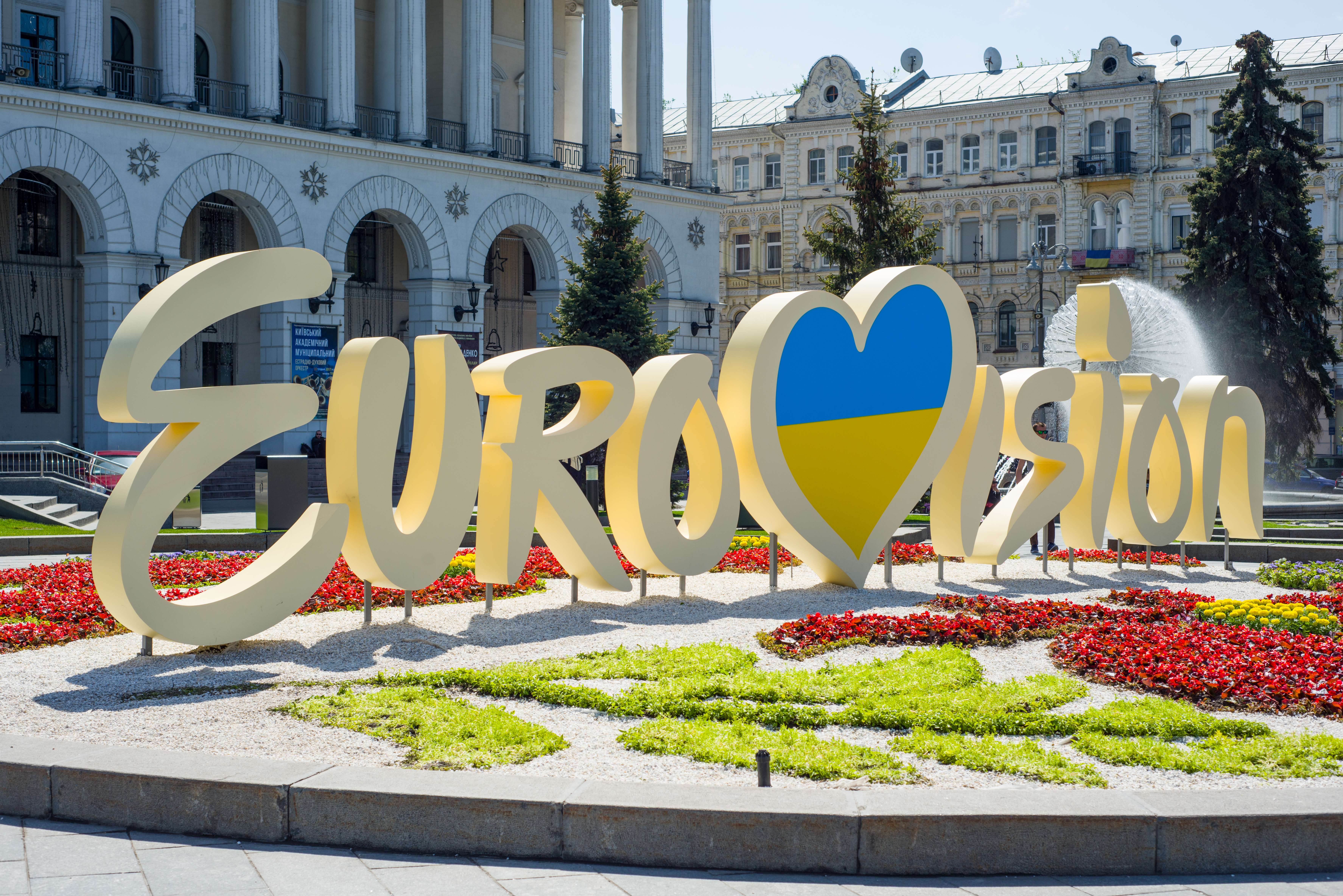
Almost every global brand faces a fundamental problem: how to stay recognizable everywhere (globally) while still feeling local somewhere. Coca-Cola adjusts flavors. IKEA tweaks not just its product lines but its showroom displays. Eurovision has to do this same sort of adaptation across dozens of languages, wildly different musical tastes, and a political landscape where “Europe” is a contested idea rather than a settled fact. For most of its history, Eurovision did not try. Each host broadcaster designed its own logo, its own visual world. The result was charming but chaotic—a different brand every year, held together more by shared memory than by visual consistency.[1] That changed in 2004, when the European Broadcasting Union (EBU) introduced its now-iconic heart logo, with the “V” of “Eurovision” transformed into a heart carrying the flag of the previous year’s winning country[2]. The heart provides continuity; the rotating flag provides novelty. For the first time, Eurovision looked like one continuous brand rather than a new product every year.
In August 2025, ahead of the 70th anniversary contest in Vienna, the EBU unveiled its most ambitious brand refresh yet. Developed by the Sheffield-based studio PALS, the new identity introduced a custom typeface called “Singing Sans,” a simplified logotype, and a graphic element called the “Chameleon Heart”—a three-dimensional heart composed of seventy layered surfaces, one for each year of the contest. The Chameleon Heart can absorb the colors of the previous year’s winning country, the aesthetic of a performer, or the mood of a campaign, while remaining unmistakably Eurovision. This is what brand strategists call a “living brand system”: an identity that is not fixed but adaptive, governed by rules flexible enough to accommodate diverse expressions without losing coherence. Think of Google’s ever-changing doodles, or MTV’s shape-shifting logo in the 1980s.
The metaphor is quietly revealing. A chameleon changes its appearance while preserving its underlying identity—precisely what Europe aspires to be. The EU’s motto is “United in diversity.” Eurovision’s is “United by Music.” The parallel is no accident. And the heart itself, operating at a level that bypasses language and precedes cultural translation, encodes that aspiration in a symbol nearly anyone on Earth can read.
Three Minutes to Brand a Nation
If the Eurovision masterbrand is the frame, the different countries’ entries—the songs and their performances—are the paintings inside it. Each performance—three minutes, before a television audience exceeding 160 million—functions as a concentrated act of nation branding.[3] No trade fair, no diplomatic reception, no advertising campaign offers comparable reach at comparable cost. And because participation requires substantial financial commitment, institutional capacity, and domestic support, entering Eurovision is what behavioral economists call a costly signal—which is precisely what makes presence or absence so legible.[4]
The choice of song, language, staging, and narrative arc all communicate how a country wants to be perceived. What is striking, from a consumer-behavior perspective, is which entries succeed. It is rarely those that try hardest to be generically “European”—polished, English-language, sonically safe. It is the entries that are most defiantly themselves. Finland’s Lordi—a heavy-metal band in monster costumes—won in 2006. Måneskin won for Italy in 2021 singing in Italian. Salvador Sobral won for Portugal in 2017 singing in Portuguese. Ukraine’s Kalush Orchestra won in 2022 with a blend of hip-hop and traditional folk, performed while their country was under bombardment. Differentiation, it turns out, is a competitive advantage. Eurovision, for all its excess, is brutally efficient at punishing inauthenticity. A skeptic might note that “be different” has itself become a kind of Eurovision orthodoxy—that non-conformity has been normed. But the winners just listed do not resemble one another. Finnish monster-metal, Portuguese balladry, Ukrainian folk-rap, Italian garage rock—these are not variations on a shared template. What they have in common is not a style but a stance: the confidence to be culturally specific rather than strategically palatable. That is harder to reverse-engineer than it looks.
The deeper pattern—that external pressure makes national expression more distinctive, not less—connects to my own research. In work with Sonal Pandya and Rajkumar Venkatesan, we have examined how consumers respond to brands with national associations when a nation faces threats.[5] We find that external threats—such as foreign military conflict—increase consumers’ attachment to nationally associated brands, because consuming those brands affirms a sense of identity. The psychology at Eurovision is remarkably similar. When countries perform under geopolitical pressure, their entries often become more culturally distinctive, not less. Jamala’s “1944,” which won for Ukraine in 2016 with a song about the deportation of the Crimean Tatars, was a refusal to dilute national character for the sake of mass palatability. The audience rewarded it.
The hosting privilege amplifies the nation-branding effect. Liverpool 2023 generated a net economic boost of £54.8 million and attracted over 300,000 additional visitors. Basel 2025 drew 500,000 visitors and produced 248 million Swiss francs in national revenue; 95 percent of surveyed out-of-region visitors said they would recommend the city. Vienna expects the advertising value of hosting the 2026 contest to reach approximately €730 million.[6] For a host city, Eurovision is a week-long brand activation—a live demonstration of organizational capacity and openness to the world. And for smaller or less familiar countries, Eurovision can be genuinely constitutive, creating a national brand rather than merely embellishing one.
Persuading through Ritual
What sets Eurovision apart from conventional branding is the extraordinary density of the sensory experience. Research in sensory marketing—my own area of work—has shown that engaging multiple senses simultaneously intensifies emotional responses, strengthens memory, and increases persuasion.[7]
A message that you hear and see and feel in your body is more powerful than one arriving through a single channel. Eurovision understands this intuitively. Each performance layers music and voice with immersive LED environments, pyrotechnics, choreography, and a roaring arena crowd whose energy is contagious through the screen. The effect is not additive but multiplicative—senses reinforcing one another to produce emotional immersion that no studio recording can match.
And Eurovision extends this sensory logic far beyond the broadcast. The contest has become a year-round digital ecosystem: in the first five months of 2025, Eurovision content accumulated 748 million TikTok views and 969 million Instagram views, while Eurovision songs achieved over 3,000 Apple Music chart placements in May alone.[8] Eurovision now lives on television, on social media, on streaming platforms, in fan communities, and in the host city’s public spaces—each channel reinforcing the others. The result is a form of emotional infrastructure: not a treaty, not a policy, but a repeated practice of being in the same room as other Europeans. The brand’s footprint vastly exceeds the three hours of its Grand Final.
But there is one design feature that I regard as perhaps the most consequential, and it has nothing to do with technology: you cannot vote for your own country. This single rule reshapes the entire psychological structure of the event. It forces every viewer to direct attention outward—toward another nation’s song, another nation’s performer. It turns the abstraction of “Europe” into a series of emotional micro-commitments: I liked their song; I voted for them; I cared about a result that was not mine. Most institutions that want European solidarity try to persuade through arguments. Eurovision persuades through a ritual. That is arguably the most effective instrument of soft European identity construction that exists—not because it asks people to think about being European, but because it asks them to feel it.
When the Promise Is Tested
A brand is, at its core, a promise. Eurovision’s promise, crystallized in “United by Music,” is that a shared cultural experience can hold a community together across differences. But brands are not judged by slogans; they are judged by the gap between what they claim and what they tolerate. Marketing scholars call this the “say-do gap.” When it widens, trust erodes.
In 2026, that gap became impossible to ignore. Five countries—Iceland, Ireland, the Netherlands, Spain, and Slovenia—withdrew from the Vienna contest, in the largest boycott since 1970. The trigger was Israel’s continued participation in the contest amid its military campaign in Gaza, which some broadcasters argued was incompatible with the values Eurovision claims to represent.[9] The 2024 winner, Nemo, returned their trophy to the EBU in protest. Ireland’s 1994 winner Charlie McGettigan announced his intention to do the same. When winners hand back—or pledge to hand back—trophies, the community that sustains the brand is turning against the institution that manages it. Russia’s expulsion after its invasion of Ukraine and Belarus’s suspension over press-freedom violations had shaped expectations of consistency; the decision not to apply similar logic to Israel created a perception of double standards that proved untenable for a segment of the coalition.
The EBU’s response has been classic brand protection: tighten voting rules, introduce safeguards against coordinated or fraudulent voting, bring back professional juries in the semifinals, and reaffirm the contest’s neutrality. It is the kind of procedural reform organizations deploy when legitimacy is perceived to be at stake. Whether it will be enough is not a question marketing can answer alone, because the controversy is not primarily about stagecraft. It is about belonging—who gets to remain inside Europe’s cultural space, and under what terms.
What the Brand Reveals
A brand is never just a logo or a tagline. It is a system of promises through which an organization tells the world—and itself—what it believes in. Eurovision’s brand tells us that Europe believes in the power of emotion over argument; that it values authenticity and rewards genuine expression over manufactured appeal; and that it has constructed, through seventy years of song contests, one of the most effective shared-identity mechanisms ever devised—one that works precisely because it disguises itself as entertainment.
But the brand also tells us something harder. The Chameleon Heart, with its seventy layers, is designed to absorb and adapt. Chameleons, however, cannot survive every environment. The community that Eurovision has built is real, but it is not unconditional. It depends on a shared sense that the rules about who belongs—and on what terms—are legitimate. When that legitimacy is contested, the music alone is not enough.
As I write this as an Italian, I find myself thinking about that living room in Cortina—the sequins and the voting and the inexplicable excitement of watching strangers from across a continent compete for a trophy. Eurovision worked on me before I had any vocabulary for why, starting with the opening bars of Charpentier’s Te Deum, the seventeenth-century fanfare that has served as the Eurovision anthem since 1954. If you grew up anywhere in Europe, you know the sound: it meant something continental and solemnly important was about to begin. That, in the end, is the mark of great marketing: it reaches you before you realize it has arrived. The question for Eurovision’s next seventy years is whether the institution behind the brand can live up to the feelings it creates.
Luca Cian is the Killgallon Ohio Art Professor of Marketing and Chair of the Marketing Area at the University of Virginia’s Darden School of Business. His research on visual persuasion, social identity, and consumer responses to artificial intelligence has been published in the Journal of Marketing Research, Journal of Marketing, Journal of Consumer Research, and Nature Communications, among other places. His work has received several awards, including the Society for Personality and Social Psychology Cialdini Prize for Outstanding Contributions to Field Research in Social Psychology (2025), the BSPA Publication Award for Innovation in Behavioral Policy (2024), and the American Marketing Association CB SIG Research in Practice Award (2021).
Notes
[1] On brand architecture, see David A. Aaker and Erich Joachimsthaler, Brand Leadership (New York: Free Press, 2000). On the distinction between “house of brands” and “branded house,” ch. 4–5.
[2] The heart carries the flag of the previous year’s winning country, not necessarily the host nation. This distinction became visible in 2023, since Ukraine won in 2022 but could not host due to the Russian invasion. Thus, the UK hosted on behalf of Ukraine, and the Ukrainian flag appeared inside the heart. In practice, the winner almost always hosts the following year, so the two typically coincide.
[3] EBU, Eurovision Song Contest 2025: Record-Breaking Reach, May 2025. The Grand Final reached 166 million viewers with a 47.7% share—the highest since 2004. Among 15–24-year-olds the share was 60.4%, nearly four times the channel average.
[4] Simon Anholt, Competitive Identity: The New Brand Management for Nations, Cities and Regions (New York: Palgrave Macmillan, 2007). For a Eurovision-specific study, see Paul Jordan, The Modern Fairy Tale: Nation Branding, National Identity and the Eurovision Song Contest in Estonia (Tartu: University of Tartu Press, 2014).
[5] Pandya, Sonal, Luca Cian, and Rajkumar Venkatesan. “Grocery shopping for America: mitigation strategies for threats to national identity.” Journal of Marketing Research 61.4 (2024): 760-777. We find that external threats increase consumers’ attachment to nationally associated brands through a self-enhancement mechanism.
[6] AMION Consulting, Economic Impact of Eurovision Song Contest in Liverpool, commissioned by Liverpool City Region Combined Authority, October 2023: £54.8 million net economic boost, 306,000 additional visitors. EBU sustainability report for Basel 2025: 248 million Swiss francs in national revenue; 95% of out-of-region visitors would recommend the city. EcoAustria estimates the advertising value of global media coverage for Vienna 2026 at approximately €730 million.
[7] Aradhna Krishna, Luca Cian, and Tatiana Sokolova, “The Power of Sensory Marketing in Advertising,” Current Opinion in Psychology 10 (2016): 142–147.
[8] EBU, “Vital Statistics: Eurovision 2025’s Record-Breaking Reach,” May 2025. TikTok and Instagram figures cover January 1–May 24, 2025. Apple Music chart placements (3,000+) are for May 2025. The official Spotify playlist became the platform’s most-streamed globally the day after the final. The Roblox experience attracted 1.2 million visits from 183 countries.
[9] On the relationship between ESC participation, EU membership, and human rights, see the companion article in this issue by Manuela Achilles and Peter Debaere.
