
By Catherine Baker
This is part of our Research in Focus feature on Eurovision: A Vision for Europe?
The LGBTQ+ politics of the Eurovision Song Contest are at a crossroads. Since the late 1990s, this annual competition organized by the European Broadcasting Union (EBU) for its member broadcasters—all public service media organizations—has built a unique reputation as a space where queer and gender non-conforming musicians can be symbolically affirmed as representatives of their respective nations in front of an audience of more than 160 million viewers. It has done so within the norms of impartiality that the EBU expects its members to uphold and within the contest’s rules aimed at guaranteeing it is a “non-political” event. In this article, I first briefly describe the increasing visibility of LGBTQ+ equality and queer culture in the Eurovision Song Contest, as symbolized in the win by bearded drag queen Conchita Wurst in 2014. I then explain the impact of Hamas’s 7 October 2023 terror attack against Israel on the contest’s most recent editions and how geopolitics may be changing the relationship between the competition and the LGBTQ+ community.
Beginnings and Upswing
The song contest has had LGBTQ+ fans for decades, and members of the LGBTQ+ community began openly competing in it during the late 1990s. Páll Óskar from Iceland became Eurovision’s first openly LGBTQ+ representative in 1997, and Dana International from Israel was the first trans participant and first winner from any LGBTQ+ background in 1998. Eurovision 2007’s winner and runner-up were both gender non-conforming acts from Central and Eastern Europe, at a time when LGBTQ+ rights in this region were a talking point in European integration processes: Marija Šerifović from Serbia (who had not then declared any sexual identity but later declared herself as lesbian) won, and the runner-up was Ukraine’s Verka Serduchka, a long-running cross-dressed comedy character international fans adopted as a drag queen. The bearded Austrian drag queen Conchita Wurst (“Conchita”), winner of Eurovision 2014, seemed to symbolize a triumphant narrative of “Europe” as a space of progress towards liberal inclusive values. She dedicated her win on stage to “everyone who believes in a future of peace and freedom.” Her words could have reflected both LGBTQ+ causes and broader social freedoms, in a geopolitical context in which Russia had introduced federal anti-LGBTQ+ laws and illegally occupied Crimea shortly prior.[1]
In the 2000s and early 2010s, every Eurovision act with LGBTQ+ or gender non-conforming subtexts was notable in itself—especially since most of these acts emanated from Central and Eastern Europe. Each edition of Eurovision after Conchita won the contest included multiple performances by contestants describing their identity in ways fans understood as queer, in addition to performances that expressed liberal empowerment narratives regardless of entrants’ own identities. These performances alluded to the transnational, Western, commercial queer culture circulated through phenomena such as RuPaul’s Drag Race, which was abstracted from its origins in the US’s grassroots queer and trans of color ballroom scene. Queer performers have appeared even more frequently after the contest returned in 2021 from its COVID-19 hiatus. Between 2012 and 2025, seven winners of Eurovision have been regarded by fans as queer, including Sweden’s Loreen, also the first woman to become a double Eurovision champion (in 2012 and 2023). Notably, it was after 2019 that five out of those seven winners participated in the contest, showing an acceleration of the trend.
At the same time, an increasing number of governments adopted anti-LGBTQ+ and anti-trans policies across the world, so that it was even more meaningful to queer viewers that after COVID-19 the contest’s organizers made it possible for performers to celebrate national identity and queer identities simultaneously through the use of flags and flag colors, which are generally part of the symbolic language of international competitions. For example, in 2021 all the gowns worn by Eurovision’s Dutch co-presenter Nikkie de Jager during the contest’s three live broadcasts featured the trans pride flag colors. In 2022, both Australia’s Sheldon Riley and Dutch singer S10 carried rainbow flags along with their national flags in the Grand Final’s opening flag parade, as did Icelandic trio Systur with their national flag and a large trans flag in support of trans youth. Italy’s Marco Mengoni in 2023 entered the flag parade tightly holding both the Italian and Progress pride flags, just as the Italian government was attacking LGBTQ+ family rights and successive UK governments had been undoing established policy on trans inclusion.
While anti-LGBTQ+—especially anti-trans—politics were indeed becoming threatening in many countries, even places where LGBTQ+ rights advances were thought to have been settled, that climate did not appear to affect Eurovision. Under EBU rules, every broadcaster competing in or transmitting Eurovision must broadcast it in full: that is, broadcasters are not allowed to redact any entries for their home audiences. It does not seem that broadcasters in states where anti-LGBTQ+ governments control public media have used Eurovision’s governance mechanisms to resist LGBTQ+ visibility or the broadcast of gender non-conformity during the contest. Instead, the broadcasters that have come to regard the contest’s LGBTQ+ visibility as too sensitive to broadcast simply left the contest. Reportedly, this is why Turkey’s broadcaster has stopped participating after 2012—officially claiming the decision was based on its dissatisfaction with Eurovision’s system of Grand Final qualification. Hungary’s broadcaster also withdrew after 2019, during state anti-LGBTQ+ clampdowns. However, Russia kept participating, despite Vladimir Putin’s efforts to place Russia at the center of a global anti-liberal ideological bloc that argued that LGBTQ+ rights were unwelcome “European” impositions on sovereign states.[2]
More general attacks on liberal values have also impacted Eurovision. In 2021, the broadcaster from Belarus, a country part of Putin’s anti-liberal bloc, was found to be complicit in state crackdowns against opposition protestors, which led to the EBU taking unprecedented action against it by suspending its membership. After Russia’s full-scale invasion of Ukraine in 2022, the EBU also suspended Russia’s broadcasters, which subsequently withdrew from the organization altogether. The ways in which the EBU managed the situation in Belarus and Russia in 2021–2 raised some fans’ expectations that the organization would start acting more assertively to defend international human rights norms. Indeed, these processes of exclusion meant that several broadcasters associated with prominent illiberal regimes ceased participating in Eurovision.
October 7 and Eurovision 2024
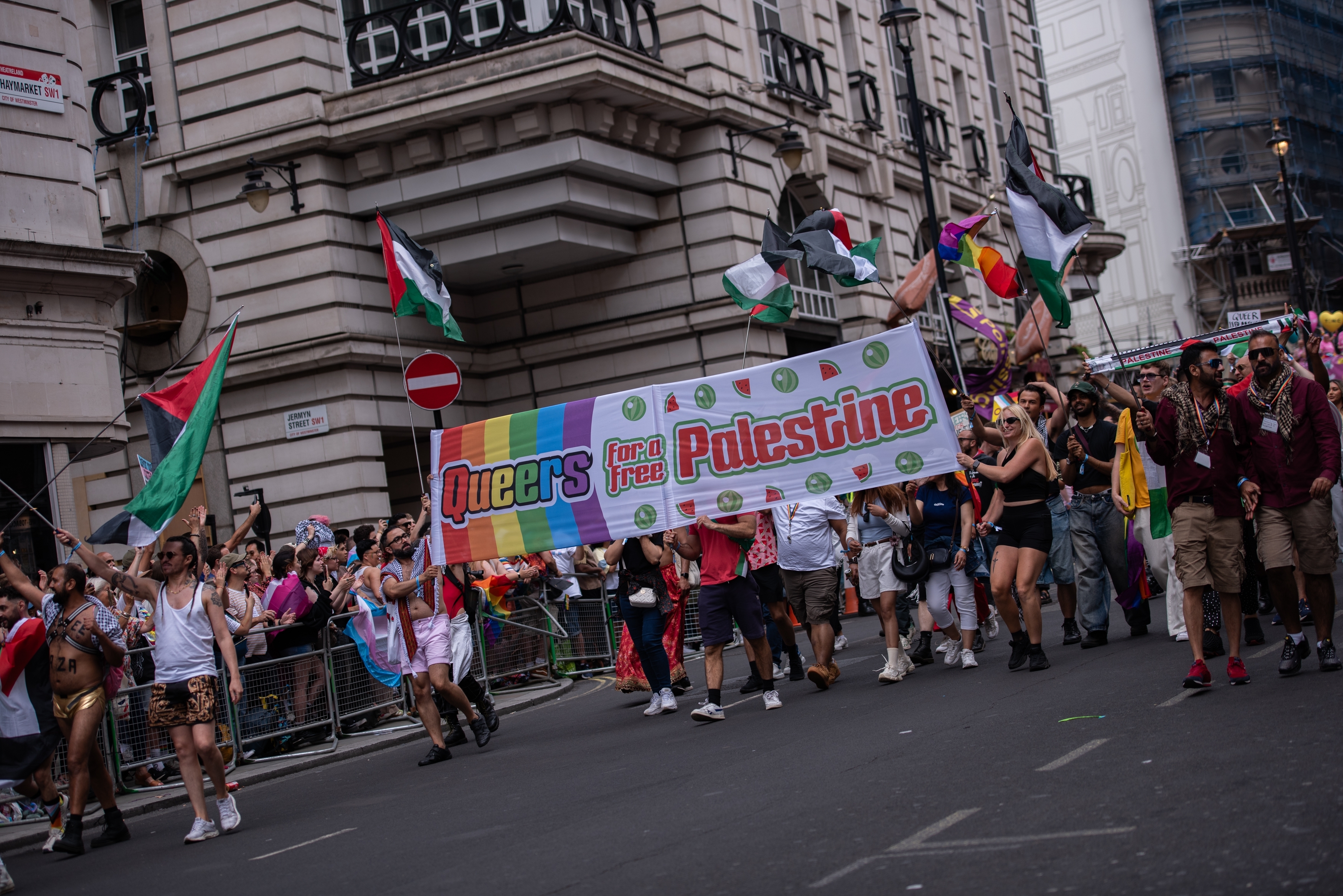
In the midst of Russia’s war on Ukraine, Eurovision 2023, hosted in Liverpool on Ukraine’s behalf, not only showed the continuation of the contest’s upswing of queer participation but also a fusion into a single, immersive, emotional atmosphere that blended support for LGBTQ+ causes and solidarity with Ukraine. The geopolitical narrative surrounding the contest enjoyed wide public consensus.[3] The many queer artists who entered national selections for Eurovision 2024 in summer 2023 likely believed they would encounter the same atmosphere. However, Hamas’s 7 October 2023 terror attack on Israel and Israel’s military response in Gaza, which destroyed the fabric of Palestinian social life, changed the context. Solidarity with Palestine had been an important cause in left-wing queer culture, so that entrants and fans sympathetic to Palestinians suddenly found Eurovision conflicting with their values in new ways.
Hence, the participation of Israel’s broadcaster in Eurovision reactivated the Boycott, Divestment and Sanctions’ (BDS) campaign against Eurovision. This campaign was founded in 2005 by a coalition of Palestinian civil society groups calling for international sanctions against Israel. The coalition has advocated for sanctions akin to those once in place against South Africa’s apartheid system and including an academic and cultural boycott. The BDS movement has maintained a priority target list to lead its action and expected international activists working in solidarity with Palestine to follow its strategy. Before 2024, it had only targeted Eurovision once, in 2019, when the contest was held in Israel. During that 2019 competition in Tel Aviv, the Icelandic band Hatari, whose artistic approach has affinities with queer kink practices, decided to cooperate with queer Palestinian creative workers in displaying Palestinian flags during the Grand Final voting.
Artists who entered national selection processes for Eurovision 2024 in summer 2023 would probably not have anticipated a boycott campaign against the 2024 contest, because BDS had never targeted a Eurovision contest held outside Israel before. But the Israeli military’s war in Gaza after the 7 October attacks changed this context. When BDS confirmed Eurovision was a boycott target in March 2024, the EBU was still negotiating with Israel’s broadcaster over its entry’s song lyrics that could have been construed to commemorate the 7 October attacks. By then, most broadcasters had already selected their respective songs and artists were committed to take part. The debated boycott campaign created an atmosphere that was drastically different from that of Eurovision 2023’s physical and digital spaces, and many fans experienced discomfort. Some had misgivings about how the EBU was managing the context of Israel’s war on Gaza, and others wished for a “business-as-usual” experience. Local residents who habitually wore keffiyehs and people from marginalized communities feared they would be subjected to discrimination in the city, owing to heavy police presence during the contest. And some Jewish residents and visitors were anxious about potential antisemitic treatment.[4]
In spite of the controversy, Eurovision 2024’s queer artists were among those most moved to express solidarity with Palestinians. These artists included Saba, self-described as “proud to be the first brown, queer woman to sing for Denmark”; the mixed Indigenous/white Australian duo Electric Fields and their backing ensemble; Portugal’s Iolanda; the established UK pop star Olly Alexander; Lithuania’s first openly LGBTQ+ entrant Silvester Belt; and the contest’s first two non-binary artists, Ireland’s Bambie Thug and Switzerland’s Nemo. Although he did not participate in Eurovision, it is worth mentioning Bashar Murad, who entered Iceland’s national competition (but lost in the final), in partnership with Hatari’s drummer, and is both queer and Palestinian. After October 7, he found himself under an international media spotlight. But he did not have to decide to withdraw, since he lost the selection. It is unclear what contractual consequences would have awaited any confirmed entrant withdrawing over Israel’s continued participation, since all 2024 contestants did travel to Malmö, even those who had misgivings about an Israeli entry being allowed to take part in the competition.
In Malmö, participants thus encountered a highly charged atmosphere. Many contentions involved backstage filming. Bambie, Nemo, Iolanda, Belt, and the alternative Greek musician Marina Satti, who had all expressed support for Palestinians, perceived that they were intrusively being filmed by members of the Israeli broadcaster’s delegation. The atmosphere backstage became more unsettled after an unrelated incident concerning the Dutch contestant, Joost Klein, surfaced. Klein was disqualified after the semi-final because he had struck a camerawoman’s equipment. Protocol prevented the EBU from giving full details of the incident, but rumors that Klein’s dismissal had been linked to his stance against Israel’s participation could not be easily quelled. In this volatile context, Eden Golan, Israel’s contestant, was confined to her hotel by her state’s security services and heavily booed during her performance, though the broadcast controversially muffled that booing.
In Malmö, Nemo (whose pronouns as a non-binary person are they/them) won the contest for Switzerland with a physically and vocally demanding song that used metaphors of breaking binary code to explain their own experience of non-binary gender. Whereas Conchita’s winning speech and triumphant voice in 2014 had suggested the contest was in the course of achieving its myth of inclusivity, Nemo gave a speech whose tone and delivery was much more tentative: “I hope this contest can live up to its promise and continue to stand for peace and dignity for every person.” Nemo went on to a press conference where a journalist asked them what they thought about security confiscating a spectator’s non-binary flag. Nemo replied that they had to smuggle in their own non-binary flag, adding (in reference to their trophy being accidentally broken on stage) that “maybe Eurovision needs a little bit of fixing too.” Bambie’s (they/them) message to journalists backstage was even more forthright, as they disagreed with how the EBU was managing the contest and expressed pride in their fellow artists pressing for change. Bambi described queer and non-binary contestants as “what the Eurovision [really] is.”
The highly-charged atmosphere participants encountered in Malmö led the EBU to launch a post-contest review, which resulted in a new artist code of conduct, a ban on filming in most backstage areas, and the appointment of a new event director overseeing the executive supervisor who was already in post. In October 2024, Martin Green was appointed in this new position by the EBU. He had been the British Broadcasting Corporation’s CEO for Liverpool 2023, suggesting the EBU viewed Eurovision 2023 as a success and that Green could address what had gone wrong in 2024.
Eurovision 2025 and 2026: Disagreements and Divestments
Dissent over Israel’s participation continued into Eurovision’s cycle after Malmö (2024). Some broadcasters expressed concerns that online advertising sponsored by the Israeli government encouraging pro-Israel internet users to vote for Golan, Israel’s contestant, might have enlarged her public vote score. No broadcaster withdrew, however, over these concerns. BDS continued its boycott campaign, and the 2025 Eurovision host, Basel, became the second successive city to witness larger than expected local anti-Israel protests. Fans who were uncomfortable about Israel’s continued participation but could not bring themselves to boycott the event altogether nevertheless found individualized ways of renegotiating or deprioritizing their relationship with the contest.
Queer scenes and friend groups no longer could assume that Eurovision was the automatic source of fun it had often represented for them in the post-Conchita years.[5] The EBU itself aggrieved many queer fans when it announced that artists would no longer be able to display pride flags or any non-national flags during the broadcast, preventing the simultaneous expression of queer and national identities that had cheered queer viewers since 2021. The EBU explained that this decision was about bringing Eurovision practice closer to the Olympics’ (much-disputed) approach to neutrality and impartiality. However, the increased pace at which policies targeting queer visibility and trans existence were emerging globally at the time made for an alarming context for the decision. In response, Nemo criticized both the policy targeting artists’ flags and Israel’s participation for being inconsistent with the contest’s long association with queerness, gay culture, and Eurovision’s claimed values of “peace, unity and human rights.”[6]
More than half a dozen queer artists still competed in Basel, including Croatia’s first openly LGBTQ+ representative, Marko Bošnjak, and the Austrian winner, JJ. The latter won the contest on the very last set of votes in a tense split-screen with Israel’s runner-up Yuval Raphael. Raphael, a survivor of the Nova Festival massacre perpetrated by Hamas, was heavily booed, and two protestors attempted to throw paint at her during her Grand Final performance.[7] Evidence published by the EBU’s own fact-checking service showed the Israeli Government Advertising Agency had purchased cross-platform Google advertising to encourage users to vote for Raphael as many times as the contest’s public voting system allowed (technically, each user can vote up to twenty times across all contestants, though most viewers in practice tend to vote for a few favorites only and do not use their twenty votes).[8] This issue escalated to become the contest’s most serious crisis since the mega-event started, with broadcasters from Slovenia, Spain, Ireland, Iceland, and the Netherlands being particularly critical of the EBU. In summer 2025, an EBU review revealed that its members still had not reached a consensus about Israel’s participation. Therefore, the matter was referred to the December 2025 EBU General Assembly for a two-stage decision: first, members would vote on contest voting reforms. Second, if the vote on voting reforms were inconclusive, there would then be a separate vote on Israel’s participation. Since the voting reforms passed, no separate vote on Israel’s participation occurred, leading the Slovenian, Spanish, Dutch, Irish, and Icelandic broadcasters to withdraw from Eurovision 2026.
The changing respective positions of Páll Óskar (Iceland) and Dana International (Israel) about Israel’s participation have been a symbol of the contest’s fractured politics among the LGBTQ+ contestants. While the two artists stood together in the late 1990s on LGBTQ+ issues, they came to be in opposition in 2025 over the Israel question, indicating that the LGBTQ+ Eurovision community is not politically monolithic. Indeed, when in 1997–8, Óskar became Eurovision’s first openly LGBTQ+ participant and Dana became Eurovision’s first known trans contestant and LGBTQ+ winner, both symbolized the same thing, i.e., LGBTQ+ people’s inclusion in their national communities. But in December 2025, they did not agree on Israel’s participation. As the first four broadcasters withdrew from Eurovision 2026, Dana condemned these broadcasters’ home countries on Instagram for making what she called “violent and insulting” announcements that rejected Israel from a contest it had participated in for more than fifty years. She suggested these withdrawals also implied a rejection of the only liberal country in the Middle East, a country that at the same time organizes Tel Aviv Pride and hosts holy sites relating to the three monotheistic religions.[9] Óskar, meanwhile, joined pro-boycott protestors outside the headquarters of Iceland’s public broadcaster Ríkisútvarpið (RÚV) as it deliberated whether to also withdraw, which it did.
Other figures who had symbolized Eurovision’s post-Conchita culture also stepped back. After RÚV’s withdrawal, Nemo (Switzerland) posted on Instagram that they would return their 2024 trophy to the EBU. For Nemo, the Eurovision values of “unity, inclusion and dignity for all,” which once made the contest so meaningful to them, were in conflict with Israel’s participation “during what the UN’s Independent International Commission of Inquiry [had] concluded to be a genocide.”[10] Their gesture inspired Ireland’s 1994 winner Charlie McGettigan, who had criticized Israel’s participation since at least 2018, to say he would too return his trophy—if he could just find it. The Austrian singer Teya, associated with the post-Conchita generation’s love of Eurovision, also posted on Instagram that she was stepping back from Eurovision. Conchita herself announced she too was withdrawing from future artistic involvement with the event (she had been a green room presenter for Eurovision 2015 in Vienna, appeared in interval entertainment during several other contests, and was expected to appear at Eurovision 2026).[11] These symbolic characters of the post-Conchita era all chose to divest from the event, even though they once loved it, in particular for its normalized celebration of both LGBTQ+ identity and nationhood.
An Uncertain Future
Critical frameworks for understanding Eurovision’s LGBTQ+ politics around Israel’s participation have revolved around “pinkwashing” and its associated concept “homonationalism” since Milija Gluhovic (2013) used these ideas in his work on Eurovision. Both concepts help better understand how the opposition to Israel’s participation and the LGBTQ+ agenda have come together at Eurovision. Pinkwashing refers to ways in which institutions and states promote apparent advances in liberal LGBTQ+ equality to deflect attention from human rights abuses. The concept emerged in 2010-11 from North American queer protesters accusing the Israeli state of officially promoting LGBTQ+ causes to improve its international image while covering up human rights abuses against Palestinians (including LGBTQ+ Palestinians). More generally, resistance to pinkwashing has become a major cause for queer political activism in the West. Connected to pinkwashing, homonationalism has been theorized by Jasbir Puar during the Global War on Terror. It refers to narratives that promote liberal states as civilized and progressive because of their apparent LGBTQ+ rights achievements. But it also demonizes certain communities, chiefly Muslims in the Middle East and the population of multicultural Western cities, as collectively homophobic.
By 2013, European queer of color critics such as Fatima El-Tayeb were using these ideas to explain racism towards migrant communities of color on queer scenes in western European cities.[12] Gluhovic’s discussion of LGBTQ+ rights discourses surrounding the contest in Azerbaijan (Baku 2012), Russia (Moscow 2009), and Serbia (Belgrade 2007), where human rights records had provoked debates about fans’ safety, introduced these ideas to the critical literature on Eurovision’s own cultures and narratives of liberal inclusion.[13] That literature has often extended the ideas of pinkwashing and homonationalism into the critique of simplistic narratives that assume that Eastern Europe, Russia, and Eurasia are “lagging behind” a West that is inherently progressive on LGBTQ+ rights. During the 2000s, these narratives often manifested around Eurovision’s gender non-conforming song entries, reaching a peak after Conchita’s win.[14]
Developments since 2023–4 have altered Eurovision’s LGBTQ+ politics, though it is too early to tell their long-term impact. Israel’s post-7 October entries, unlike those in the 2010s, which quite often alluded to gay tourism or alternative fashion, have not as of 2026 expressed any significant connections to queer cultures. This orientation could suggest that teams in charge of Israel’s representation at the contest have deprioritized appealing to LGBTQ+ audiences. Even if that remains the case, Israel’s LGBTQ+ rights record nevertheless remains available in liberal nationalist narratives supporting the country’s continued right to participate in the event. And many Israelis continue to regard this participation as symbolic proof of Israel’s acceptance within “Europe” and its community of values, including LGBTQ+ inclusivity.[15] In European countries where many might have viewed LGBTQ+ rights as settled a decade ago, meanwhile, the landscape of queer politics since the homonationalism debate began has been altered. This change owes to the campaigns organized to frame queer events as “political” or unsuitable for children, the stepping back of corporations from the sponsorship of pride events, and the attack on trans rights by government policies and the courts.
As of March 2026, Eurovision remains a boycott target. Viewers and fan media outlets are still re-evaluating their relationship to the event. Moreover, LGBTQ+ musicians who are considering participation must be aware that their public presence will be scrutinized for months from different and antagonistic political perspectives. The contest’s code of conduct implemented in 2025, which restricts participants’ political expression, has remained in place for the 2026 event. When Sweden’s artist Felicia expressed the view that Israel should not be allowed to participate, the EBU reminded her broadcaster of the rules.[16] Every edition of Eurovision puts great pressure on artists, attributing to them a quasi-ambassadorial role. They must take part in weeks of publicity and rehearsal leading to the event, then repeatedly deliver live performances on complex stages. In 2026, participants must confront all those usual pressures but in a particularly contentious political context.
How much these new factors affect LGBTQ+ musicians’ willingness to participate in Eurovision is unclear. There is no single answer to how many LGBTQ+ musicians are competing in Eurovision 2026, because not all LGBTQ+ persons state their identity for the public. Indeed, the liberal LGBTQ+ model that favors public claims about identity labels would not accommodate the many nuances of “queer in/visibility” in participating countries.[17] And some artists may only discuss their identities in public after this article is written. It currently seems, nevertheless, that fewer LGBTQ+ artists are competing in Vienna in 2026 than competed in Basel in 2025. Among the confirmed participants, Greece’s Akylas has identified himself as a queer artist, and Lithuania’s Lion Ceccah has already created gender non-conforming performances. Denmark’s Søren Torpegaard Lund is gay but has experienced some backlash from his home audience about his own performance’s camp aesthetics. Remarkably, for the first time since COVID-19, no self-identified queer women appear to be competing at the time of writing. None of these details about participation are conclusive enough to define a watershed in Eurovision’s queer politics, and stakeholders in Vienna are certainly expecting many LGBTQ+ tourists. Taken together, nevertheless, these elements suggest a change in emotional texture, a demarcation from 2014 when Eurovision affirmed Conchita as its winner.
Catherine Baker is Reader in Twentieth-Century History at the University of Hull. She specializes in the cultural history and politics of national, European, and LGBTQ+ identity-making in post-Cold War Europe, and the international politics of mega-events. She has written and edited nine books since 2010, including the forthcoming Performing Queer Nations: the Eurovision Song Contest Since 1990 (Manchester University Press).
Notes
[1] Catherine Baker, “The ‘gay Olympics’?: the Eurovision Song Contest and the politics of LGBT/European belonging,” European Journal of International Relations 23:1 (2017): 97–121.
[2] Emil Edenborg, “Russia’s spectacle of ‘traditional values’: rethinking the politics of visibility,” International Feminist Journal of Politics 22:1 (2020), 106–26.
[3] Catherine Baker, David Atkinson, Barbara Grabher, and Michael Howcroft, Culture, Place and Partnership: the Cultural Relations of Eurovision 2023 (British Council, 2024), https://www.britishcouncil.org/research-insight/eurovision2023 (accessed 11 March 2026)..
[4] Myrto Dagkouli-Kyriakoglou, Adriana de La Peña, Laleh Foroughanfar, Jennie Gustafsson, Lorena Melgaço and Chiara Valli, “Eurovision and the city: ‘United by Music’ meets ‘Malmö against Genocide’”, Urban Planning 10 (2025), https://doi.org/10.17645/up.9701 (accessed 10 June 2025).
[5] Zoë Jay, “’If it makes you happy, it can’t be that bad’: liberal enjoyment and complicity in popular culture,” Review of International Studies, https://doi.org/10.1017/S0260210526101788.
[6] Daniel Welsh, “Eurovision winner Nemo backs calls for Israel to be excluded from this year’s contest,” Huffington Post, 8 May 2025, https://www.huffingtonpost.co.uk/entry/eurovision-winner-nemo-backs-israel_uk_681ca2d0e4b00e22a29934ff (accessed 11 March 2026).
[7] Nadeem Badshah, “Eurovision crew member hit with paint amid bid to disrupt Israeli performance,: The Guardian, 17 May 2025, https://www.theguardian.com/tv-and-radio/2025/may/17/eurovision-crew-member-hit-with-paint-amid-bid-to-disrupt-israeli-performance (accessed 11 March 2026).
[8] Maria Flannery and Derek Bowler, “Israeli government agency paid for adverts targeting Eurovision Song Contest public vote,” Eurovision News: Spotlight, 19 May 2025, https://spotlight.ebu.ch/p/israeli-government-agency-paid-for (accessed 11 March 2026).
[9] @danainternational, “Good evening, the Netherlands, Spain, Ireland, and Slovenia,” 4 December 2025, https://www.instagram.com/reel/DR2zoQbjN44 (accessed 11 March 2026).
[10] @nemothings, “I will always be grateful to the Eurovision community…,” 11 December 2025, https://www.instagram.com/p/DSIMV83DO4d (accessed 11 March 2026).
[11] Conchita Wurst, Facebook, 13 January 2026, https://www.facebook.com/photo/?fbid=1431322468365750&set=pcb.1431322488365748 (accessed 11 March 2026).
[12] Fatima El-Tayeb, “‘Gays who cannot properly be gay’: queer Muslims in the neoliberal European city.” In Matt Cook and Jennifer V. Evans (eds), Queer Cities, Queer Cultures: Europe since 1945: 263–81 (Bloomsbury, 2014).
[13] Milija Gluhovic, “Sing for democracy: human rights and sexuality discourse in the Eurovision Song Contest.” In Karen Fricker and Milija Gluhovic (eds), Performing the ‘New’ Europe: Identities, Feelings, and Politics in the Eurovision Song Contest: 194–217 (Palgrave Macmillan, 2013).
[14] Baker, “The ‘gay Olympics’?”
[15] Daniel Mahla, “Distinguished member of the Euro(trash) family?: Israeli self-representation in the Eurovision Song Contest,” Israel Studies 27:2 (2022): 171–94.
[16] Anthony Granger, “Sweden: EBU contacts SVT and Felicia following singer’s comments on Israel,” Eurovoix, 10 March 2026, https://eurovoix.com/2026/03/10/%F0%9F%87%B8%F0%9F%87%AA-sweden-ebu-contacts-svt-felicia-following-singers-comments-on-israel/ (accessed 11 March 2026).
[17] Emil Edenborg, “Visibility in global queer politics,” in Michael J. Bosia, Sandra M. McEvoy and Momin Rahman (eds), The Oxford Handbook of Global LGBT and Sexual Diversity Politics (Oxford University Press, 2020), 348–63.
