
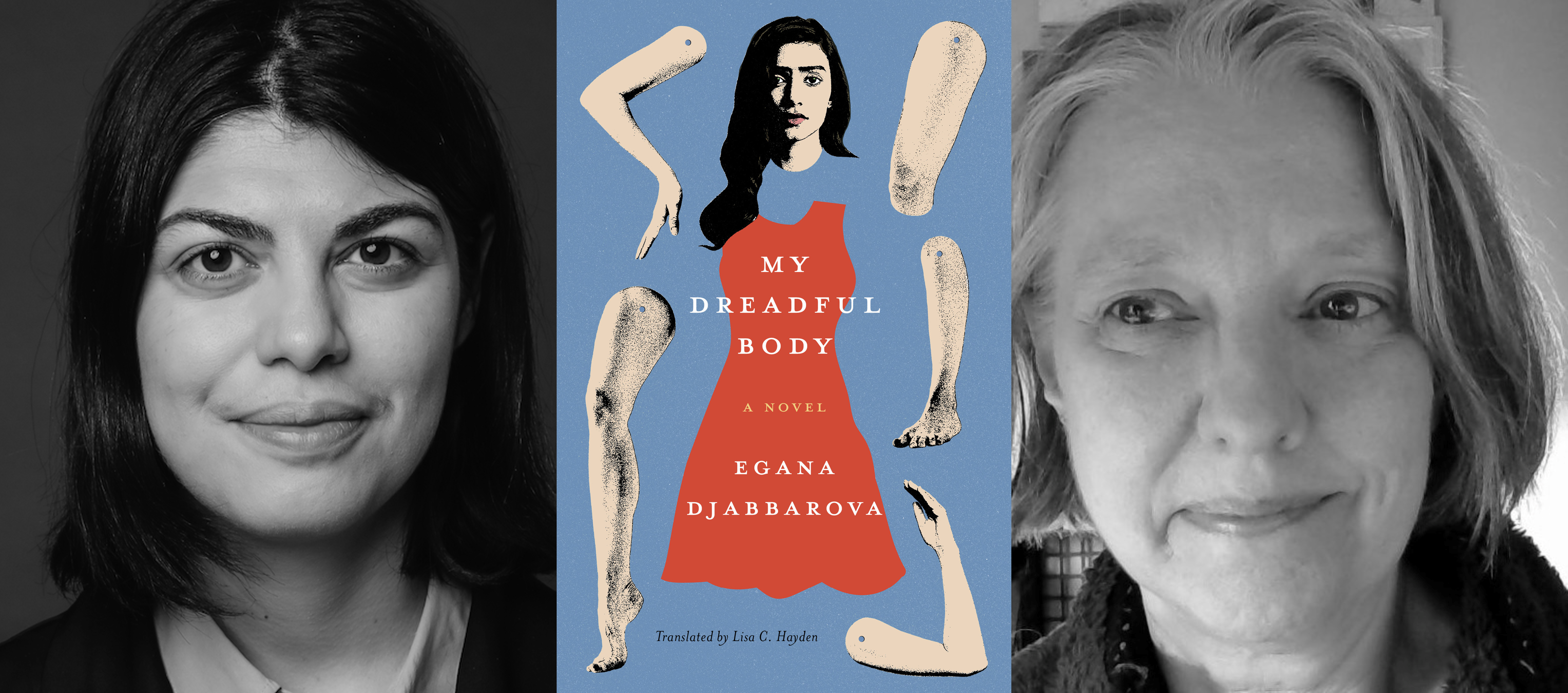
Translated from the Russian by Lisa C. Hayden.
All the popular girls in my class at school had blue or green eyes, so I quickly realized I was unlucky that my own eyes were brown. There was nothing interesting about them: they were as ordinary as tree bark, the top of a sturdy table, or a cleaning lady’s floor rag. Too many ugly and common things were brown. All my cousins and other relatives also had brown eyes. That’s nothing like a blue sky or roaring blue ocean or lovely green leaves or exciting green grass or fabulous blue rivers. Why was everything beautiful either blue or green? Why was there so little that was beautiful and brown?
It turned out that the Earth had been poisoned to its very core after the decaying bodies of former colonizers managed to pass on their standards to the world, whereby everything blue was beautiful but brown was hideous. So that even a little girl from a world where everyone else has brown eyes wanted blue eyes. Blue ones like some of the sultans’ wives or Turkish actresses had, probably after receiving the blueness from mothers, grandmothers, and great-grandmothers who were in the sultans’ harems or became trophies for the conquering Ottoman Empire. In my Baku cousins’ stuffy apartments, we watched beguiling Turkish videos: we saw the blue eyes of Turkish actresses or pop singers, sadly noting that our bloodlines had no such eyes. Since my sister and I didn’t speak Azerbaijani well and our cousins didn’t speak Russian, we had no common conversation topics, meaning all we could do together was look. We looked at objects, rooms, books, and the television screen. In essence, we wanted to rewrite the history of our bloodline so that distant blue-eyed beauties appeared in it after having been enslaved because of their attractiveness and atypical appearances. The ordeal of the violence that had occurred would thus turn us into something unusual, setting us apart from the crowd and placing us in the company of other beautiful girls. But why had beauty ended up being inseparable from violence? And why did one woman need to enslave another in order to become “the norm”?
At some point, I became utterly preoccupied with the idea of changing my eye color from brown. I was sad when I paged through photos in magazines where the actresses and models (of course) had blue eyes, and I was sad when I observed my blue-eyed classmates. I decided that I definitely had to transform my own eyes by growing up and buying the bluest contact lenses possible so my eyes would finally stop being brown. Even if they didn’t turn blue, I wanted them at least to look like my father’s eyes, which were honey brown with greenish flecks. My eyes stayed brown no matter how much I attempted to convince myself that they weren’t or tried applying makeup after choosing an essential shade of eyeshadow. One time, though, I suddenly burst into tears while sitting in front of a mirror. And when I looked at my reflection, I noticed that my eyes had become a bit lighter and taken on a honey tint along with green, like my father’s eye color, though mine was fainter, nearly unnoticeable. I finally calmed down: my eyes weren’t completely brown after all, and they did have a greenish tint, though the truth was that the change only appeared after many tears. My eyes only lightened during moments of despair, as if suffering were a bleach, the price to be paid for the “beautiful.”
Even a household’s göz monjuk—or, the eye of Satan, as some imams call it—was blue. It was an important attribute of any Azerbaijani home: a blue eye with a small black pupil in the middle. It hung over the entrance to prevent any member of the family from falling under the evil eye; children wore pins with little beads that looked like eyes, too. The eye of Satan also hung across from the entrance to small stores and local artists’ studios in Baku’s İçərişəhər, the Old City. I remember from early childhood that the scariest thing a stranger could do was cast the evil eye on someone, which is why all the women in my family knew several methods for protecting themselves and their loved ones. In addition to the little eyes, there was also uzerlik[1], a plant that made a house a home. As soon as the last guest closed the door behind them, my mother would take out a generous bunch of uzerlik and burn it in a special vessel. It’s so intoxicating, dense, and intriguing that I’ve never sensed a more pleasant and interesting smell in my whole life. There was no place safer in the entire world than a dense cloud of uzerlik: my mother would shroud you in smoke and intone, “Pis gozler partasin pis gozler kor olsun.”[2] My mother maintained that haters’ eyes burst each time a dry head of the uzerlik broke off. The evil eye explained nearly any unhappiness in a home and was to blame for any calamity that came about. It didn’t matter if eyes were blue or brown—the main thing was if they were kind or evil. And that they wanted beauty to be beautiful and health to be healthy.
We always returned to Russia from summer vacation with a multitude of little eyes, be they in bracelets on slender wrists or on safety pins and chains with beads. I enthusiastically put on blue bracelets, shrewdly thinking that they’d protect me if someone wished me ill. The little blue amulets helped me forget my own eye color and reminded me to always look instead into the eyes of others. Mama had brown eyes, as did my sister, my mother’s mother, my mother’s sister, and my girl cousins: everyone around me had brown eyes.
For me, though, it was my paternal grandmother who had the most mysterious eyes. Black-and-white photographs in albums and on a large gravestone didn’t convey the color of her eyes, something my father never spoke about. Of course it’s easy to guess that they were brown, just like all her children’s eyes. But something else was more important: they radiated kindness.
Egana Djabbarova, born in 1992 into an Azerbaijani family in Yekaterinburg, Russia, is a poet, essayist, and scholar. She is the author of several collections of poetry. Having been forced to flee Russia in 2024 because of her LGBTQ activism and opposition to the war in Ukraine, she lives in Hamburg, Germany.
Lisa C. Hayden is a literary translator who received her MA in Russian literature from the University of Pennsylvania. She spent six years in Moscow and lives in Maine.
[1] Узерлик, transliterated into Russian from the Azeri üzərlik, is the plant known in English as wild rue.
[2] “May the eyes of ill-wishers burst, may evil eyes go blind” (Azerbaijani).
This excerpt from MY DREADFUL BODY is published by permission of New Vessel Press. Copyright © 2025 Egana Djabbarova. Translation copyright © 2026 Lisa C. Hayden.
