
A Review of Motherland: A Feminist History of Modern Russia, from Revolution to Autocracy
By John Pickles
Writing Women
Motherland is a sweeping narrative of Soviet and modern Russian history told through the experiences of women ranging from revolutionary figures, Soviet soldiers, members of displaced Jewish families, late‑Soviet professionals, and activists such as Pussy Riot members and Yulia Navalnaya. The narrative is structured by and through vignettes and experiences of the author’s family. In 1990, Julia Ioffe left the USSR with her family as a seven-year-old. She returned in 2009 as a journalist and Fulbright scholar to a rapidly changing Russia. The Soviet women in her family had been doctors, engineers, researchers, or educators, encouraged by the early Bolshevik feminists who opened public and private spaces to them. But the Russia Ioffe returned to was one in which women’s roles had become quite different and were rapidly being shaped by conservative values and the increasingly tight relationship between a conservative Church and an oligarchic president.
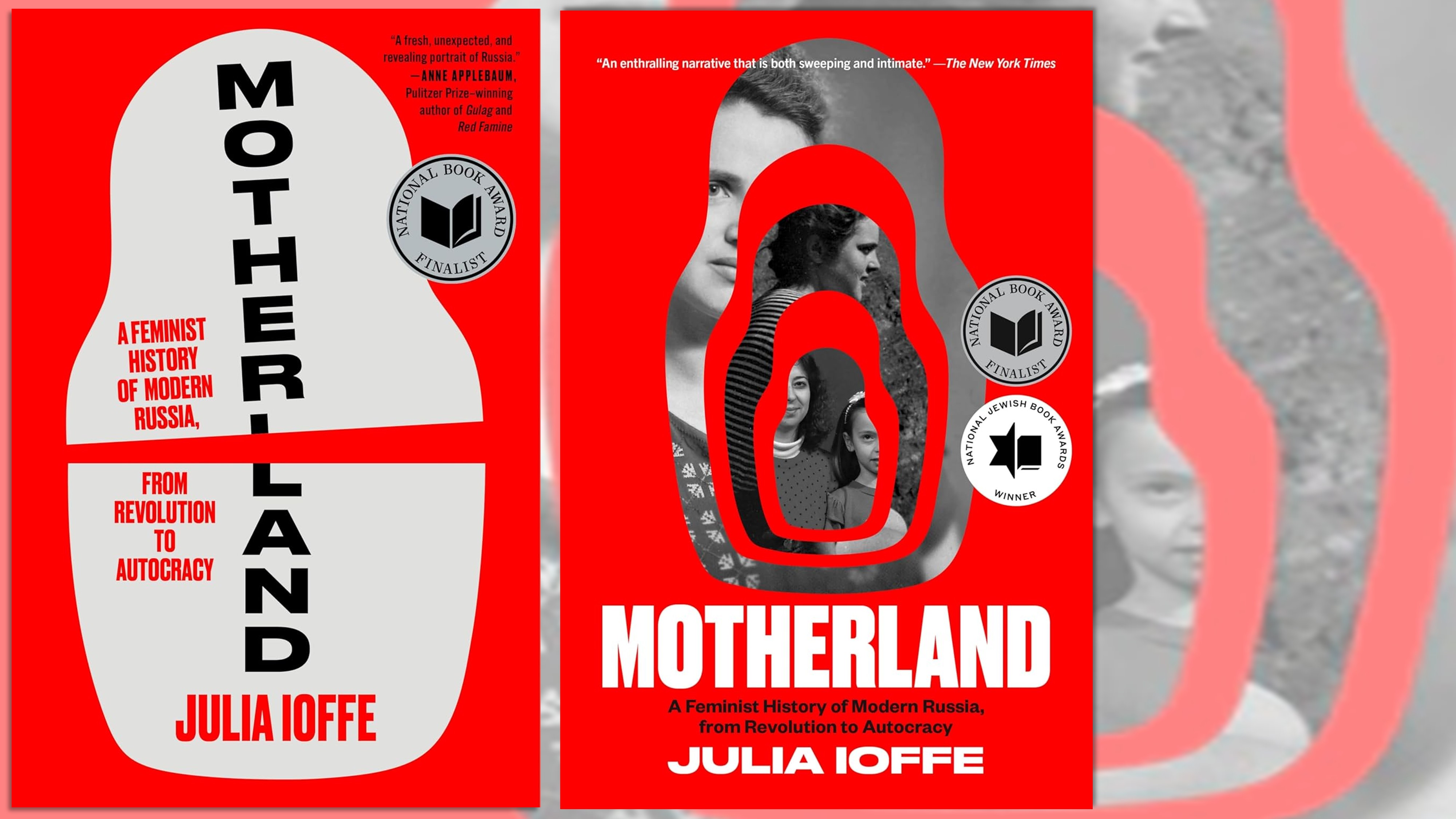
Ioffe’s goal in Motherland is to turn “modern Russian history on its head” by centering women’s stories rather than treating them as add‑ons to the biographies of male leaders. She starts symbolically with clever covers for the hardback and 2026 paperback versions of the book. The first represents a tantalizing cracked open Russian mamushka doll about to reveal the many layers of women within, and the second shows images of some of those women in the layered dolls. In the book, Vladimir Lenin, Joseph Stalin, Nikita Khrushchev, and Vladimir Putin appear, but often through the lives of their wives, lovers, daughters, and other women caught up in or reacting to their projects and pathologies. In this way, Ioffe produces a rich genealogy of the Soviet and Russian twentieth century in which reproductive politics, everyday survival, and domestic arrangements are placed alongside the changing scope of professional roles women played in Soviet society. Throughout, the reader encounters a collage of stories about known historical actors and the women in their lives interwoven with the life stories of Ioffe’s own great‑grandmothers and other family members. The result is at the same time memoir, social history, and political reportage, with the roles and experiences of women functioning as the main analytical lens through which to understand the USSR’s and Russia’s passage from revolutionary utopia to a place where women’s gains were closed down under Stalinism and late socialism, and finally the setting for post‑Soviet capitalism and Putin’s authoritarianism.
Ioffe’s central argument is that the Soviet “great experiment” promised—and in part enacted—unprecedented emancipation for women, including through legal equality, paid work, socialized domestic labor, access to health care, the removal of church marriage as a constraint in favor of civil ceremonies and the ability to divorce, and sexual freedom. But in practice this promise also loaded women with a ”double burden,” a theme the author develops throughout the book. After detailing the tremendous gains women created in their rights, roles, and opportunities during the early revolutionary period, Ioffe shows that the 1930s saw the re-marginalization and re-scripting of women as mothers and workers. By reconstructing both famous and ordinary women’s lives, she contends that contemporary Russian politics cannot be understood without grasping the complex flow of promises, gains, compromises, betrayals, and differential opportunities women experienced.
The book is organized mainly chronologically in three parts, each anchored in constellations of women embodying larger historical conjunctures, although these are not directly characterized. The three parts roughly cover revolutionary vanguards and early Soviet feminism; war, sacrifice, and the postwar “double burden”; and post‑Soviet capitalism, activism, and Putin’s oligarchy.
Revolutionary Vanguards and Early Soviet Feminism
Ioffe begins with the struggle over Russia and the building of the USSR as a site for one of the “most audacious social experiments in history” in which the liberation of women was a central, not a marginal, goal. Early reforms in family law, reproductive rights, and education created unprecedented upward mobility and autonomy for early Soviet women, but these gains were constrained by patriarchal party structures and the demands of industrialization, war, and demographic recovery. The author recounts a socialist modernity in which official expansion of forms of gender equality and social rights coexisted with entrenched gender hierarchies.
The opening chapters trace late‑imperial radicalism and the early Bolshevik period through figures such as Alexandra Kollontai, Lenin’s lover and a leading feminist theorist of the “new woman.” Kollontai advocated a socialism in which women would be economically independent, freed from patriarchal family constraints, and sexually autonomous, insisting that work and collective responsibility mattered more than romantic possession—ideas she was able to put into practice as the People’s Commissar for Social Welfare in the first Soviet Government after the October Revolution. Ioffe explores how Kollontai—in that role—guided the Bolshevik state under Lenin to initially advance progressive family and reproductive policies, including through liberal divorce law, access to abortion, and experiments in the social provision of childcare, public health, orphan care, and support for the war-disabled. The extending of rights and opportunities to women was particularly important in a revolutionary state in which resistance from White Russians and rural autonomy over food production inhibited economic development. Ioffe juxtaposes this avant‑garde vision with the lives and careers of her own great‑grandmothers and their drive to become educated, professional Soviet women.
Even Stalin is shown to have supported pro-women policies in his first years in office; but by the early to mid-1930s this began to change. With his growing consolidation of power and the expansion of the “Terror” in 1936, women’s rights and opportunities were subordinated to party priorities and changing demographic imperatives. Ioffe sees in these shifts the foundations of a specifically Soviet form of gendered citizenship: women as heroic workers and mothers. But here the title Motherland takes on a more sinister meaning, specifically in the form of the notorious chief of secret police, Lavrentiy Beria, who is fleshed out to embody how Stalinist power inscribed itself violently on women’s bodies and transformed even their everyday sense of belonging in the city.
Ioffe’s grandmother Emma remembered “the pale blue house” on the Garden Ring near the Kremlin, which became notorious as the place where security chief Berea carried out his vile practices of abusing young women, whether he took them randomly from the street or arranged for their abduction for days or longer. By focusing on “the pale blue house”—his Moscow residence—Ioffe charts a childhood geography of fear in which girls and their mothers literally walked the long way around because “everyone knew” what happened in “that house.” The house became a spatial symbol of gendered terror in an ordinary urban landscape that quietly organized how women moved, what routes they took, and what dangers they faced under the retrenchment of powerful and violent masculinist administrators. In a particularly compelling section, Ioffe reconstructs Berea’s pattern of abducting young women and girls, taking them into the house, drugging and repeatedly raping them, then sending them home in a chauffeured car, always assisted by his chauffeur and bodyguard, Colonel Rafael Sarkisov, and his sometimes procurer Sardion Nadaraia. Ioffe foregrounds the story of Valentina (Lyalya) Drozhdova, taken at 16-17 while out buying bread; she was held and raped for days, impregnated by Beria, and later forced to return under threats that her mother would be sent to the Gulag. Berea is not the only example of perversion and violence in the Soviet administration, but—as Ioffe makes clear—his activities were widely known in Moscow. Victims tried to complain but, as Berea was head of the security police, complaints always landed on his desk. His fellow Comintern members knew of his behavior but chose to ignore it, seeing it as part of the more general state terror he oversaw and implemented. Moreover, these acts were not far removed from some of their own affairs, abuse of power, and capture and abandonment of wartime field-wives.
By placing Beria’s abuse alongside Kollontai’s utopian feminism, wartime sacrifices, and postwar family law, Ioffe reads Stalinism as a crucial moment in which promises of women’s emancipation were hollowed out and a culture of female fear and male unaccountability was normalized instead. Beria is not just a monstrous individual; he is a prism through which to see how a putatively egalitarian socialist project could still rely on and reproduce intensely gendered violence.
War, Sacrifice, and the Postwar “Double Burden“
In part, Stalin’s continued support for expanded roles for women depended on the needs of war. The Soviet Union’s entry into the Second World War resulted in an immense outpouring of female as well as male patriotic response, with large-scale female enrolment in the military. Many expected to fight at the front and some did—or they were deployed behind the lines serving as medics and support staff. Ioffe highlights those born after 1917 as the “first Soviet generation,” who as teenagers earned state‑sponsored parachuting, sniper, or aviation certificates and then flooded recruiting offices after June 1941, with in particular nearly a million Soviet women serving in the armed forces as snipers, pilots, tank crew, machine‑gunners, and medics—no longer restricted to serving as nurses in the rear. One figure emblematic of this cohort was a Jewish paratrooper, Ida Segal, who at 18 fought in some of the war’s most brutal battles at Stalingrad and Kursk. Stalin seized on such women’s performance: he used top female snipers who outperformed men as propaganda symbols, even sending one ace sniper on a tour of Britain to raise funds for the Soviet war effort.
Alongside women in combatant roles, Ioffe foregrounds the many female medics and doctors trained when education opportunities and institutions first opened to women. In the war, they actively cared for the wounded from the battlefield or staffed hospitals depleted of male doctors. Ioffe illustrates their shifting double-burden, even under wartime conditions, through the story of her great‑grandmother—a pediatrician—seconded to a military hospital while still responsible for caring for her children and household. All the while, news of family members who lived in the shtetls of eastern Poland and Ukraine generally meant reports of whole village and family deaths, as German forces pushed east.
Nearly 27 million Soviet citizens died in the Second World War, leaving a society where men were starkly outnumbered and vast regions were depopulated. This demographic catastrophe appears in the book through “millions of single mothers who rebuilt and repopulated a devastated country,” raising children alone while working full time and coping with housing shortages, queues, and trauma. Ioffe highlights how they were celebrated as heroine citizen-workers defending communism but were quickly pushed back into conventional maternal roles after 1945, as the structural demands to expand the population sought to address the crisis of war deaths and casualties. Stalin taxed the childless, made abortion illegal for long stretches, and treated women’s bodies as the main instrument for demographic recovery, turning bereaved wives and widows into what Ioffe calls the “reproductive shock troops” of reconstruction.
Encouragement for millions of single and married women to have more children further contributed to the normalization of their “double shift” of factory or office work followed by unpaid—and increasingly under-supported—domestic labor. Despite formal legal equality, women bore disproportionate responsibility for social reproduction, which the state instrumentalized for demographic and ideological ends. In the process, men’s roles in the family also changed, as they increasingly separated themselves from the daily tasks of childcare and housework, creating the stereotypes of what we might call the helicopter father and the layabout, often drunk, husband. Changes such as access to contraception, marital norms, and the place of female professionals in late‑Soviet society are vividly illustrated in the book through intimate family stories alongside more public biographies.
After the war, ideological commitments to women’s liberation were quickly and relatively easily instrumentalized or reversed in response to other state priorities. With the death of Stalin, the removal of Berea, and Khrushchev’s ascension to power (1953-1964), policy concerning women’s work and family life shifted. Ioffe explores the limited openings for women’s speech and mobility through the roles and experiences of Khrushchev’s “First Lady” and other women of the nomenklatura class. In this period, the question of women’s labor became ever more central, but women’s double burden deepened as state policies narrowed gender roles and women’s sexual and social rights. Khrushchev expanded pronatalist policies and tied women’s civic worth to reproduction through a tiered tax system: the more children women had, the lower their tax burden, and medals were awarded to those giving birth many times, the “Hero Mother” having ten or more children. He attacked women’s control over their own fertility and reduced men’s liability by criminalizing unlicensed contraception manufacture and lengthening prison terms for abortion providers. He decreed that only children born of couples whose marriage was registered counted as “legitimate” and that unmarried women giving birth could neither name the father nor compel him to support the newborn. The “very idea of fatherhood began to dissolve,” while parenting became synonymous with motherhood.
Ioffe reads the shift from Khrushchev to Leonid Brezhnev (1964-1982) as a change in the texture of women’s lives: under Khrushchev, women faced an actively interventionist, often moralizing family policy, while the Brezhnev era generated a “stagnation” in which women’s burdens hardened into a taken‑for‑granted routine. Under Khrushchev, formal de‑Stalinization brought with it highly conservative, patriarchal family policies that legally “[let] men off the hook” and cast women as primary reproducers and carers. Under Brezhnev, that settlement was not dramatically reformed, but women’s lives were further reshaped as petty corruption and informal networks became more common, adding to their uncertainty and daily burdens. As the state emphasized heavy industry over consumer goods, the economy of shortage deepened and women’s daily time-budgets were increasingly being taken up in queuing, bartering, “making do,” and trading unwanted goods they bought in shops for other needed commodities. The Bolshevik feminist experiment unwound, not only through spectacular terror (under Stalin and Beria) but also through these quieter, bureaucratic stagnating arrangements that made women’s superior burden seem normal. The post-Brezhnev period was one of fragmentation in politics and deep uncertainty in economic and social life. Women’s lives at the end of the Brezhnev/Andropov/Chernenko period collided with the 1990s cultural liberalization, “shock” economy, and increasingly unregulated mafia-style economy.
With the break-up of the Soviet Union at the end of December 1991, Gorbachev’s perestroika transformed Russian society in a variety of ways. By focusing on Raisa Gorbacheva, Gorbachev’s wife, Ioffe points to the publicly engaging and politically meaningful role she played in humanizing perestroika at home and the face of Russia abroad (in strong contrast with the wives of former party leaders). Perestroika had other effects too. While liberalizing social mores and opening demonstrative spaces, it also adopted features from Western models of economic transition and shock therapy that produced their own forms of disruption to Russia’s economic and gendered life‑worlds. The emerging market economy created professional uncertainties, family breakdowns, and new forms of opportunity and vulnerability. Ioffe suggests that the erosion of social supports and the explosion of inequality in the 1990s weighed heavily on women, particularly as welfare provisions and workplace guarantees were reduced or withdrawn. For Ioffe, perestroika was less about Gorbachev as a reformer and more about how his reforms reconfigured the everyday calculations of women. These took several forms.
Under Brezhnev, women’s jobs were often boring, underpaid, but relatively predictable. Perestroika destabilized that predictability. Factories and research institutes where women often had well-established, long careers began shortening hours, delaying wages, or—in time—closing. Female engineers, doctors, or mid‑level professionals found that their salaries no longer covered basic needs, or that their jobs were “restructured” out from under them. Economic reform hit household budgets first, and because women already managed most budgets, they were the ones who had to improvise most. Inflation and shortages meant that a woman who once queued and bartered within a known system now had to juggle cash in multiple (rapidly devaluing) currencies, secure food in new private kiosks, navigate emerging black and gray markets, and decide which bills to skip. Some turned increasingly to their “shortage economy” adaptations, selling goods from home, sewing, baking, tutoring, even expanding these activities into quasi‑businesses. Others became shuttle traders, spending days on trains or buses to Poland, Turkey, or the Caucasus to buy goods that could be resold in street markets. Ioffe describes one woman who, trained as an engineer or doctor, suddenly found her salary worthless and her workplace collapsing, forcing her to turn to shuttle trading (chelnoki) or small‑scale commerce, dragging bags of goods across borders to keep her family afloat. The rhythms of work became physically more challenging and irregular, while household incomes experienced heightened risk. In this and other vignettes of women’s daily lives, perestroika and its aftermath appear less as a source of “freedom” and more as a way to informalize responsibility: the state retreated, and women became the welfare system of last resort.
Particularly in provincial towns, women faced a triple bind: collapsing social services, unpaid or delayed wages, and an emerging culture in which male unemployment dovetailed with rising alcoholism and domestic violence. As their options were eroded by plant closures, unpaid wages, and gutted social supports, women migrated internally—from poorer regions to Moscow or St. Petersburg—to work as nannies, cleaners, or live‑in carers, often leaving their own children behind in the care of grandparents. Maternal sacrifice, already normalized under late communism, was reconfigured around market logics and deepening regional inequalities.
Ioffe is careful to show that some women did gain real opportunities, especially urban, educated, business, or professional women. A woman from Leningrad or Moscow with good education and second language skills might pivot into jobs in foreign‑funded NGOs, Western companies, journalism, or “cultural mediation” (translating, organizing conferences, or working for new independent media). Friendships, travel, and professional identities that would have been impossible under Brezhnev became possible. Yet the gains were fragile: jobs were uncertain, legal protections were thin, and advancement was still constrained by masculine networks in politics and business.
In addition to constraining this work, wage, and professional development, perestroika destabilized old moral codes without putting in place the kinds of robust protections or feminist norms that had emerged after the Revolution with Kollontai and Lenin. The loosening of censorship and social control certainly expanded some opportunities for women’s intimate life, and some women found greater space to choose partners, leave bad marriages, or talk openly about abuse and harassment. But the rapid expansion of pornography, commercial sex, and sexualized advertising industries also treated women as sexual commodities. Ioffe again focuses on the street to trace how young women’s experience changed during that time. For a woman, walking down a Moscow street meant more catcalls and transactional propositions and an increased sense that her body had become a resource in a newly money‑saturated culture.
Post‑Soviet Capitalism, Activism, and Putin’s Oligarchy
For Ioffe, three generations of Soviet women had “carried this fairy‑tale country on their backs,” rebuilding and repopulating it after wars and purges, so that the 1990s arrived already weighted by expectation, exhaustion, and disillusion. The breakup of the USSR brought economic chaos, welfare retrenchment, and demographic crisis; women shouldered childrearing and care with less state support, while many men exited through early death, alcoholism, or marginalization, deepening the pattern of institutionalized male irresponsibility she traces to late‑Soviet family policy. In that landscape, Putin initially appeared to many women not as an obvious authoritarian but as “the man they never had”: sober, controlled, physically vigorous, and promising order and salaries paid on time after a decade of male fecklessness.
In Ioffe’s reading, the breakup of the USSR created the social and psychic terrain for Putin’s hyper‑masculine regime to grow and, in turn, rollback Soviet‑style gender emancipation into a new, state‑sponsored patriarchy in which “motherland” literally did mean Khruschev’s “land of mothers.” Putin’s own public image of virility, fostered through the display of his prowess in judo and hunting, and even of his learning to skate to play ice-hockey, together with his shirtless photo‑ops, made—for many—his personal chauvinism part of the regime’s appeal. In turn, he enrolled state media and official discourse to promote a gender script in which an ideal Russian woman is patriotic, self‑sacrificing, modest, primarily oriented to marriage and children, and supportive of male authority in both family and state.
While the USSR advertised itself as being on the vanguard of world feminism, Putin’s Russia has been rebranding as the last bastion of conservative Christian values. Federal and regional authorities tightened access to abortion (through gestational limits, “cooling‑off” periods, and pressure on clinics), often in partnership with Orthodox groups and American evangelicals, while loudly celebrating large families and “hero mothers” who received national awards for bearing ten or more children. Soviet cults of the “hero mother,” Orthodox moralism, and Western right‑wing family rhetoric are being increasingly folded into state ideology.
These practices have occurred in part through the courts. Ioffe highlights the 2017 de‑criminalization of many forms of first‑time domestic assault (reclassifying them as civil offenses with much lighter penalties than criminal offenses). In one example, Ioffe details the case of Margarita Gracheva. Her husband—convinced Margarita was having an affair with a work colleague—became ever more suspicious and violent towards her, finally leading him to cut off both her hands while using tourniquets to ensure she would survive, before turning himself into the police confident in the fact that the legal system would be more lenient if she lived and he cooperated. Indeed, he did receive a very lenient sentence for “domestic abuse.” Gracheva recovered and grew into a public figure, whose stoicism Ioffe describes brilliantly.
Here we encounter the explicit ideological framing of Russia as a form of historically developing anti‑feminist society borrowing from, and contributing to, global right‑wing networks (church, anti‑abortion NGOs, etc.). Ioffe situates the 2013 “gay propaganda” law and its later extensions within the same gender counter‑revolution: the state defines the heterosexual, reproductive family as a frontline institution of national defense and punishes those who challenge it. Feminists and queer activists—Pussy Riot, women’s crisis‑center workers, LGBTQ+ advocates—have become key targets, facing surveillance, prosecution, and smear campaigns as enemies of “traditional values.” And here Ioffe turns to Pussy Riot and Yulia Navalnaya as her key late‑Putin figures to show how women are instrumentalized by his “traditional values” regime but are also challenging it.
She recounts the emergence of Pussy Riot and the group’s 2012 “punk prayer” in Moscow’s Cathedral of Christ the Savior as one of several demonstrations that were seen as a direct attack on the new church–state alliance: Pussy Riot members denounced Patriarch Kirill and Putin for turning Orthodoxy into a prop for male, authoritarian power and for condemning feminism and LGBTQ+ rights as “Western perversions.” These are not fringe shock artists, although some of them have adopted shock practices. The core of the group comprises political analysts in their own right: they named the way Putin has shifted Russia from a self‑proclaimed vanguard of world feminism to a self‑proclaimed bastion of conservative Christian family values, with women redefined as obedient mothers and—with the Chechen war and Ukrainian invasion—supporters and reproducers of soldiers. For Ioffe, the long arc is one in which three generations of Soviet women rebuilt and repopulated the country while men “repeatedly laid waste to it.” Putin’s war in Ukraine extends that pattern: massive male casualties followed by renewed pressure on women to produce more children. For Ioffe, Pussy Riot’s arrests and harsh sentences were emblematic of how the regime treats women it sees as troublesome: criminalizing not just opposition, but specifically feminist and queer‑coded opposition that refuses the state’s gender script.
Motherland closes poignantly with Yulia Navalnaya and Alexei Navalny’s story. An economist with a traditional public role as wife at her husband’s side, Navalnaya had to endure Navalny’s poisoning, jailing, and ultimately killing with a public face. After her husband’s death, she stepped into a more openly political role abroad and became the most recent case in a long line of women forced into political centrality and exile by men’s imprisonment or death.
Complicity and Resistance in Women’s Lives
In her fascinating long arc from Kollontai to Pussy Riot and Navalnaya, Ioffe leaves the reader with a Russia where women remain indispensable to both power and resistance, but where the state has rebuilt a powerful machinery of “traditional” expectations, legal rollbacks, and real and symbolic controls meant to keep women’s emancipation partial and precarious.
Throughout, Ioffe weaves her family’s biographies into a captivating reading of social and political history of Soviet and Russian women. Her family serves as a recurring encounter that grounds macro‑historical transformations in specific life trajectories—physician great‑grandmother, Soviet soldier, migrant, caregiver and child-raiser, refugee, and returnee. Reviewers have noted that this personal family history makes complex historical developments accessible and emotionally powerful, particularly around topics such as birth control, sexual norms, and the lived experience triggered by reproductive policies. At the same time, the density of personal and historical characters can make the narrative demanding, especially with the inter-changing uses of Russian full names, patronyms, and diminutives, a challenge also for any reader of Dostoyevsky or Tolstoy! But there is a deeper sense here of family history. Throughout, Ioffe interweaves the experiences of family members she has known or can trace in family photos and letters with the experiences of a wider community of family and neighbors in the shtetl communities across the Pale of Settlement. Stretching across the western part of the Russian Empire and including present-day Ukraine, Belarus, Lithuania, Moldova, and parts of Poland, these are also stories of those who did not live to create their own family histories—a poignant telling of the broader soviet-era Jewish story. The Pale of Settlement is not presented as mere background, or where pogroms took place, but as a nexus of pogrom survival, migration, re-connection, and eventually emigration for some and a drive to downplay Jewish identity for many who remained.
Across its chronology, the book foregrounds recurrent patterns of violence, sacrifice, and care borne by women: war casualties, domestic abuse, state repression, but also unpaid emotional labor and informal support networks. By juxtaposing famous figures (Kollontai, wives and daughters in the Kremlin’s orbit, feminist activists) with “ordinary” single, married, and divorced mothers and workers, Ioffe suggests that the burdens and strategies of coping span class and status, even if experienced very differently. This leads to a subtle reading of complicity and resistance: many women are simultaneously beneficiaries of state projects, agents within them, and victims of their unintended consequences. The book complicates any straightforward story of linear progress or unidirectional oppression, emphasizing instead the uneven and often reversible character of gendered gains in Russian history while holding firmly to the various reworkings of Soviet and Russian women’s “double burden.”
Addendum
Motherland was the National Jewish Book Award winner, a National Book Award finalist, and a Guardian newspaper Best Book of 2025. Ioffe’s articles have appeared in the Washington Post, the New York Times, the New Yorker, Foreign Policy, Forbes, Bloomberg Businessweek, The New Republic, Politico, and The Atlantic. She is a founding partner and Washington correspondent at Puck. The hardback, e-book, and audio versions of the book were released in October 2025, and the paperback version is planned for release in October 2026.
I am grateful to my fellow Russian book club readers, David Franklin and Matt Longnecker, whose discussion of the book and comments on this review essay have been invaluable.
John Pickles is Distinguished Professor Emeritus of Geography and International Studies at the University of North Carolina Chapel Hill. His research focuses on global value changes, regional economic development, and social theory. He has carried out research in Bulgaria since 1989 and currently serves as the Editor-in-Chief of the Journal of the Bulgarian Geographical Society. He lives in Chapel Hill, North Carolina.
Motherland: A Feminist History of Modern Russia, from Revolution to Autocracy
By Julia Ioffe
Publisher: Ecco (an Imprint of HarperCollins)
Hardcover / 512 pages / 2025 (paperback release date: October 2026)
ISBN-10: 006287912X; ISBN-13: 978-0062879127
