
By Kerem Coşar
This is part of our Research in Focus feature on Eurovision: A Vision for Europe?
I grew up in Istanbul in the 1980s. Like many urban, college-educated compatriot families, mine watched the Eurovision Song Contest not only out of artistic enjoyment but as a barometer of how Europe saw us, Turks. Year after year, Türkiye sent its best singers to perform before a panel of European judges; yet, the results, as shown in figure 1 that plots Türkiye’s finishing position in each contest from 1975 to 2012 (2012 being the last year Türkiye participated in the contest), delivered the same frustration: low scores resulting in bottom rankings. For those of us who grew up watching this ritual, the disappointment was not really about the songs. It was about what the scores seemed to say about us.
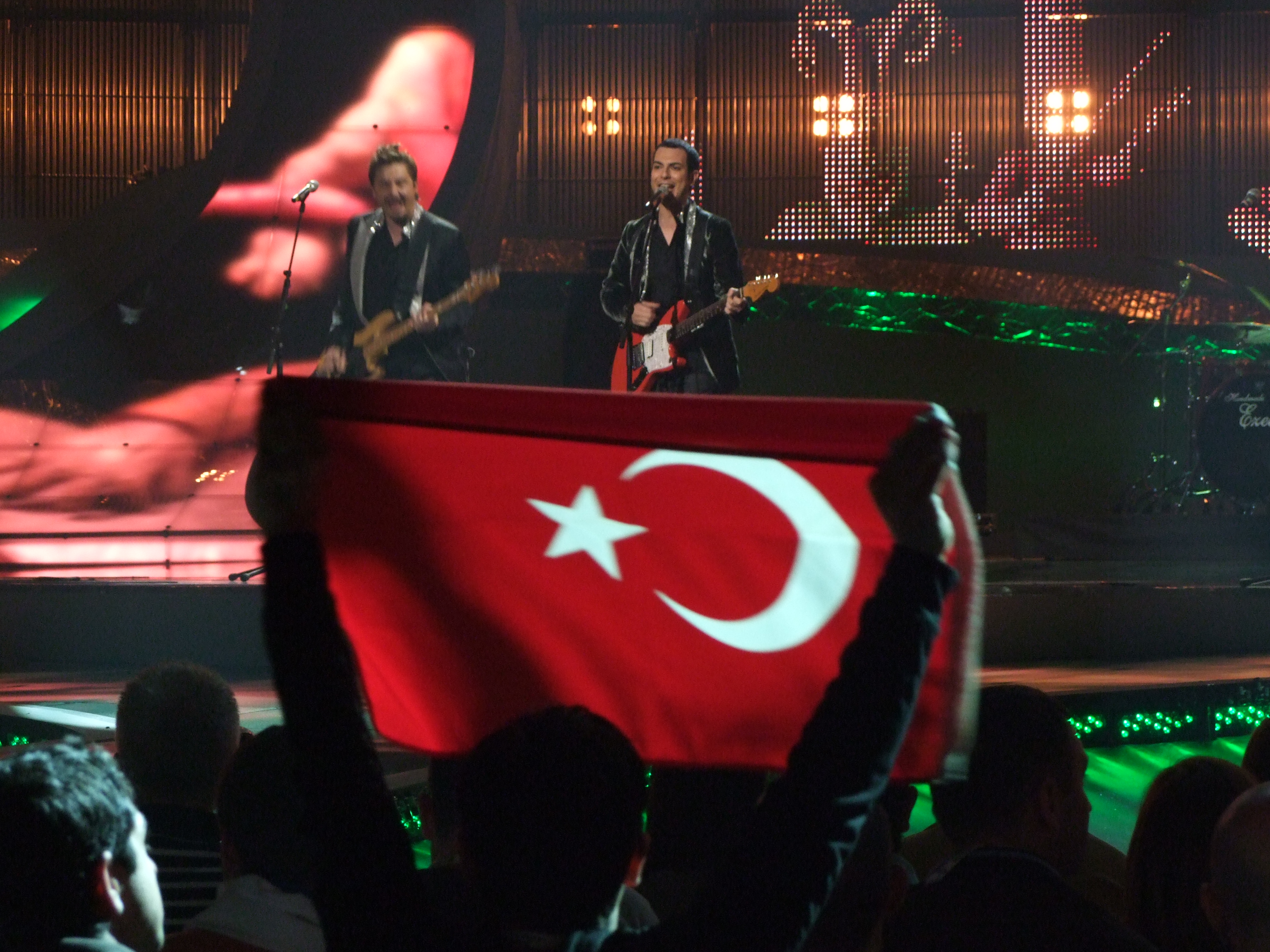
Türkiye entered Eurovision for the first time in 1975, sending pop singer Semiha Yankı to Stockholm with a song called “Seninle Bir Dakika”—“A Minute with You.” The song finished last, receiving only three points. It was an ominous beginning to what would become a decades-long, emotionally charged relationship with a contest that many Turks came to regard as a proxy for Europe’s judgment of their country. What made these dismal years particularly sharp was the political context in which Turks consumed these results. The 1980s were years of deep ambivalence about Türkiye’s European identity. The country applied for full membership in the European Economic Community in 1987, the same year it received zero points on the Eurovision stage. Eurovision was the equivalent of a door shut firmly in our faces. But the decade of bottom-half finishes was followed by a dramatic upward shift from the mid-1990s onward—culminating in a 2003 victory—and a sustained run of strong results through the 2000s.

Scholars have investigated the bilateral voting data of the Eurovision Song Contest. A statistical analysis of voting patterns reveals regularities that conform to the gravity relationship governing economic and social connectedness among countries, which suggest that linkages decrease with distance between regions and countries and increase with population size.[1] It has been shown that at Eurovision two countries are less likely to vote for each other’s songs as the distance separating them increases and that countries with greater gross domestic products receive higher scores.[2] For Türkiye, these regularities in voting pattern caused an unkind context for the songs it brought to the competition for most of the first two decades of participation. Türkiye was a low-income country sitting at the eastern edge of Europe. Moreover, Turkish entries in those years often featured local melodies and Turkish-language lyrics, which may have been musically interesting but did not translate easily to the ears of juries in Scandinavia or Western Europe. While subsequent studies confirmed a voting bias driven by linguistic and cultural distances rather than by political vote trading,[3] the Turkish audience faced the uncomfortable question of whether the low scores Türkiye’s songs received genuinely reflected the jury’s aesthetic taste or signaled a reluctance to embrace Türkiye as a European country, or both.
The transformation that eventually changed Türkiye’s fortunes at Eurovision cannot be understood without understanding the transformation of Türkiye itself in the late 1990s and early 2000s. After the catastrophic financial crisis of 2001—which wiped out savings, collapsed the currency, and sent inflation shooting up—the country began a remarkable period of macroeconomic reform. The crisis also transformed the political landscape. The 2002 elections decimated the established parties that had presided over the economic meltdown, handing a parliamentary majority to the newly founded Justice and Development Party (AKP). The AKP government embraced the International Monetary Fund (IMF) stabilization program already in place and paired it with an ambitious agenda of institutional reform tied to EU accession negotiations—giving Türkiye’s recovery both an economic and a geopolitical dimension. In the subsequent decade and a half, the Turkish economy grew at a high average annual rate, and the average per capita income of Türkiye’s citizens rose from $14,500 in 2002 to $26,500 in 2016.[4]
Based on the gravity relationship principle, Türkiye’s higher income should have triggered increasing success for Türkiye’s songs at Eurovision. However, something else was also at play, since economic growth of this kind is not merely a financial phenomenon but also reshapes how a country is seen from the outside and, crucially, how it sees itself from within. The 2000s brought a surge of international visitors to Türkiye, whether tourists or Turkish expatriates temporarily traveling back home. Figure 2 captures this shift in two ways: the dashed orange line shows the number of international arrivals per Turkish resident rising from around 0.10 in 1990 to 0.42 by 2012, while the solid blue line shows Türkiye’s share of outbound travels from the high-income EU countries Germany, the UK (in the EU at the time), France, and Sweden climbing from 2.2 percent in 2000 to 4.3 percent by 2012. Both trends accelerated remarkably in the early 2000s, as millions of Europeans by then had had direct, personal experience of Türkiye, its hospitality, and culture. These numbers may suggest that Europeans had become at least better acquainted with Türkiye by the mid-2010s and that this contributed to the building of a more positive image for the country on the international stage. It is thus not unreasonable to suggest that this shifting cultural visibility made Türkiye’s entries at Eurovision land differently in the minds of European voters—particularly after the contest switched from jury-only voting to a televote system that put the decision about winning songs in the hands of ordinary viewers.

Figure 2. Türkiye’s share of outbound tourism from Germany, UK, France, and Sweden (left axis, 2000–2012) and tourist arrivals per Turkish resident (right axis, 1990–2012). The gold vertical dashed line marks the year Türkiye won the European Song Contest (2003). Source: Turkish Ministry of Culture & Tourism; UNWTO; World Bank WDI. Pre-2005 share figures are estimated.
The introduction of televoting at Eurovision after 1997 was a structural shift that benefited countries with large and engaged diasporic communities, as well as countries whose respective cultural profiles had become genuinely popular across borders.[5] Türkiye fulfilled both conditions. The Turkish diaspora in Germany alone has numbered in the millions: by late 2003, close to 1.9 million people holding Turkish citizenship were living in Germany.[6] And the likely growing number of Europeans who had spent a summer holiday in Türkiye may have been positively predisposed when a Turkish singer appeared on the screen. Cultural familiarity is not irrelevant to how people vote.
Into this changed landscape walked Sertab Erener, one of Türkiye’s most celebrated singers, with a song that broke from Turkish Eurovision tradition in a significant way. “Every Way That I Can,” performed in Riga in May 2003, was the first Turkish entry to be sung entirely in English—a choice that was controversial at home but strategically acute. The Turkish Language Association had publicly called on Erener to perform in Turkish, arguing that the contest was an opportunity to promote Turkish culture and language. Erener was unmoved. She had accepted the invitation to represent Türkiye on the explicit condition that she could perform in English, believing—correctly, as it turned out—that the language would open the song to a much wider audience.
The free-language rule that made it possible for her to sing in English had been reintroduced in 1999, after a period in which Eurovision had required entries to be performed in national languages. This change had significant consequences for entrants whose languages had previously functioned as a barrier to wide accessibility. For Erener, singing in English did not imply abandoning cultural distinctiveness, as “Everyway That I Can” wove in Anatolian folk instrumentation and Erener’s vocal style carried unmistakable resonances of Turkish classical and pop tradition. But it meant that a viewer in Stockholm or Dublin could follow the story told in the song without subtitles and hum along to the chorus by the second listen. In a mass-audience televote, accessibility matters. The performance itself proved electric: Erener and four dancers delivered a routine that drew on Ottoman harem imagery while being thoroughly contemporary in its choreography. When the votes were tallied, Türkiye had won the Eurovision Song Contest for the first time, edging out Belgium by a few points in one of the contest’s closest finishes. The reaction in Türkiye was extraordinary. People there saw the win as the culmination of their years-long quest to be acknowledged and accepted by Europe. For a country that spent decades managing the ambiguities of its identity, the question was never merely diplomatic or economic. It was experienced personally, emotionally, in living rooms, by ordinary people who absorbed their country’s repeated exclusions as something that reflected on them.[7]
Following the 2003 victory, Türkiye hosted the contest in Istanbul in 2004, showcasing the city to an audience of millions. It then enjoyed a strong run of top finishes through the rest of the decade—a trajectory visible in Figure 1’s rightward cluster of high-placed results. Yet, this period also coincided with shifts within Türkiye. After decades on the margins of Turkish politics, political Islam came to power with an increasing grip on the country’s culture and institutions. The core constituency of AKP—the ruling party since 2002—was very different from the urbanites who closely followed Eurovision in the 1970s and 1980s. Moreover, the song contest may not have had the same cultural symbolism for the Turks residing in rural regions or first-generation rural migrants to urban areas.
By 2012, Türkiye had withdrawn from the contest entirely—initially citing, among other things, dissatisfaction with the voting rules and, in a later statement from the state broadcaster TRT, objections to the cultural direction of Eurovision more broadly. This withdrawal not only reflected the broader deterioration of Türkiye’s relationship with the European Union throughout the decade but also a deeper cultural reorientation: the European identity that had once felt so consequential to urban, secular Turks was losing its hold on a society whose political center of gravity had shifted elsewhere. According to a study by Skoove & DataPulse Research analyzing data from Spotify, a popular streaming platform, local content had an 83 percent share in music streaming in Türkiye as of 2025, marking the second highest domestic content share after India.[8] For those of us who grew up in the 1980s and watched Türkiye come last in Eurovision, the 2003 win helped ease the obsession about achieving success in the song contest. Moreover, the country’s turn inward toward an identity politics with no need for European juries diverted energies from an external cultural struggle about Türkiye’s role in Europe to an internal one about the role of secular values in Türkiye itself. The next generation inherited a different world. They enjoy personalized entertainment in the era of streaming and are increasingly indifferent to Eurovision as a joint experience. For them, Türkiye’s stalled EU bid and the internal culture war have higher stakes than any song contest. The ten-year-old who cried when Türkiye received zero points upon its first participation in Eurovision got his answer in 2003. The ten-year-old who came after him already stopped watching.
Kerem Coşar is a Professor of Economics at the University of Virginia and a research affiliate of the National Bureau of Economic Research (NBER), the Centre for Economic Policy Research (CEPR), and CESifo. He received his PhD at Pennsylvania State University in 2010. He previously held positions at the University of Chicago Booth School of Business and Stockholm School of Economics. His research focuses on international trade, economic geography, and economic history. He is an associate editor at the Journal of International Economics.
Notes
[1] Head, Keith, and Thierry Mayer, “Gravity equations: Workhorse, toolkit, and cookbook,” in Gita Gopinath, Elhanan Helpman, Kenneth Rogoff (eds.), Handbook of international economics, Volume 4 (Elsevier, 2014), pages 131-195. Bailey, Michael, Drew Johnston, Theresa Kuchler, Dominic Russel, Bogdan State, and Johannes Stroebel, “The determinants of social connectedness in Europe,” in Samin Aref et al. (eds.) International Conference on Social Informatics (Springer International Publishing, 2020).
[2] Schoenberg, Alina M., Dimitrios G. Ierapetritis, Chiara Foramitti, and Christopher Schwand. “Economic And Political Dependencies In Cultural Voting: A Gravity Model Analysis of Eurovision.” Romanian Journal of Regional Science 19, no. 1 (2025).
[3] Ginsburgh, Victor and Abdul G. Noury, “The Eurovision song contest. Is voting political or cultural?.” European Journal of Political Economy 24, no. 1, pp. 41-52. (2008)
[4] Purchasing power parity GDP per capita in constant 2021 international dollars, World Bank series NY.GDP.PCAP.PP.KD.
[5] Spierdijk, Laura and Michel Vellekoop, “The structure of bias in peer voting systems: Lessons from the Eurovision Song Contest.” Empirical Economics 36, no. 2 (2009): 403-425.
[6] Euwals, Rob, Jaco Dagevos, Mérove Gijsberts, and Hans Roodenburg, Immigration, integration and the labour market: Turkish immigrants in Germany and the Netherlands. No. 2677. IZA Discussion Papers, 2007.
[7] Solomon, Thomas, “Articulating the historical moment: Turkey, Europe, and Eurovision 2003,” in ed.1, A Song for Europe, (Routledge, 2017), 135.
[8] Pérez Posada, Susana, “Spotify showdown: Which countries stream local artists the most,” Skoove Magazine, https://www.skoove.com/blog/spotify-local-vs-global-music/
Image: Attribution via Wikimedia Commons, Daniel Aragay, CC BY 2.0.
