
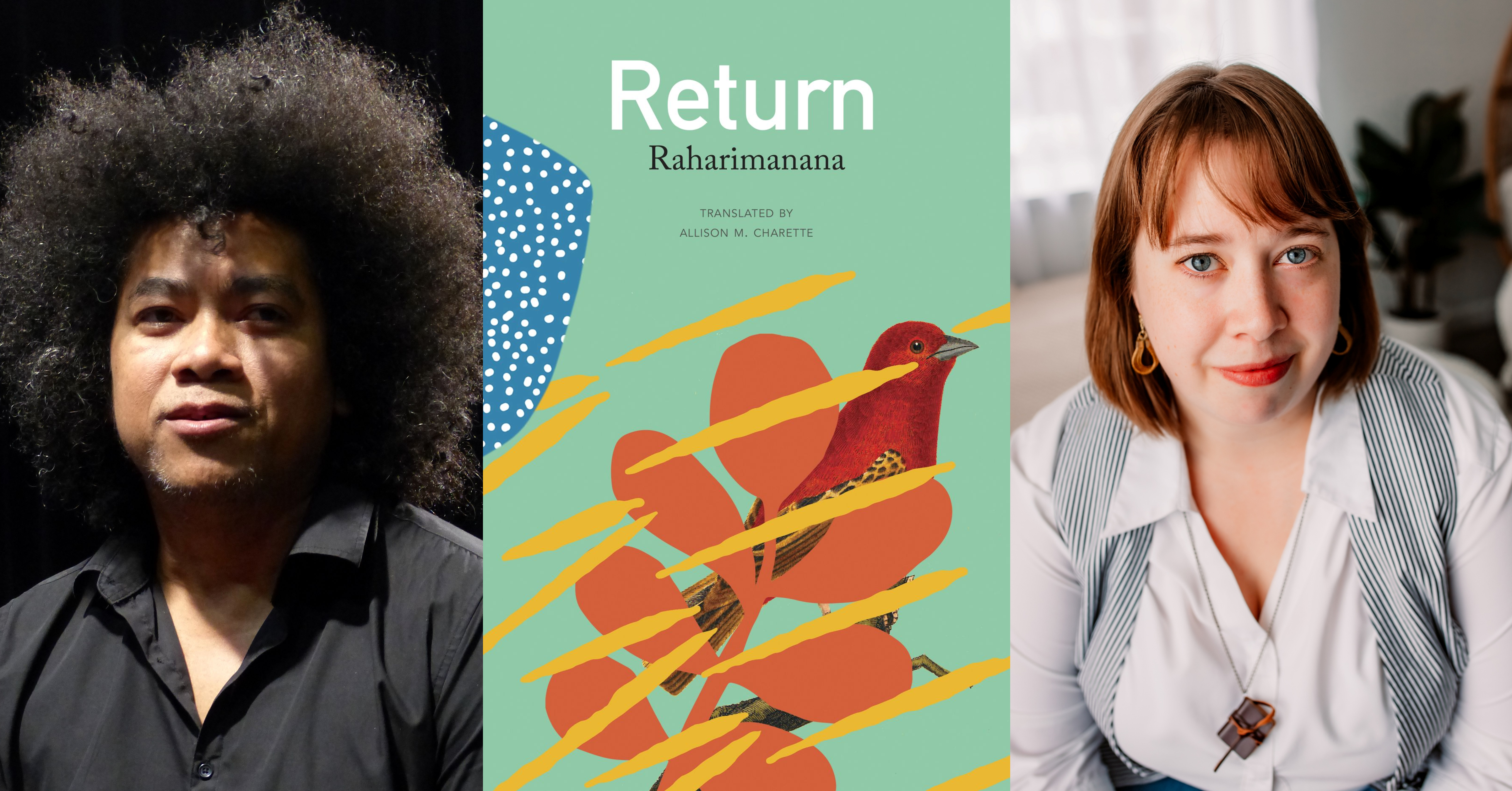
Translated from the French by Allison M. Charette.
Later, he saw one of his childhood photos, he was outside in the
yard, a young child, barely walking, wide astonished eyes, reaching out
his hand, he guesses it was towards his father who was taking the pic-
ture. That was in Antalaha, at the time still a village, between forest
and vanilla crops. He remembers that moment very well: What was he
doing there? Was somewhere else possible, even though in his cocoon
of flesh he was unchanging? The outside, it was chaos.
And here is his father reaching his arms out to him, here is his
father holding him. Time holds us, our fathers hold us, our stories hold
us, but only our mothers truly carry us, carry the whole of us.
The Photograph
There’s a studio portrait that shows all five of them. His two sisters,
Vola, Nannie, his older brother Pat, and him a newborn, in his mother’s
arms, asleep. His mother posing not with a smile, but with statuesque
poise and unadorned beauty. She wore her hair in a chignon worthy of
royalty, with white gloves set off by her grey tailored skirt. The framed
photograph hung on the living-room wall. His mother looked like the
women in magazines, he realized that she was different from others,
and she seemed karana too, he looked at his eldest brother, he had
straight hair, lighter skin, and didn’t take after anyone, almost like a
little Vazaha . . .
So he asked his mother: ‘Mama, are you karana too, like Papa?’
She said no. ‘Your father is a karana métis, I am French, I’m a Malagasy
métis.’ And he asked: ‘A French métis?’ ‘No,’ his mother replied, ‘a
Malagasy métis.’ He didn’t understand the distinction, much less the
term métis. His mother showed him the photograph of his grandfather,
Paul Joseph. It depicted an old white man, in a suit and shoes, thickset,
moustached, hair slicked and styled, bushy eyebrows, hands on hips, a
broad stance, a wide and frightening smile—a Vazaha. He’d seen his
grandfather before, of course, but he was never able to match him to
his portraits. It was like he transformed into a white man when his pic-
ture was taken. He wasn’t exactly sure whether the camera was magic
or his grandfather was a magician. Vazaha in pictures and Dadilahy in
real life. His mother was proud of her métis heritage: ‘Look how beauti-
ful we are, that’s because we’re a mix of many things, we’re métis.’
‘You’re Breton on my father’s side, so you are French, because
Bretons are a French ethnic group, Antakarana on my mother’s side,
and so Sakalava, because Antakaranas are the Northern Sakalavas,
you’re karana on your father’s father’s side, Tsimihety on your father’s
mother’s side, you’re Betsimisaraka on my mother’s mother’s side. And
we’ve taken all the beauty from every one of these roots. In one house,
we are the whole island. You’re even a little bit Merina, because the
Tsimihetys and Merinas are kin, and because you were born here in
Antananarivo, the first of my children born here.’
Before he was born, his parents lived in Fénérive Est. His father
found work at the University of Antananarivo and the whole family
moved with him. A year later, Hira was born.
He liked it when his mother spoke Antakarana to him. He always
thought his mother was singing. He’d answer in Merina. He would
shift between different vernaculars and didn’t always understand when,
outside the house, someone would correct him on the way he spoke.
He would quarrel with his friends over a word, over his accent. He’d
go home to his mother and tell her about their quarrels. His mother
would smile and tell him not to listen to all the people who tried to
correct him. We’re right, she told him, not them. We are rich in all our
dialects, we are free to speak however we want, and we will speak how-
ever we wish. It was just that Hira had a speech impediment, he
couldn’t pronounce certain sounds, he mixed up d and l, tr and dr, he
had a lisp, he was bada lela, slow-tongued, lazy-tongued. His mother
always told him to place his tongue below his teeth, along the gumline.
She put a coin on the tip of his tongue and he would have to speak
without flipping it over.
***
Mahajanga
1.10 a.m.
Hira is coming to settle the memory and pain. He is in the room where
he was born. In Ambohipo. Antananarivo. In a few hours, he will set
off on the journey to return to his father. Out in Mahajanga. He has
hired a car and two drivers to get to his parents’ city. Two drivers so
they can take shifts, so they won’t lose any time. Because Hira only has
two days and two nights for this trip. Coming such a long way, ten
hours of flying, ten hours of driving, to stay such a short time! But it’s
just as well. This time. A priceless gathering. Hira’s been planning this
trip for several months. The chance to do it, and the time. An invitation
to Mauritius and a possible stopover. His parents are waiting for him.
Hira feels the tension in his veins.
The night seems to be so deep. It’s the first time in weeks that he
tries to fall asleep by letting go of the pressure, tries to tell himself it’s
ok, he can surrender to sleep, fully and completely. But he doesn’t feel
like he can. Not yet. His father is waiting for him. Has his father maybe
grown weak again? Might his heart stop beating, just like that, without
warning? Might his wounds reopen, become infected? Hira tries to
calm down. After all, he is happy. Happy to be here where he was born,
to lie down under the same roof where his parents had lived, and he
too, of course, but can we really think of the house where we were born
as ours, once we become adults and experience so many other things
once we have built a new home, with our partners, our children? Still,
Hira does find that sense of calm again. of protection. But he also
knows that this is just the natural inclination of a son for his parents,
it in no way reflects his current reality. Today, he is the one taking care
of his father, not the other way around. He thinks about his father’s
life, his father’s story. Immense pride overwhelms him, mixed with sad-
ness. They lived in this house. This is where his father truly began his
adult life. His father had come from a place more distant than the prov-
inces, more distant than the shores. His father had come from an abus-
ive childhood. Hira does not want to think on it any more. Time to
change the subject, he thinks. Change your life . . .
He feels the presence of his father’s books around him, nearly the
same smells, nearly, but more decayed, a musty book smell, damp, a
sick book smell, the smell of books that have been orphaned, left with-
out eyes to see them. It’s been a long time since Hira left the country,
left these works behind, it’s been a long time since the patriarch left for
another city, that other city, Mahajanga, a long time since he left his
library behind.
Not long after that unpleasantness with the dictator, his father had
decided to move back to his home region, to Mahajanga. Hira had just
got his bac, so he had to stay to pursue his studies, just like his older
brother, his older sister, already at uni, but his father left. He didn’t yet
have the means to transport all the books. He would have needed to
hire a second truck for that. So, many of them stayed there, locked away.
Hira had actually picked out which ones should go and which should
stay. Then, he carefully closed up the wardrobe. No one has touched
it since. In nearly twenty years . . . Hira’s system is still there, to keep
the wardrobe fastened shut: pieces of cardboard wedged into the door
hinges. The locks had popped off ages ago. Actually, Hira had broken
them off himself to get at the forbidden books, back when ol’ greyhairs
was still trying to monitor what he was reading. Hira remembers it very
clearly, he had just passed his entrance exam for Year Seven, he had just
received his first diploma, the CEPE from primary school, he figured
enough already, he was all grown up now, what kind of father forbids
you from reading?
Hira thinks about the rest of the books that no longer exist, the
ones that died, out in Mahajanga. He’d been told about how, just after
his father was arrested on the road out to Amborovy, the soldiers had
come onto the family’s homestead. Two military trucks. They’d loaded
up the furniture, clothes, and curios. Everything. Except the books,
which they piled up in the middle of the yard, they poured petrol on
them and struck a match. The books flared up and the flames licked
the leaves of the mango tree. Then they set fire to the house. And left.
Hira can picture that scene very clearly. It plays over and over in
his mind. A fire of blackened pages, the letters seeming to float through
the air and then crumble into ash. Letters that are not printed, no, not
in the ashes, they’re left caustic, unreadable, smouldering, and filled
with rage.
This is a nightmare he regularly has: he is walking to the exact spot
where the fire was, letters are burning the soles of his feet, he tries not
to fall because, in the dust where the ash lies, sentences are starting to
be written. He must push aside the ash but keep the dust. Then his
father appears. Hira makes the fire disappear with a nod, so that his
father won’t notice anything. His feet are still burning but he acts like
nothing’s wrong. He walks beside his father, forcing himself to stand
up tall, the letters turn back to ash. He makes an enormous effort to
not turn around. To not see the ash eating away at the dust and wiping
out the sentences that had barely been reformed. He prays that some
of the letters would have had enough time to seep into his feet, into his
flesh. And he wakes up. With a feeling of such regret in his chest . . .
Raharimanana, born in Antananarivo, Madagascar, is a novelist, essayist, poet, and multidisciplinary artist. As an editor, he co-founded Editions Project’îles with poet Nassuf Djailani. His latest literary publication, La Voix, le loin, 100 poèmes (2022), inspired the further creation of both a play and an installation of photography, music, and poetry that has been shown internationally. His work has garnered many prizes, from the 1990 Prix du Théâtre Interafricain for one of his earliest plays, translated into English as The Prophet and the President, to the 2023 Prix International Benjamin Fondane for his body of work, awarded annually to a non-French francophone writer. Since 2004, he has co-directed the Plumes d’Afrique festival of literary and artistic creation in francophone Africa.
Allison M. Charette is a dedicated translator specializing in bringing fiction from Madagascar into English. She has translated Naivo’s Beyond the Rice Fields (2017) and Johary Ravaloson’s Return to the Enchanted Island (2019), both to critical acclaim. A co-founder of the Emerging Literary Translators’ Network in America and the ALTA Emerging Translator Mentorship Program, Charette is committed to supporting and mentoring new translators. In 2018, she was awarded an NEA Fellowship in Literary Translation to translate Michèle Rakotoson’s novel, Lalana.
This excerpt from RETURN is published by permission of Seagull Books. Copyright © 2018 Raharimanana. Translation copyright © 2025 Allison M. Charette.
Photo credits:
Raharimanana: Jocelyn Maillé
Allison M. Charette: Jennie Kieffer Photography
