
By Manuela Achilles and Peter Debaere
An Introduction to GlobalEurope Research in Focus, Eurovision: A Vision for Europe?


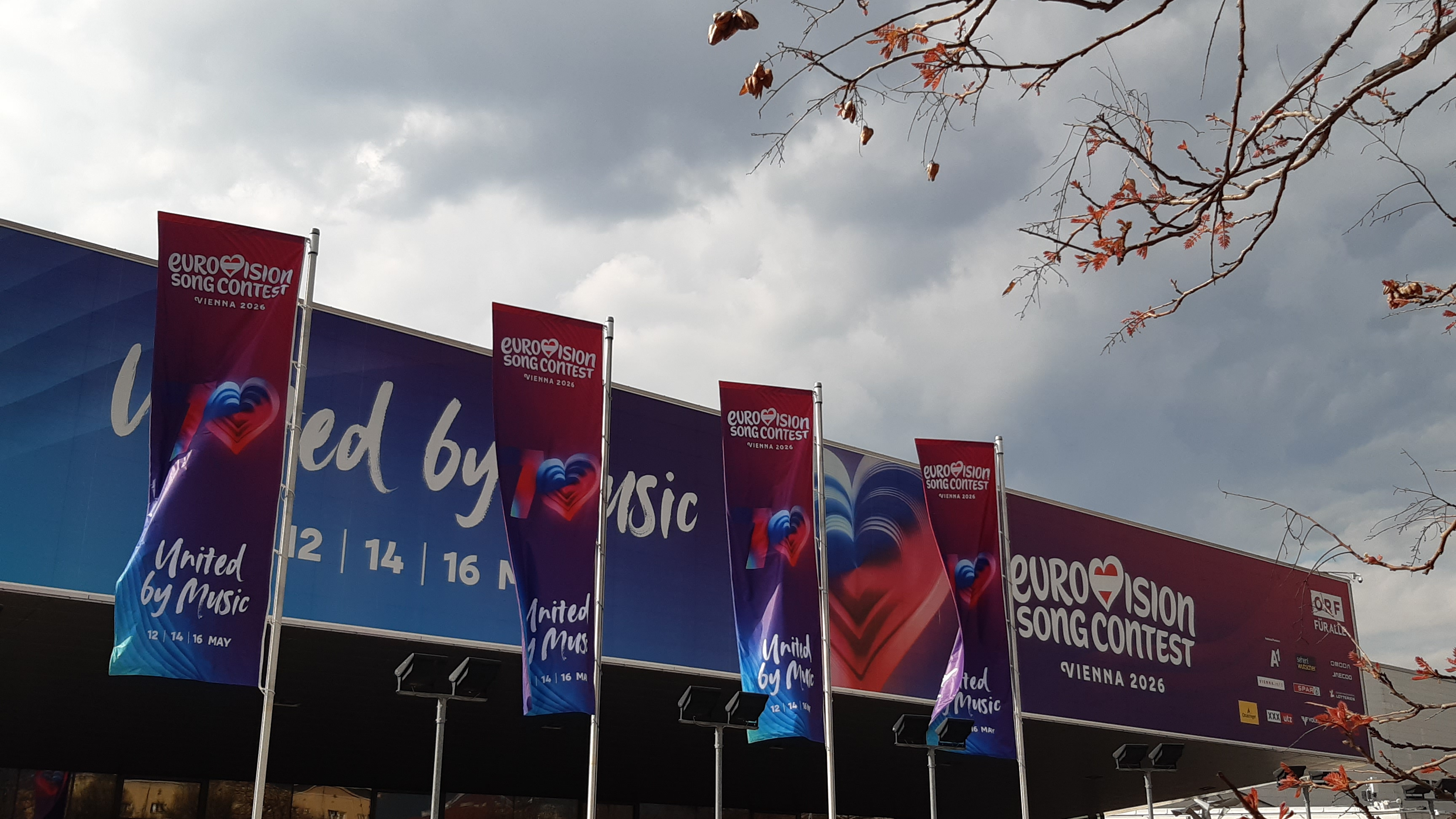
Preparations for the 70th edition of Eurovision are in full swing. This year, the popular song competition and multimedia spectacle—watched by millions around the world—will be held in Vienna. Austria is hosting the contest because its 2025 entry, JJ’s song “Wasted Love,” won last year in Basel. Thirty-five countries have now announced their entries, with five long-term contestants (Iceland, Ireland, the Netherland, Slovenia, the Netherlands, and Spain) absent in protest of Israel’s participation amid the unresolved conflict in Gaza.[1] On May 12 and 14, two semi-finals will determine who advances to the Grand Final on May 16, when a combination of expert and public votes will crown the 2026 winner.[2] For seven decades, Eurovision has connected national music industries and television audiences across Europe and beyond. What began as a modest broadcasting experiment under the auspices of the European Broadcasting Union has grown into one of the most widely followed cultural events on the continent.
This year’s contest, with its official motto “United by Music,” takes place against a troubling geopolitical backdrop that is redefining Europe’s position in the world. This rapidly shifting context is characterized by the convergence of military conflict, economic realignment, and intensifying cultural contestation. Armed conflicts remain central, including the continuing war in Ukraine following Russia’s 2022 invasion, and war in Gaza in response to the Hamas terrorist attacks on Israel on October 7, 2023. These are now unfolding alongside broader regional escalations involving the United States, Israel, and Iran. At the same time, the transatlantic relationship—long a cornerstone of Europe’s security and economic model—has entered a period of heightened uncertainty. The US administration under Donald Trump has repeatedly threatened to withdraw from the North Atlantic Treaty Organization (NATO), challenged multilateral trade frameworks such as the World Trade Organization (WTO), and imposed unilateral tariffs that adversely affected both European and global economies.[3] It has also signaled a more limited commitment to European integration, thereby reinforcing trends already visible during Donald Trump’s first term, and is increasingly projecting domestic US cultural conflicts—particularly around supposedly “woke” politics and “diversity”—onto European debates. A recent national security document goes so far as to describe Europe as facing “civilization erasure.”[4]
Of course, there are many reasons beyond geopolitics for Europe’s precarious position in the world. Some of those reasons relate to its own internal struggles and shortcomings. In response to strong US economic performance in recent years and to Asia’s meteoric rise (its share of world GDP stood at barely 15 percent in 1970 and now exceeds 35 percent), Europe has registered comparatively modest growth. The European financial crisis that started in 2009 raised questions about the rapid expansion of the eurozone to some of its periphery countries. Open disagreements with Victor Orbán’s Hungary have revealed the strains of the European Union’s rapid enlargement, although recent political developments in Hungary suggest a potential, if uncertain, reorientation toward closer alignment with European institutions. The internal challenges of the European Union are well documented and receive notable attention in the 2024 Draghi and Letta reports.[5] Mario Draghi, former President of the European Central Bank, highlights the EU’s difficulty in capitalizing on new technologies and criticizes the persistence of fragmented rules across member states despite the Single Market: “If Europe cannot become more productive, we will be forced to choose between scaling back our social model, compromising our climate ambitions, or losing our economic freedom.”[6] Europe’s uneven commitments to a green economy have also made it dependent on external energy sources, including Russia, thereby increasing vulnerability to geopolitical pressure. Enrico Letta, Italy’s former Prime Minister, similarly calls for institutional and political reform, warning that without deeper integration and more effective governance, support for the European project may wane.[7]
Taken together, these external and internal pressures point to a long-standing challenge: Europe has struggled to articulate a coherent vision of itself and speak with a unified voice, particularly in international affairs and collective defense. Efforts to develop common positions have often been constrained by national priorities, institutional fragmentation, and differing strategic outlooks. Economic transformation and technological change have further complicated coordination. The result is a continent that relies heavily on the United States, even as the post-World War II order shows increasing signs of strain. Against this background, one may ask what role Eurovision plays, with its exuberant celebration of European diversity and its theatrical display of continental togetherness. Does the contest merely offer escapist entertainment, or does it sustain forms of cultural connection that acquire new importance amid political uncertainty?
These questions framed a week-long program at the University of Virginia, where US-based scholars of Europe and colleagues from Europe came together ahead of this year’s Eurovision contest to reflect on the competition and its broader significance. Hosted by a newly constituted Europe Forum, with support from the Center for German Studies and other units, the multi-disciplinary program combined scholarly talks, roundtables, and screenings of Eurovision performances and controversies. It concluded—with a measure of self-awareness—in a student-driven karaoke night. This special issue of GlobalEurope presents expanded versions of the contributions that grew out of these conversations. Taken together, the articles approach Eurovision as a popular cultural form through which broader questions about Europe—its boundaries, identities, and forms of connection—can be explored in ways that complement more conventional approaches.[8]
Historian of postwar Europe Dean Vuletic, in an interview with Manuela Achilles, situates the Eurovision Song Contest (ESC) within the broader history of modern Europe and outlines the major phases of its development. He traces the contest’s origins in the technological ambitions of the European Broadcasting Union rather than in projects of political integration, and distinguishes key turning points from the early postwar decades through the Cold War, the era of European expansion after 1989, and the more openly politicized phase since the mid-2010s. Vuletic emphasizes that Eurovision has always been shaped by political tensions, even as its organizers maintain a framework of formal neutrality, and highlights how the contest functions both as a reflection of shared European experiences and as a unique transnational event that brings audiences together through competition and voting. He also addresses recent controversies surrounding war, participation, and values, suggesting that while such conflicts have intensified, they extend longer-standing dynamics within the contest rather than marking a complete break.
Cultural historian Manuela Achilles and economist Peter Debaere argue that participation in the Eurovision Song Contest functions as a para-diplomatic practice that signals and shapes a country’s relationship to European political institutions and norms. Their longitudinal analysis shows that many states enter the Eurovision stage long before they obtain EU candidacy or membership, and that withdrawal or sustained absence—most notably in the case of Turkey—corresponds to increasing distance from Europe. This dynamic unfolds in tension with the European Broadcasting Union’s technocratic assertion of neutrality, which frames Eurovision as a non-political media competition. Achilles and Debaere demonstrate that this claim redirects rather than eliminates political meaning. Participation and absence become legible markers of movement toward political integration, retreat from it, or contestation of the expectations embedded in European institutions and norms, including, increasingly, commitments to human rights.
Marketing scholar Luca Cian presents Eurovision as one of Europe’s most ambitious exercises in brand construction. While the heart logo and the new “Chameleon Heart” express an ideal of unity amid diversity, each national entry functions as a distinct act of nation branding and a costly signal of identity, conveying how countries seek to be perceived before a vast transnational audience. The contest’s sensory-rich structure, combining music, visuals, and audience participation, together with the rule against self-voting, creates a ritual that directs attention outward to other nations and sustains a shared emotional space. At the same time, Eurovision operates as a layered brand system that brings together a global master brand with multiple national expressions. The withdrawals announced for 2026 expose limits within this community and raise questions about the legitimacy that sustains it.
Post-Cold War historian Catherine Baker examines the reconfiguration of Eurovision’s queer politics from the late 1990s to the present. She traces the contest’s emergence as a space of LGBTQ+ visibility and symbolic inclusion, culminating in the widely perceived high point of Conchita Wurst’s 2014 victory, and then analyzes how this trajectory has been unsettled by the convergence of global anti-LGBTQ+ backlash and the political repercussions of Israel’s participation following the October 7 attacks and the war in Gaza. Baker shows that boycott campaigns, intensified scrutiny of artists, new governance restrictions, and divergent broadcaster responses have disrupted the contest’s earlier alignment with liberal narratives of inclusion. These developments are reshaping the conditions of participation for queer artists, contributing to withdrawals and acts of divestment by figures central to Eurovision’s queer history, and producing a more fraught environment in which artistic agency and visibility are increasingly constrained.
Musical performance scholar Ivan Raykoff examines Eurovision as a uniquely multilingual and translational space in which national identities are performed, mediated, and reinterpreted across linguistic boundaries. Drawing on examples from the contest’s vast repertoire of songs in dozens of languages, he shows how meaning in Eurovision is only partially accessible through literal understanding and instead emerges through sound, performance, and affect. Engaging Julia Kristeva’s notion that “the foreigner lives within us,” Raykoff argues that Eurovision invites audiences to encounter linguistic and cultural difference while recognizing shared forms of connection across it. Rather than resolving the tensions between national specificity and global accessibility, the contest sustains them, offering a cosmopolitan practice in which misunderstanding, translation, and estrangement become central to the experience of belonging.
Musicologist Ella Jackson situates Eurovision’s musical history in conversation with contemporary anxieties about Europe. Drawing on a harmonic analysis of all seventy‑two Eurovision winning songs, she identifies a striking shift around the year 2000, when major‑like tonalities give way to a strong preference for minor‑like tonalities. Jackson connects this development to several broader changes: the rise of televoting and new expectations of emotional authenticity, global pop trends that favor darker harmonic colors, and the expansion of the contest into a wider and more diverse musical geography after the Cold War. Rather than treating this shift as evidence of cultural decline, she argues that these developments reshape Eurovision’s expressive vocabulary, allowing minor‑like tonalities to signal intimacy, national storytelling, and stylistic hybridity. In this account, the contest adapts to new audiences and new forms of musical meaning while continuing to sustain the exuberant kitsch that has long defined its identity.
Economist Kerem Coşar uses Eurovision as a lens through which to examine Türkiye’s long and unsettled relationship with Europe, particularly from its perceived position at the continent’s margins. Blending personal reflection with quantitative analysis, the article traces Türkiye’s trajectory from decades of low ESC rankings after its 1975 debut—often experienced by viewers as a form of cultural exclusion—to a marked shift in the late 1990s and early 2000s. Coşar links this transformation to broader changes within and beyond the contest, including economic reform, rising tourism, the growing visibility of the Turkish diaspora, and institutional shifts such as televoting and the relaxation of language rules. These developments culminated in Sertab Erener’s 2003 victory, widely understood as a moment of symbolic recognition, even as it left deeper questions of belonging unresolved. Türkiye’s withdrawal from Eurovision since 2012, in turn, reflects both changing dynamics within the contest and a broader reorientation in the country’s political and cultural relationship to Europe.
Middle East expert Zvi Gilboa examines Israel’s participation in the Eurovision Song Contest. Drawing on broadcast media, television features, and reporting on the contest and its national selection process, he shows that Eurovision offers Israel a stage for projecting cultural belonging while negotiating internal questions of representation and identity. Situating his discussion against recurring controversies surrounding Israel’s participation, Gilboa argues that Eurovision occupies a central place in Israeli cultural life, from the early successes of the late 1970s—widely experienced as moments of international recognition—to later shifts in media structures, language practices, and selection formats. Drawing on examples from Izhar Cohen’s 1978 victory and Dana International’s boundary-breaking win in 1998 to the multilingual performance of Mira Awad and Achinoam Nini (Noa) in 2009, the article shows that Israel’s entries function as “musical ambassadors,” projecting images of the nation outward while reflecting changing social dynamics inward. This dynamic becomes especially visible in the contemporary era of reality television, where the selection process has become a highly mediated arena of identity formation. The case of Valerie Hamaty, whose near-selection before and after October 7 elicited sharply different reactions, underscores how Eurovision continues to serve as a stage for competing visions of Israeli identity.
Central and East European historian Kyrill Kunakhovich examines the history and political meanings of the Intervision Song Contest. He traces the contest from its origins in the Cold War to its revival in Moscow in 2025, following Russia’s exclusion from Eurovision after the invasion of Ukraine. First launched in 1965 within the Intervision television network of the Eastern Bloc, the contest reproduced the spectacle of Eurovision while promoting a different vision of international cultural exchange under state socialist conditions. Kunakhovich argues that Intervision has consistently emerged when states excluded from Eurovision seek to construct their own arena of musical internationalism. Although the contest closely follows the Eurovision model, it lacks the political and social conditions that allow Eurovision to translate performance into lived experiences of transnational mobility and exchange. Intervision therefore functions less as a rival than as a substitute shaped by exclusion.
A few common themes emerge from the contributions in this issue. Eurovision appears throughout as a political arena in which participation, withdrawal, and exclusion give concrete form to questions of belonging. The current boycott by five long-time Eurovision contestants alongside the earlier exclusion of Russia, brings this dynamic into sharp relief. This constellation is not entirely new or exceptional. As Dean Vuletic reminds us, Eurovision has consistently been shaped by the most immediate conflicts of its time, including military tensions, human rights violations, disputes over totalitarian regimes, and democratic backsliding. While aware of the challenges, the contributions in this issue also emphasize Eurovision’s positive distinctiveness in a world that increasingly embraces raw nationalism. Eurovision allows for and, indeed, celebrates mobility, diversity, and inclusion. As Kyrill Kunakhovich shows, Russia’s Intervision does not offer a viable alternative to Eurovision. Its appeal remains limited, because its attempt to create solidarity through music lacks the deeper political and institutional commitment to human rights and transnational mobility that underpin and contextualize Eurovision. There is no comparable aspiration to the free movement of people, ideas, and identities. Nor is there a comparable willingness to cooperate and compromise on national sovereignty in the search for common ground, one of Europe’s most far-reaching political ambitions, as it is with the European Union.
Yet, Eurovision’s underlying commitments also create their own pressures. As Luca Cian’s contribution suggests, Eurovision is a complex brand, and like any such brand, it depends to a degree on consistency in what it stands for and how it is received. When that consistency frays—when boycotts multiply, when the terms of inclusion become disputed, when the contest’s values are invoked by some participants precisely to exclude others—the brand loses some of the legitimacy that makes it valuable. The parallel with the European Union is instructive. The EU, too, is a complex and layered project whose coherence depends on shared commitments that must be continually negotiated and defended. Eurovision does not resolve these tensions; it stages them. And in doing so, it offers something much more valuable than escapism: a recurring, continent-wide argument about who belongs, on what terms, and what Europe ultimately stands for.
Manuela Achilles is Professor of German and History at the University of Virginia and Director of the Center for German Studies. She works on Weimar democracy, fascism, Holocaust memory, and sustainability; recent publications include Invisible Fatherland: Constitutional Patriotism in Weimar Germany (Cambridge University Press, 2026) and “Nazis into Victims: Holocaust Fiction without Perpetrators” (literaturkritik.de, 2024).
Peter Debaere is Tipton Snavely Professor at the University of Virginia’s Darden School of Business. He is an international economist and an expert in the economics of water; he has published in leading field and general-interest journals, and his research has been funded by the National Science Foundation.
Table of Content
- Introduction, Eurovision: A Vision for Europe? by Manuela Achilles and Peter Debaere
- Eurovision in the History of Postwar Europe: An Interview with Dean Vuletic, by Manuela Achilles
- Participating Is Political: Eurovision, EU Membership, and Human Rights, by Manuela Achilles and Peter Debaere
- A Heart with Seventy Layers: Eurovision, Branding, and the Idea of Europe, by Luca Cian
- Do You Speak Eurovision? Translating Identity in the Song Contest, by Ivan Raykoff
- Eurovision’s LGBTQ+ Politics at a Crossroads, by Catherine Baker
- A Minor Turn in Europe’s Vision: The Changing Tonal Politics of Eurovision, by Ella Jackson
- Voting for Türkiye in Eurovision: Personal Reflection and Data, by Kerem Coşar
- Contested Songs and Musical Ambassadors: Israel and the Eurovision Song Contest, by Zvi Gilboa
- A Different Vision: The Intervision Song Contest from the Cold War to the War on Ukraine, by Kyrill Kunakhovich
Notes
[1] Peter Debaere and Manuela Achilles. “The Israel-Hamas War: Where Is Europe?” EuropeNow Daily, December 19, 2023. The Israel-Hamas War: Where is Europe? – EuropeNow
[2] For details about the contest, see “Eurovision Song Contest 2026: Vienna,” Eurovision World.Com, April 14, 2026; Eurovision Song Contest 2026: Vienna
[3] On Trump’s trade policy, see Peter Debaere and Manuela Achilles, “Trade Policy as an Assertion of National Power: Reading Hirschman to Understand the Donald Trump Administration,” Global Europe, October 2025; Trade Policy as an Assertion of National Power: Reading Hirschman to Understand the Donald Trump Administration – GlobalEurope
[4] The White House, National Security Strategy of the United States of America. November 2025; p. 25; 2025-National-Security-Strategy.pdf.
[5] For a good summary of both reports, see Sophie Ruediger and Alessandra Sesia, “The Big 5 Institutions of the European Union,” Charlottesville, VA: Darden Business Publishing. 2026.
[6] “Mario Draghi’s Best Ideas Are Those Europe Finds Least Comfortable,” Economist, September 10, 2024.
[7] Enrico Letta, “Much More Than a Market,” European Council and Council of the European Union, April 2024, https://www.consilium.europa.eu/media/ny3j24sm/much-more-than-a-market-report-by-enrico-letta.pdf..
[8] On the current retreat in the United States of European Studies, and area studies more generally, see the Open Letter from the Council for European Studies (CES) Opposing the Proposed Closure of the UNC Area Studies Centers, January 7, 2026; https://councilforeuropeanstudies.org/support-for-area-studies-at-the-university-of-north-carolina-chapel-hill
Photo credit: Edina Paleviq
