
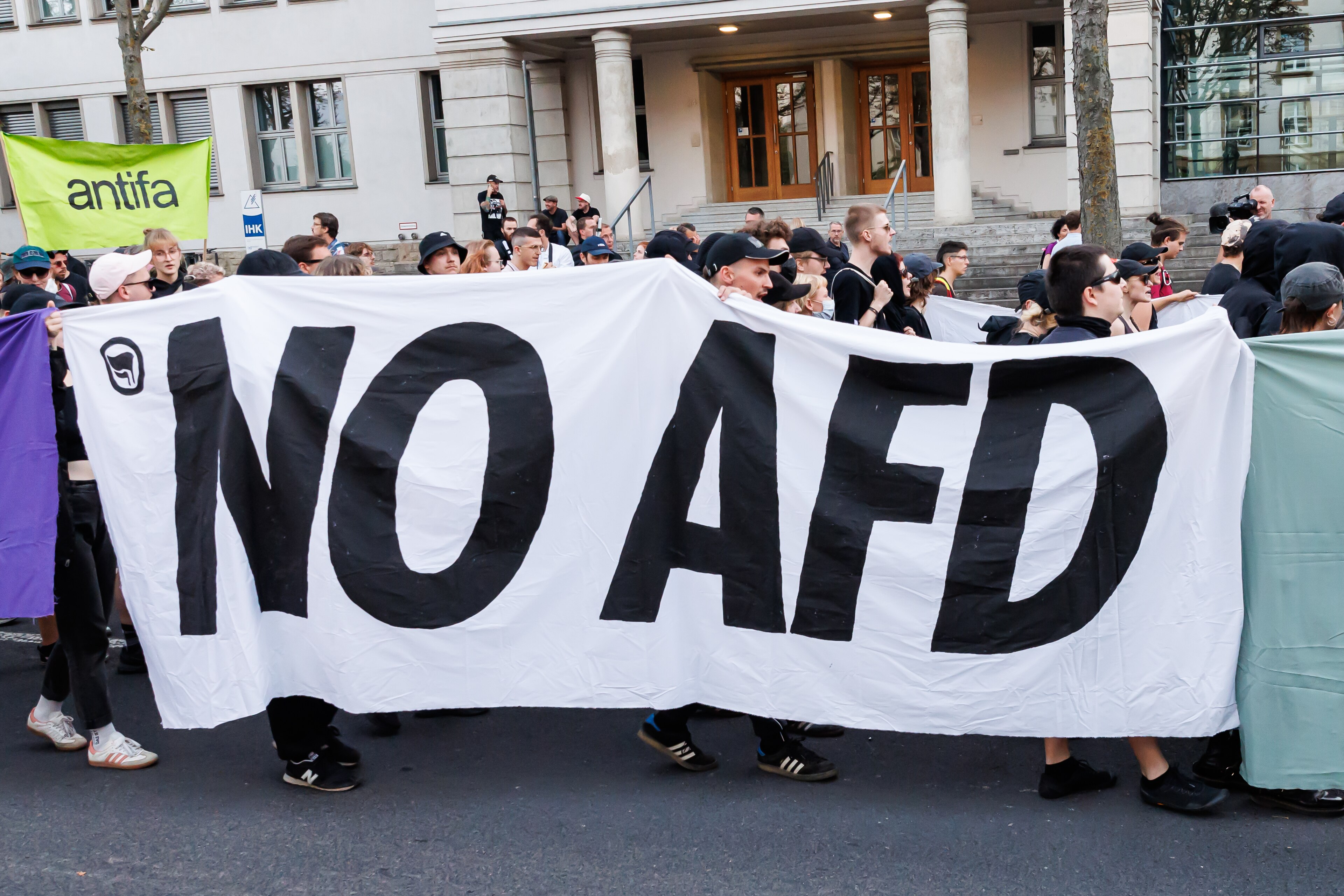
By Elizabeth B. Jones
On September 6, 2026, German voters in the eastern state of Saxony-Anhalt will decide whether to uphold democracy by rejecting the far-right party known as the Alternative for Germany (AfD). If the AfD wins an absolute majority, Saxony-Anhalt’s parliament will be the first controlled by an extreme right-wing party in Germany since 1933. While some 40 percent of the electorate now supports the AfD in Saxony-Anhalt, a growing number of voices there and in Germany more broadly forcefully disavow its hateful and violent messages. The article surveys a range of grassroots initiatives in Saxony-Anhalt that are forging a powerful counter-narrative of support for diverse and equitable communities, where respect for human rights and democracy are the guiding principles. These projects have been endorsed by a robust network of German authors, artists, academics, and policymakers who urge the established political parties, especially the conservative Christian Democrats, to reject all forms of cooperation with the AfD and warn of the profound dangers to German democracy even if the AfD fails to win an outright majority.
On May 23, 2026, the play “Wunde Stadt,” or “City of Wounds,” premiered in Magdeburg, capital of the central German state of Saxony-Anhalt. It was inspired by the horrific 2024 attack on the Magdeburg Christmas market, which killed six people, wounded hundreds of others, and traumatized the city. The playwright, Kevin Rittberger, spent months interviewing victims and uses their stories to grapple with the tragedy and offer healing. The play’s focus is on the victims and survivors and is intentionally silent about the perpetrator, a Saudi-born Shi’a Muslim who had lived in Germany since 2006. What does the Magdeburg attack and “City of Wounds” have to do with the upcoming state election in Saxony-Anhalt in September 2026? The short answer is the growing strength of Germany’s largest far-right political party, the Alternative for Germany, or AfD.
Like other right-wing parties in Europe and North America, the AfD makes ultra-nationalism and xenophobia one of its central pillars. Predictably, the AfD denounces “City of Wounds” and Rittberger’s effort to bridge the divides magnified by the 2024 attack and to build community without respect to race, creed, skin color, or other markers of difference. According to a June 2026 poll, 40 percent of voters in Saxony-Anhalt support the AfD. If the party won an absolute majority this fall, the Magdeburg statehouse would be the first in Germany controlled by the far right since the early 1930s; and AfD leader, Ulrich Siegmund, pledges to make Saxony-Anhalt a model for the entire Federal Republic. But the recent narrative of Germany’s steady rightward turn is being challenged by an array of initiatives, including “City of Wounds,” and their vision of a more inclusive and open-minded society. In the coming months, the established parties must work together with those alarmed by the AfD’s racist swagger to persuade voters that Germany’s future democracy depends on healing the wounds laid bare in “Wunde Stadt” and that they can create the conditions for all to thrive in diverse, prosperous, and welcoming communities. German and international observers agree that this is a huge lift, but Viktor Orbán’s recent ouster in Hungary and Donald Trump’s plummeting popularity in the United States suggest that the AfD’s victory in Saxony-Anhalt is not inevitable.
The AfD’s Rise
Since its inception in 2013, the AfD has built strongholds in all of the former East German states, including Saxony-Anhalt, but in recent years the party has gained ground in all sixteen German states and the slogan “East, East, East Germany!” is now shorthand for an ultra-nationalist, misogynist, anti-migration, and anti-multicultural vision of Germany.[1] This development mirrors broader European trends: despite Orbán’s stunning defeat by pro-EU and pro-Ukraine conservative Péter Magyar, right-wing populist parties have attracted growing support in Austria, France, Italy, Spain, Portugal, Poland, Finland, and the United Kingdom. At the same time, Germany’s major established parties, all of which have roots in postwar West Germany, except The Left (Linkspartei, Die Linke), have seen declines in support both nationally and in Saxony-Anhalt; these include the Christian Democrats (CDU), the Social Democrats (SPD), the Free Democrats (FDP), and the Greens (die Grünen). Since 2021, Saxony-Anhalt’s current majority coalition government of CDU, SPD, and FDP has governed under the slogan “We’re building Saxony-Anhalt. Strong. Modern. Crisis-Resistant. Just.”[2] Officially, all the established parties have ruled out forming a coalition with the AfD, a stance known as the firewall, or Brandmauer. One of Germany’s newer right-wing parties, the Bund Sahra Wagenknecht (BSW), has been roiled by controversy and internal leadership battles in Magdeburg and is not expected to be a factor in September unless it can split the right-leaning electorate. Meanwhile, some commentators contend that The Left, despite its ties to the former East German Socialist Unity Party, or SED (which ruled as a one-party state), merits consideration as a coalition partner with the CDU and the SPD.[3] These commentators point to the recent experiments with such partnerships in neighboring Thuringia and the Free State of Saxony as a way of edging out the AfD. In any case, Siegmund avers that the AfD will not cooperate with any of the major parties—he wants to “rule alone.”
In 2024-25, the AfD platform for the election to Germany’s national parliament, the Bundestag, was mostly right-wing populist boilerplate: support for the market economy and middle classes; tighter national security, border patrols, and immigration controls; demands for a neutral Ukraine and renewed trade with Russia; reform of the “biased” media; the expansion of coal and the abolishment of subventions for renewable energy; pronatalist policies based on “traditional marriage”; and replacing the European Union with a “Europe of Fatherlands.”[4] In contrast, the AfD’s preamble to its 2026 platform for Saxony-Anhalt is a three-page list of grievances, chiefly the “unwarranted panic” about the AfD being sown by the so-called “old parties.” Predictably, the second paragraph cites the Magdeburg Christmas market attack as symptomatic of increasingly dangerous streets, the current government’s “lax treatment of foreigners,” and its “disgraceful persecution” of ordinary German citizens.[5] The AfD preamble’s overarching theme is that anyone who opposes the AfD is anti-democratic, and it warns ominously that the September vote is “our last chance.” Its shrill tone forms a striking contrast to the frothy social media posts trumpeting the party’s messages of “Security, Freedom and Heimat!” and “We’ll rescue Germany!” Sociologist David Begrich, a longtime political commentator in Saxony-Anhalt, described the AfD’s 2026 program as a “154-page right-wing power fantasy,” or “rechte Machtfantasie,” with ambitions for the complete overhaul of all sectors of the state’s political, economic, social, and cultural life.[6] Indeed, 27 cultural institutions in Germany recently signed an open letter warning that the AfD, if victorious in September, will impose a nationalistic, narrow vision of German culture that threatens free artistic expression.[7]
The State of Saxony-Anhalt
Founded in 1945 from cobbled-together regions of the former Prussia, many might call Saxony-Anhalt a typical “drive-through” [Durchfahren] state. It is the eighth largest of sixteen German federal states and the eleventh largest in terms of population, with ca. 2.1 million inhabitants and approximately 1.8 million eligible voters. The state is landlocked and bordered by the states of Brandenburg, the Free State of Saxony (usually referred to simply as Saxony), Thuringia, and Lower Saxony. Several years after Germany’s 1990 reunification, Saxony-Anhalt’s district lines were redrawn to create three urban districts—Magdeburg, Halle, and Dessau-Roßlau (its three largest cities)—and eleven rural districts. Its middling size notwithstanding, Saxony-Anhalt boasts six UNESCO world heritage sites, among them the town of Wittenberg, where Martin Luther posted his 99 theses and sparked the Protestant Reformation; Dessau, home to the twentieth-century art and architectural movement known as the Bauhaus; the well-preserved medieval town of Quedlinburg, home to the Lyonel Feininger Museum; and the eighteenth-century “garden city” of Wörlitz, where Prince Franz of Anhalt-Dessau and his wife constructed an educational site open to all featuring a Gothic church, a Jewish synagogue, a monument to pantheism, a model volcano, and much more. In the former East Germany, Saxony-Anhalt was a leading producer of industrial chemicals and coal, but also home to the Saale-Unstrut wine region, the Harz Mountains, and the famously fertile soils of the Magdeburger Börde. Saxony-Anhalt’s economic and cultural riches are especially striking when set against the backdrop of Magdeburg’s difficult history. Reviewers of “Wunde Stadt” have noted the centuries of suffering endured by the city’s citizens, most notably the brutal 1631 massacre of its population during the Thirty Years’ War, which gave rise to the term “Magdeburgization” [Magdeburgisierung, -isieren] meaning total annihilation, its decimation by Allied bombs in 1945, and, most recently, the Christmas Market attack.[8] Conspicuously, Saxony-Anhalt has the third lowest number of foreigners (after Saxony and Thuringia), with approximately 132,000 of them, or 2.7 percent of the state’s population. And the majority of these incomers, 56 percent, come from Ukraine, Poland, Romania, Russia, and Bulgaria; the largest number of non-Europeans are Syrians, who number about 29,000.[9]
The podcast “2,1 Millionen,” or “2.1 Million,” launched in April 2026 by three regional journalists, offers a concise overview of the issues at stake in the September 6th election. Its first guest, Hagen Eichler, Magdeburg state house correspondent at the Mitteldeutsche Zeitung, noted that since the 2021 Bundestag election, voters “have become accustomed to the idea of an AfD government” as an alternative to its chief rival, the CDU. The major problems confronting Saxony-Anhalt, according to Eichler, are economic stagnation; a shrinking and aging population; a dysfunctional education system where ten percent of high school students do not receive a diploma; and the rising cost of living due to Russia’s war on Ukraine and the United States’ war on Iran. Eichler stressed that Saxony-Anhalt’s economic stagnation and population loss are long-term problems, pre-dating German unification in 1990 by two decades. Moreover, the state’s economic struggles have persisted. The decision in May 2026 by Volkswagen to cancel its contracts with a 150-year-old aluminum factory in the Harz region, where job losses could top 1,200 people, is the latest bitter blow to rural residents and the current government’s economic revitalization plans.[10] At the same time, childcare and housing costs are more affordable than elsewhere in Germany. The real paradox, Eichler concluded, is that based on a recent poll, a whopping 90 percent of residents “enjoy living in Saxony-Anhalt” (“leben gern in Sachsen-Anhalt”), but when asked how others are doing and the state in general, they feel “things are going in the wrong direction.” Eichler summed up a key political challenge for the established parties: despite 40 percent support for AfD, party affiliation remains weak, and, thus far, the established parties have failed to connect with voters. But he added that the undeniable media savvy of the AfD may only count for so much when the most reliable voters are over 60.
Party Politics and Street Politics
There is unanimous agreement among expert observers about the problem of fickle and/or feeble party affiliation. In his blockbuster 2024 book about the persistent divisions between the former East and West Germanies, Ungleich vereint [Unity without Equality], sociologist Steffen Mau underscores the fluidity of voters’ party loyalties in the former East as a product of its history.[11] He notes that the established West German parties were slow to organize in the new states and have failed to convert voters into loyal party members; indeed, as of 2025, less than one percent of all voters in the former East Germany had joined the CDU, SPD, FDP, or the Greens.[12] Even more troubling is the fact that far-right groups swiftly infiltrated many small towns and villages after German reunification, forging a robust network that the AfD has exploited to its advantage.[13] Mau emphasizes that one cannot overestimate contemporary Eastern Germans’ deep alienation from politics in general and their weariness of change, despite their general support for the idea of democracy.[14] This apathy is reflected in the lower turnout numbers in Eastern states for national (26-35 percent) and state elections (30-40 percent) compared to the Western German states, though it should be noted that participation in local elections is slightly higher in Eastern Germany.[15] Moreover, he notes, the increased politicization of society, especially by extremists on the right, and the simultaneous weakening of party ties are symptomatic of most western democracies; the phenomenon is just more pronounced in the former East Germany.[16]
The crucial site of political activity in the German East, Mau contends, is the streets and market squares. Begrich agrees, calling the street party barbecue, or Grillfest, the extreme right’s most fundamental, and savvy, outreach strategy.[17] Here again, the AfD and the plethora of other regional far-right parties like the Freie Sachsen (Free Saxony) are dominant, while the established parties “have no idea” how to channel the demands and energy generated there into organized interest politics.[18] Yet while AfD organizers invoke the thrill of 1989 by framing their grassroots gatherings “the Peaceful Revolution 2.0 [friedliche Revolution 2.0],” Mau stresses that many of these events have crossed the line into violence. In this respect, there are echoes of the 1920s and early 1930s, when the National Socialists took their battle for control to the ballot box and Germany’s streets, with the Brownshirts in the vanguard.[19] Begrich observes that the AfD’s relentless organization of family-focused gatherings in small towns, its constant visibility outside of election seasons, is typical of other far-right parties in Europe.[20] This omnipresence was another political strategy honed by the National Socialists.[21] Other striking parallels between the AfD and the Nazis are the mastery of the era’s latest technology to mobilize large numbers of voters and the relentless attacks on “un-German” cultural movements and monuments, like the Bauhaus.[22]
Mau asserts that if one wants to understand the current political culture in the former East Germany, including Saxony-Anhalt, there are two central factors: first, the feeling of alienation after the heady months before and after the fall of the Berlin Wall, which was experienced as a loss of power and agency, and second, the weariness with the years of unrelenting and confusing change beginning in the 1990s, which also has affected the post-unification generation. Further, he suggests that the tension between the demands of “we want to be heard” and “we want what we want” complicates the tough, often protracted discussions key to a thriving democracy.[23] No matter what, Mau concludes, if the “quiet middle” can be roused in the coming months as it was in the huge nationwide street demonstrations in early 2024 against right-wing extremism and for tolerance, then there is a chance they will drown out the loudest purveyors of hate.[24] He argues that the best chance for mobilizing Eastern German voters to support democracy is to create “laboratories of participation” where citizens are involved in all levels of policymaking, such as the Climate Panel in France and the Irish Citizen’s Assembly that helps advise the Lower House of Parliament in Ireland.[25]
The Opposition: Countering the AfD Narrative of Inevitable Victory
For the AfD, there are clear advantages to framing the September election as a sure victory, the most obvious being that it reinforces a “why bother voting?” attitude among the undecided. At the same time, those who oppose the AfD want to ensure that voters understand the cataclysmic changes in all areas of society if Siegmund becomes Saxony-Anhalt’s minister-president with, or even without, an absolute majority. The quest for a balanced threat assessment might explain the obvious ambivalence about using the term “watershed election” [Schicksalswahl] when journalists and other non-partisan observers discuss the September vote, particularly when considering the implications for the other Bundesländer. Siegmund himself frequently invokes “the domino effect.”[26] Perhaps the most underestimated risk posed by the “make or break” label is the drowning out of the myriad voices challenging the perception that Eastern Germans uniformly and wholeheartedly support the AfD’s agenda. Compounding this problem, notes local journalist Annika Leister, is the media’s tendency to focus more on the AfD’s victories rather than its defeats.[27] For example, it would be fruitful to highlight the small towns and villages where AfD council members’ attempts to defund cultural centers that they deem unpalatable have failed, such as the AfD’s repeated attempts to close the Telux Cultural Center in the Saxon town of Weißwasser in the Lausitz.[28]
The journalist M. Gessen, in a recent New York Times editorial about lessons from the Hungarian election last March, stressed the vital role played by regional and local non-profits, as well as other grassroots organizations, in promoting messages of tolerance and democracy in the face of hateful right-wing propaganda.[29] Among those who spoke at Magyar’s victory rally in Budapest were “teachers who had organized against a unified state-dictated curriculum; a young man who spoke up against abuses in the child care system; a high school student persecuted for reciting an anti-Orban poem; organizers of Budapest’s L.G.B.T.Q. Pride celebration. The speakers stayed onstage, gradually forming a crowd of the kind — the many kinds — of ordinary Hungarians who had ended the Orban era.”
The Magdeburger Staatstheater’s staging of “City of Wounds” is one example of the courageous initiatives to present an alternative vision of modern Germany, and its enthusiastic reception among audiences is heartening. But there are dozens of other organizations laboring to promote messages of tolerance and support for diversity and human rights in Saxony-Anhalt and the broader region. In addition, there are citizens’ initiatives building on the tradition of East German grassroots groups that framed environmental protection and democracy as going hand-in-hand.[30] Some of them are new, others have existed for decades, and they encompass a variety of approaches to enacting positive change.
Remaining for a moment in Magdeburg, the association called “With one another: the Network for Democracy and Open-Mindedness in Saxony-Anhalt” [Miteinander e.V. Netzwerk für Demokratie und Weltoffenheit in Sachsen-Anhalt] was founded in 1999, after a regional wave of far-right violence against “foreigners.” Its mission is “to promote an open, pluralistic, and democratic society in Saxony-Anhalt and beyond. [They] combat racism, anti-Semitism, and all other forms of group-based hate that leads to discrimination, exclusion, and violence.”[31] By providing advice and support for grassroots organizations, with a particular emphasis on reaching young people, the association seeks to strengthen existing pro-democracy networks and foster new ones. Besides Magdeburg, the association also has offices in Salzwedel and Halle. Most recently, “With one another” has begun hosting regular lunchtime and after-work meetings open to all (also digitally) who are interested in discussing concerns about the September election and finding ways to strengthen civil society. As an example, a recent public forum tackled the problem of threats of violence to municipal and state employees. In partnership with another non-profit, “Saxony-Anhalt: Open to the World! [Sachsen-Anhalt: Weltoffen!]” “With one another” is sponsoring monthly “We have a choice/vote” [Wir haben die Wahl] social gatherings for citizens eager to foster diverse communities where “everyone learns to live together peacefully.”[32] Significantly, these groups also strive to address contentious issues beyond the explicitly political, for example environmental sustainability and perennial rural problems like the viability of family farms. A recent forum organized by Saxony-Anhalt: Open to the World! tackled the question of farm women’s role in maintaining profitability while also learning to adopt new, more sustainable farming practices.[33]
Looking beyond the spheres of the arts and politics, there are citizen initiatives in the realm of environmental protection and education whose missions run counter to the AfD’s insistence (along with MAGA and other right-wing groups elsewhere) that there is no human-caused climate change.[34] One such project is called Zerbst in bloom [Zerbst blüht auf], founded in 2020 with the mission “to meet the global challenges of climate change with concrete local actions in the realms of biodiversity, water table management, and waste disposal and prevention.”[35] In 2025, the organization won Saxony-Anhalt’s top prize for environmental protection, lauded in particular for its efforts to restore a nearby peatland, the Rathsbruchs, through rewetting.[36] In a recent interview, members of Zerbst blüht auf conceded that the AfD’s anti-environmental agenda and threats to withhold funding to organizations that did not conform to their worldview had complicated their work.[37] At the same time, they felt somewhat reassured by the recent—and decisive—victory of Zerbst’s Social Democratic mayor and the fact that “there will always be citizens ready to defend our common civic and democratic values.” Another local organization, the state chapter of the national organization “Nature Protection Association,” or NABU, has pushed to get politicians in Saxony-Anhalt on the record about their commitment to nature and the importance of ecological restoration through their responses to twelve questions. This request, NABU asserted, “is not a minor issue: water, soils, forests, peat bogs, biodiversity, flood protection, healthy villages and green cities—it’s about the quality of life, our future, and our children’s future. The warning signals are obvious: drought, floods, land use and loss of biodiversity are all factors in Saxony-Anhalt.”[38] The only party that refused to answer the questions: the AfD; the party’s deafening silence, NABU warned, has alarming political implications.
There are also broader conversations in the regional, national, and international spheres about the AfD and other extreme right parties’ increasing influence and power in Germany. The 2025 essay collection Extremwetterlagen: Reportagen aus einem neuen Deutschland [Extreme Weather Conditions: Reportages from a New Germany] poses questions about the current mood of Eastern Germans and documents the changed circumstances that have confounded and frustrated many of them, especially in rural areas and small towns.[39] The four contributors, who have made careers in journalism, literature, music, and academe, have deep personal experience living and working in the former East Germany, in this case the states of Brandenburg, Saxony, and Thuringia (all bordering Saxony-Anhalt). Their portraits of individuals and organizations fighting for democratic values and social diversity, and against right-wing extremism, reveal at once how little has changed since German unification and how much. While the authors received warm welcomes by many eager to discuss their grassroots work and its challenges, they also encountered wariness and occasionally open hostility when probing subjects like support for the AfD. Their accounts are likewise haunting portrayals of places that have been hollowed out by withering economic and demographic fortunes in recent decades, abandoned, deserted, neglected. Sometimes the vacuum has overtones of foreboding, but more often the authors show that these are worlds waiting to be rediscovered and voices longing to be heard and understood.
Many of the individuals profiled in Extremwetterlagen, to whom the book is dedicated, have long experience with the work of promoting tolerance, diversity, and memory—including uncomfortable or painful monuments to the past. In one chapter, journalist Tina Pruschmann introduces us to the director of the Communication and Documentation Center for the former Nazi concentration camp Sachsenburg, a Ukrainian postdoctoral researcher who is fighting to preserve the space and the biographies of its victims. A day after meeting the researcher, Pruschmann and her photographer, Artem, stumble across a lodging house and cultural center in the village of Bockendorf, where a banner proclaiming “Social. Local. Think about it” [Sozial. Lokal. DenkMal[40]] hangs over the entrance. The owner and director confided that it has been an uphill battle to attract local villagers to concerts, their patrons being mainly tourists, but he still insisted that “When structures are broken, there is much more room for creativity, when there’s nothing there, you have 100% potential.” The last interview in Pruschmann’s chapter is with the owner of a health food store in Tharandt, near Dresden, who matter-of-factly explained that she regularly removes the right-wing placards plastered on the lamppost in front of her business. She decided to run for local office representing an environmental party, Grün der Zeit, “although as a single mother with three teens, I really don’t have time.”[41] These portraits exemplify the multitude of large and small ways that people push for what they believe is the right thing against the rising pressure to stay quiet.
In late May, the Amadeu Antonio Foundation, a Berlin-based non-profit, published a detailed analysis of the stakes in the Saxony-Anhalt September election for all of Germany.[42] The foundation, established in 1998, is named for an Angolan worker beaten to death by young men in a small Eastern German town in November 1990 solely because of his skin color. Its mission is “to reinforce a democratic civil society that promotes pluralism and human rights while opposing right-wing extremism, racism, and anti-Semitism.” The foundation’s director, Timo Reinfrank, does not mince words about the importance of the September election in Saxony-Anhalt for the nation, warning of the grave risks to democracy even if the AfD fails to gain an absolute majority. The report underscores the role of post-election Saxony-Anhalt not only as a test site for new forms of right-wing violence and the destruction of legal norms, but, crucially, also as “a proving ground for the resilience of our democracy.” Besides offering a multi-faceted threat assessment, the foundation lays out detailed defensive strategies for actors in multiple realms: the courts and state parliaments, state and national government administrations, and civil society. The conclusion: “Democracy is not an abstract concept but instead must be part of everyday experiences and embodied through concrete promises…it must be experienced at school, debated after work, defended in volunteer activities, and protected through laws.”
It’s Not Too Late
Even if it’s ‘too late,’ it’s not too late [43] (Arne Semsrott, 2024)
I’m not optimistic, but I can’t find it within myself to do nothing [44] (Anne Rabe, 2025)
In the last year or so, numerous authors have reckoned with the rise of the far right in Germany as a peculiarly national problem, but also as part of an international phenomenon.[45] They all share a deep frustration with the established parties’ handling of the AfD’s challenges to German democracy over the last dozen years. The Christian Democrats, or CDU, and the current chancellor Friedrich Merz (CDU), are the chief targets of their frustration, but they also condemn centrist and left-leaning parties’ willingness to support harsher asylum laws in the 1990s as the wrong approach after waves of anti-immigrant violence.[46] There is a sense of deep shock about the current state of German politics and skepticism about the regular invocation of a “firewall” between the AfD and CDU. Authors Anne Rabe, born in East Germany in 1986, and Armin Semsrott, born in Hamburg in 1988, as well as many others, underscore the intense pressure that the AfD’s gains have placed on CDU politicians. Even if the CDU manages to eke out a victory in September, as it did in last year’s state elections in Saxony, Rabe and Semsrott castigate the CDU’s continued attempts to try and outmaneuver the tide by co-opting the positions and rhetoric of right-wing extremism. Indeed, these authors urge readers not to avoid making historical comparisons between the “Blue-Browns,” or AfD, and the Nazis; in their view, such comparisons are not only apt, but useful as long-overdue alarm bells.[47] Moreover, they warn that the firewall analogy between the mainstream and radical right parties is destructive and deceptive, first, because it implies an impermeability that does not exist and also because it disguises the fact that in their view, the fire danger is raging all around. For example, there is ample evidence of informal conversations taking place about the prospect of AfD and CDU coalitions and about German taxpayers funding the AfD’s parliamentary work to the tune of 250 million Euros annually.[48] Semsrott asserts, “The AfD’s rise did not happen in a vacuum. It was fueled by racist debates and the established parties’ failure to establish clear boundaries between themselves and the ideas and agendas of the AfD. It’s burning on both sides of the firewall.”[49]
The title of Anne Rabe’s book, das M-Wort. Gegen die Verachtung der Moral, or The M-Word. Against the Contempt for Morality, entreats readers to rediscover and reinvigorate morality for the twenty-first century and to reject those who despise it, calling Elon Musk’s open disgust for empathy as “society’s greatest weakness.” She celebrates the voices raised against racist, misogynistic, anti-queer, and anti-democratic rhetoric and policies on both sides of the Atlantic and reminds her fellow citizens that “Our job is not to find solutions to all the (world’s) problems but to make sure we can keep going… The conviction that all human beings are equally valuable must anchor both our thinking and actions… [Morality] gives us the freedom to hope, because we know that a world which we can imagine can also be realized.”[50] The coming months will reveal whether the remedies to the agony explored so honestly and with such compassion in Magdeburg’s Wunde Stadt follow the clear moral path that she and so many others have laid out, not only for Germans, but for all those committed to human equality and dignity.
Elizabeth B. Jones retired in 2019 from Colorado State University and now lives in Corvallis, Oregon. Her scholarship focused on rural Germany, gender, internal colonization, and the environment and includes articles published in Central European History, Geschichte und Gesellschaft, German History, Agricultural History, and Continuity and Change, among others. Her book, Gender and Rural Modernity: Farm Women and the Politics of Labor in Germany, 1871-1933, appeared in 2009. She lived in eastern Germany between 1993 and 1996, mainly in Leipzig and Dresden, and has made frequent returns since then. In 2021, she began a large oak savanna and meadow restoration project in Corvallis. She joined the research editorial board of Global Europe: A Journal Placing Europe in the World, in 2025.
Notes
[1] https://dawum.de/AfD/, see also Steffen Mau, Ungleich vereint. Warum der Osten anders bleibt (Suhrkamp, 2024), 89.
[2] Koalitionsvertrag 2021-2026. Wir gestalten Sachsen-Anhalt. Stark. Modern. Krisenfest. Gerecht.
[3] Jan Schumann, „Zusammenarbeit mit der Linken? Sachsen-Anhalts CDU muß sich entscheiden (Kommentar),“ Mitteldeutsche Zeitung, May 8, 2026; „Wie weiter nach der Wahl? CDU und Linke Zusammenarbeit möglich,“ Die Zeit, May 14, 2026.
[4] Kernforderungen AfD Wahlprogramm 2025 www.afd.de
[5] Präambel, Regierungsprogramm der AfD in Sachsen-Anhalt https://afd-regierungsprogramm.de/
[6] https://www.freitag.de/autoren/david-begrich/afd-programm-fuer-autoritaeren-umbau-in-sachsen-anhalt-154-seiten-machtfantasie
[7] Press release, Magdeburg, April 28, 2026, „Warnung vor nationalistisch ausgerichteter Kulturpolitik in Sachsen-Anhalt findet breite Resonanz.“ https://www.hallanzeiger.de/informationen_sachsen-anhalt_halle-saale_saalekreis/16-04-2026-kulturinstitutionen-warnen-vor-nationalistisch-ausgerichteter-kulturpolitik-in-sachsen-anhalt
[8] Sven Behrisch, „Das Drama der Stadt kommt auf die Bühne,“ Die Zeit, May 22, 2026.
[9] As of 12/2025 according to the State Statistical Office: Ukrainians (38,950), Syrians (29,165), Poles (14,415), Romanians (11,305), Afghans (9,240), Indians (7,680), Turks (6,120), Vietnamese (5,200), Russians (4770), and Bulgarians (4720) statistik.sachsen-anhalt.de
[10] „Wir weinen nicht aus Schwäche, sondern vor Wut: wie der Harz für den Erhalt des Unternehmens Bohai kämpft,“ „Wir kämpfen weiter! Bohai-Belegschaft zwischen Ernüchterung und Hoffnung,“ 2,1 Millionen podcast, May 9 and May 18, 2026.
[11] Mau, Ungleich vereint, 92-3.
[12] Mau, Ungleich vereint, 92-3.
[13] Mau, Ungleich vereint, 101; see also Lukas Rietzschel, Mit der Faust in die Welt schlagen (Ullstein Verlag, 2018).
[14] Mau, Ungleich vereint, 102.
[15] Mau, Ungleich vereint, 108.
[16] Mau, Ungleich vereint, 108.
[17] „Der wichtigste Ort des Politiks im Osten ist das Grillfest,“ Interview with Christian Bangel, Die Zeit, January 26, 2024.
[18] Mau, Ungleich vereint, 95.
[19] Thomas Lindenberger, “Die Straße als Politik-Arena im langen 20. Jahrhundert,” in Marie-Luise Recker and Andreas Schulz, eds., Parlamentarismuskritik und Antiparlamentarismus in Europa (Droste Verlag, 2018), 151-166; Tim Wilson, “Rightist Violence: An Historical Perspective,” International Centre for Counter-Terrorism, The Hague (April 1, 2020).
[20] „Alleinregierung der AfD? Diese Wählergruppe zählt im Osten,“ Sept. 12, 2025 Tagesanbruch Podcast, https://tagesanbruch.podigee.io/2318-begrich
[21] Peter Fritzsche, Germans into Nazis (Harvard University Press, 1999).
[22] Richard Evans, The Coming of the Third Reich (New York: Penguin, 2004), 406-7, “Wie die AfD die Kultur in Sachsen-Anhalt umdeutet,” https://www.tagesschau.de/inland/gesellschaft/bauhaus-afd-dessau-100.html
[23] Mau, Ungleich vereint, 102.
[24] Demos gegen rechts Demokratie retten, gegen den Faschismus. Die Protestwelle in Deutschland. https://taz.de/Schwerpunkt-Demos-gegen-rechts/!t5338539/; see also the podcast Dimensionen des aktuellen Rechtsextremismus, Bundeszentrale für politische Bildung, „Rechtsextremismus anno 2024, podcast https://www.youtube.com/watch?v=bCehO8-ZIaE
[25] Mau, Ungleich vereint, 129, 134.
[26] Matthew Moore and Hans Pfeifer, “Germany’s Far-Right AfD vows to Make History, May 25th Deutsche Welle https://www.dw.com/en/germany-far-right-afd-saxony-anhalt-elections-ulrich-siegmund-right-wing-extremism/a-77252189
[27] „Alleinregierung der AfD? https://tagesanbruch.podigee.io/2318-begrich
[28] Nordhausen: Haushaltsdebatten vor der Entscheidung „AfD scheitert mit Kürzungsanträgen für Vereine,“ https://nordthueringen.de/news/news_lang.php?ArtNr=386127, https://www.tolerantes-sachsen.de/skz-telux-in-gefahr-ein-appell-fuer-den-erhalt-soziokultureller-arbeit-und-einer-lebendigen-demokratie-in-weisswasser/
[29] M. Gessen, “This is the Formula that defeated Orban. It would Defeat Trump too,” New York Times, May 29, 2026, https://www.nytimes.com/2026/05/29/opinion/hungary-win-election-viktor-orban.html
[30] https://germanhistorydocs.org/en/two-germanies-1961-1989/interview-with-an-east-german-environmental-initiative-in-schwerin-1980
[31] https://www.miteinander-ev.de/en/leitbild/
[32] https://sachsenanhalt-weltoffen.de/
[33] https://sachsenanhalt-weltoffen.de/index.php/events/ringvorlesung-nachhaltigkeit-kulturlandschaften-und-landwirtschaftskultur-landwirtinnen-inmitten-der-sozial-oekologischen-transformation/
[34] „Braune Ökos und völkische Aussteiger*innen,“ https://www.nabu.de/umwelt-und-ressourcen/gesellschaft-und-politik/deutschland/27133.html
[35] https://zerbst-blueht-auf.de/
[36] Daniela Apel, „‚Zerbst blüht auf‘ erhält Umweltpreis Sachsen-Anhalt für Naturschutzprojekte,“ Volkstimme, July 8, 2025.
[37] Interview with author, June 19, 2026.
[38] https://sachsen-anhalt.nabu.de/aktionen-und-projekte/aktionen/wahlpruefsteine.html
[39] Alexander Leistner, Manja Präkels, Tina Pruschmann, and Barbara Thériault, Extremwetterlagen: Reportagen aus einem neuen Deutschland (Verbrecher Verlag, 2025).
[40] Denkmal is also the word for monument.
[41] Tina Pruschmann, “Jetzt. Nicht später,” Extremwetterlagen, 61.
[42] „Szenario zur Schicksalswahl: Das droht, wenn die AfD in Sachsen-Anhalt regiert“ https://www.amadeu-antonio-stiftung.de/szenario-sachsen-anhalt/
[43] Arne Semsrott, Machtübernahme. Was passiert wenn Rechtsextremisten regieren (Droemer Verlag, 2024), 14.
[44] Anne Rabe, das M Wort. Gegen die Verachtung der Moral (Klett-Cotta, 2025), 145.
[45] Besides Rabe and Semsrott, see also Michael Kraske and Dirk Laabs, Angriff auf Deutschland. Die schleichende Machtergreifung der AfD (C.H. Beck, 2024); Philipp Ruch, Es ist 5 vor 1933. Was die AfD vorhat—und wie wir sie stoppen (Ludwig, 2024), Volker Weiss, Das deutsche demokratische Reich. Wie die extreme Rechte Geschichte und Demokratie zerstört (Klett-Cotta, 2025).
[46] Rabe, das M Wort, 167-71.
[47] Rabe, das M Wort, 35.
[48] Rabe, das M Wort, 35.
[49] Semsrott, Machtübernahme, 16.
[50] Rabe, das M Wort, 201.
Photo: Steffen Prößdorf, CC BY-SA 4.0 <https://creativecommons.org/licenses/by-sa/4.0>, via Wikimedia Commons
