
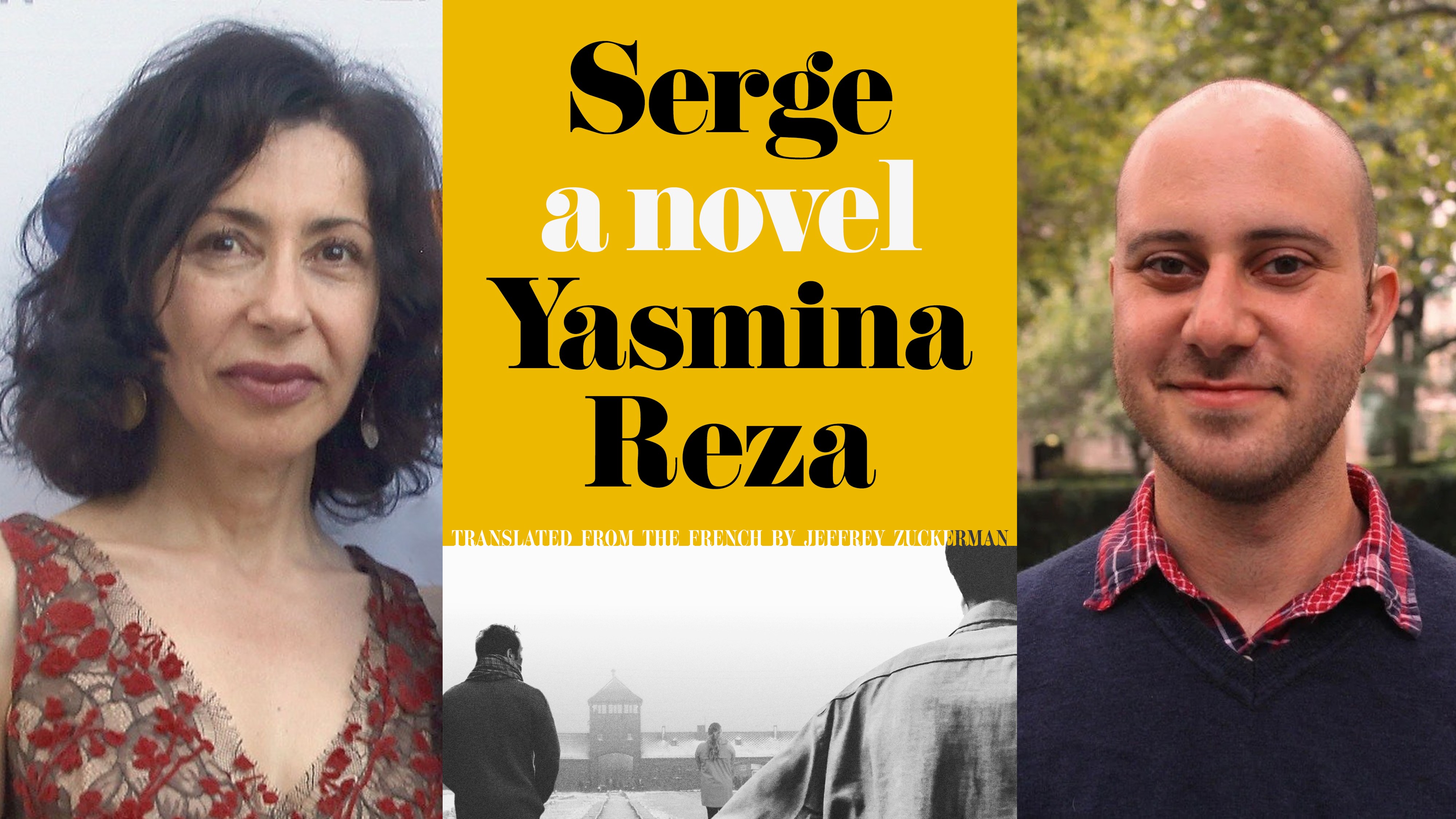
Translated from the French by Jeffrey Zuckerman.
When adult siblings Serge, Jean, and Nana embark on an unexpected road trip, they take along one daughter and more than enough tangled family history. As Jean watches his older brother fall apart, he tries to hold the center, and what might have been a solemn pilgrimage into the past quickly devolves into a tragicomedy of mutual fixations, private grievances, and the limits of kept company. As reflective as it is incisive, Serge is a testament to Yasmina Reza’s gift for finding light in the abyss.
The Birkenau camp is huge. Dizzyingly huge. Past the gate we
enter a realm devoted to death. The inevitability of this label
is undeniable. That itself is dizzying. No pretenses. The train
tracks go straight toward death. All paths, sooner or later, lead
there. At Birkenau, the industrial project of annihilation is
evident. All human activity and the spaces to shelter them are
in service of death.
At Birkenau there is nothing to do but walk. We approach
the hills. Rays of sunlight still come down. On the ramp, a man
plays at throwing a child up in the air.
Every so often a security guard comes through on a Segway.
Practically a supersonic roly-poly in a light-blue short-sleeve
shirt who goes through a barbed-wire door and disappears
behind a hut.
We walk down the railroad tracks. The tracks built to receive
Hungarian Jews. No sooner were they out of the train than they
were filing down the same path straight to the gas chamber. I try
to see what they saw. But nothing can be seen. Not the endless
expanse of grass. Not the rubble. Not the ghostly, tidy sheds.
A lawnmower can be heard in the distance. A wind presaging
stormy weather brings the scent of mountains.
We walk on a path belonging to no particular time. And we
ourselves have no idea what has led us there. I see my brother’s
body. Sunday best and gray hair. He strikes me as less solid.
Maybe even stumbling a bit.
He’s like our father going back up rue Méchain wearing a
jacket with overstuffed shoulders and billowing tails. I took him
to Cochin Hospital just two months before he died. A stupid,
pointless meeting to get a prostate exam from a big-shot buddy
of a boss at Motul. My father was dressed up to make a good
impression. The building was deserted because Mitterrand had
just had an operation there. On the way out, we were mobbed,
microphones out, by a pack of reporters cooling their heels.
“He’s doing well,” my father said calmly before the first question
had come, “the ‘Patient’ is doing well. Good evening to you,
sirs!” And on the strength of his status as a special visitor, he
strode off with pleasant condescension. He went back up rue
Méchain, drowning in the too-big suit, delighted that his voice
had rung so loud, delighted to have cheated death and come off
as a close acquaintance of the president. I couldn’t say that he
was limping, but that his body, similarly, had been tilting to the
side with each step as if weighed down by an invisible burden.
I see Nana on her own up ahead, the red messenger bag
across her back. I’m overcome by fondness for this little woman
who’s weathered the years. I could just dash over, surprise her,
kiss her on the neck. I see my brother and sister and me on this
road lined by chimneys and dead stones and I wonder what
fate landed all three of us in the same nest, not to mention the
same life. Behind us Joséphine indulges her photo obsession.
What if I married Marion, I think. Why leave the privilege
of a proper upbringing to the Ochoas? How old is she? Forty.
She could still have another kid. I’ll get a dog for Luc. A shorthaired
mongrel. Luc will play around with his dog and his
brother. I’ll be welcomed home by shrieks of joy and barking,
I’ll toss my jacket on a chair piled up with clothes.
We walk down the path leading nowhere. We’ll see the ruin,
a hideous flattened ruin in fragrant springtime. There are no
ghosts beside us. People meander up ahead. As there’s no right
pace here, we meander like them. Serge stops to light a cigarette.
He hunches to protect himself from the wind.
Here’s the ruin. The destroyed remnants of gas chambers
and crematoria. Caved-in buildings likely covered in weed
killer. Right by them is the monument to the victims: paving
stones with larger stone blocks on top engraved in several
languages. Serge hands me his phone. A message from Victor.
Uncle Serge, I read the chef’s email. I got it yesterday but everyone
knows I’m not glued to my phone esp. since I get like 1 email a
month. I have to ask: did you read it? Really read it? I don’t think
you did. You should. The chef’s offering me a two-week stage like
I’m an apprentice, but I’m applying for a full season in a team as
a COOK. (So you know: the last place I worked in is Chez Treuf,
where I really made an impression, I went from commis au froid
to chef de partie aux cuissons in just four months.) Meaning
that I’m aiming for demi-chef de partie at the very least. So, I
don’t feel any regret in turning down this offer. Like I said on
the phone, my email never received an answer; in the meantime,
other opportunities have come up. I never asked you to get back
in touch with the chef. I need you to understand that I live my life
apart from my mother and I wasn’t aware that she had asked you
to do so. You are my uncle. But given our relationship over the
past few years, I’m more inclined to say that you are the brother
of my mother. It’s saddened me that you’ve shown so little interest
in me and for so long. I am asking you to stop speaking to me in
this condescending, authoritarian tone for no good reason. You
are not my father, nor my boss, nor a “sensei” of some other sort.
I owe you nothing. Your threat will not and does not have any
hold over me. I am grateful to you for having tried to secure me a
position in this Swiss hotel, but I don’t need your help in general.
I just need a family. Victor.
“What a little shit,” Serge says.
“He’s young.”
“What a little shit.”
“He’ll get over it.”
“That tone of his. That arrogance. A prick right out of
school.”
“Ramos takes that tone.”
“‘I need a family’! Who needs a family? It disgusts me.”
“That’s his father, too.”
“What the hell are we doing here? Let’s get a move on, Jean.
All these plaques talking to humanity? All these ugly stones!”
I pull him in tight. His head against mine as he whispers,
“I hate it all.”
How nice the light is. Behind us is some underbrush. Some
pinkish trails amid the tall trees. They run the length of the
fencing and the peaceable watchtowers. In Svetlana Alexievich’s
oral history of Chernobyl, above the deserted area birds cavort
and “the sky is blue as blue.”
Nana and Jo join us. I say, “We’ve seen our fair share, haven’t
we? Shall we head out?”
“Oh no,” Joséphine says. “We have to see the Sauna!”
“What’s the Sauna?” Serge asks.
“It’s the disinfection and processing building.”
“Go without me.”
Nana turns crimson.
“You didn’t want to go into the gas chamber, you didn’t
want to see the Judenrampe, you made a point of boycotting
the Hungarian exhibition, and now the Sauna! Would it kill
you, Serge, if just once in your life you could put your ego aside
and go along with a group, just for a single day, to make your
daughter happy!”
I give her a gentle pat on the shoulder, but that only makes
matters worse.
“You could just be quiet and look. But no, you have to make
a spectacle of yourself. What are you trying to prove? That
you’ve seen it all already? That you’re not a tourist? We know
you’re not happy to be here. You don’t have to broadcast it every
second. I’m sorry; I took a plane to Kraków to see with my own
eyes the places where thousands of people died horribly, people
in our family, people we could have known personally. Serge
Popper has learned the lessons of these horrors, that’s great,
congratulations, but I haven’t, and neither has your daughter.
And who knows about Jean, he’s your toady. Your toady!”
“What lessons? There’s no lesson to learn from this,” Serge
says.
“Keep being insufferable, then.”
“Go! Go on to the Sauna!”
“Stop it, Papa! She’s right, you’re being negative and mean!”
“I mean it, go now! Be so good as to have a look at the Sauna.
I’m not standing in anyone’s way.”
“He’s being ridiculous. Come on, Jo,” Nana says.
“Okay.”
“Go, Jo. Go explore the camp with your aunt. And Victor
couldn’t care less what we’re doing here.”
“What’s Victor got to do with anything?”
“He just texted me.”
“Did he?”
“Go to the Sauna.”
“Stop it with the Sauna. What did he say?”
“There are words I don’t understand, but apparently I’m not
his uncle and I can go to hell.”
“Show me.”
“And apparently he’s an experienced chef! Just look and see!”
“He’s a chef.”
“Of course.”
Nana grabs his jacket, rummages in its pockets, and pulls
out the phone. Joséphine calmly keys in her father’s code. They
read Victor’s message together. At the end, Jo says, “That’s
funny of Victor.”
“A two-week stage!” Nana shrieks. “How did you expect him
to be happy about that?”
“You don’t think it’s odd that he sent me that while I’m at
Auschwitz?”
“What’s that got to do with anything?”
“You tell me!”
“We’re not under Hitler’s thumb. You’re not in striped
pajamas.”
“Plenty of folks would kill for a two-week stage at the
Walser.”
“Not when you’ve got an Émile Poillot diploma! And not
when you’re looking for a full season’s paid work!”
“The chef didn’t even know Émile Poillot.”
“He’s a rube! Everyone knows Émile Poillot! Did you read
the email? You didn’t read it!”
“What do I know about cuisine! I put the two of them in
touch, it’s on them to figure things out. It’s not my fault if Victor
Ochoa is the only kid on earth who doesn’t check his phone.”
“You yelled at him like he’d turned down the job of the
century!”
“Yelled! Is this boy made of sugar or something?”
“You reamed him out over the phone. You humiliated him.”
“About time someone talked to him, mano a mano! He’s
never had a proper education. A pathetic excuse for a father
and you’ve made a faggot of him!”
“Papa, you didn’t just say that!”
“What?” He took a few steps with his arms limp. “They
never should have abolished the military service.”
“Just wait two seconds, he’ll tell you that he’s ended up staff
sergeant and his men love him,” Joséphine says.
“That’s the absolute truth.”
“Can we just agree on one thing?” Nana cuts in, on the
verge of tears. “That you stop it, and same goes for you, Jean,
now and for all time, with badmouthing Ramos! I don’t want
to hear another word out of either of you about Ramos! I don’t
even want to hear his name out of your mouths, ever again!”
Joséphine hugs her tight and looks at us angrily.
“You have a point,” I say. “It’s a promise.”
I already know I won’t be keeping that promise.
To take the edge off, I add, “Let’s see the woods. Is the Sauna
that way?”
I clap Serge’s back to get him to come along. We set off in
silence. I recognize the woods. The men had stood talking, the
women and children had sat at the foot of the trees. In this
birch grove, the Hungarian Jews had awaited their turn in the
gas chamber. They had known nothing of their imminent fate.
We saw the photos this morning. In one, a tiny child had been
offering a bigger one a dandelion.
We’re alone. The sun is sporadic through the leaves. Nana
sways in her high boots. Suddenly she turns around and says
to Serge, lagging a few meters behind, “Where’s the success in
your life? I don’t see it.”
He stops, takes a drag on his cigarette, and says, “I don’t
either.”
“You go around acting all condescending, you act like you’re
doing us a favor, you spend your time judging other people’s
lives as if yours was something to be proud of.”
“No I don’t!”
“The way you talked about the Fouérés last night. You always
have to be snickering, getting a laugh in. They pull their dog
around in a cart, they call themselves Papa and Maman! If
they want to call themselves that, so be it! It’s not as pathetic
as looking around for people’s weaknesses. What’s so special
about your life? You’ve spent it looking for trouble. You’re sixty,
you don’t have a house anymore, your affairs are a mess, your
property manager’s ripping you off . . .”
“He’s putting me up.”
“Oh, how nice. I don’t get why you’re being so high-andmighty.
Monsieur Serge Popper does something for someone
once in his life, and we have to clap for him for ten years after?
You’re completely out of your mind, you sad sack. I spend my
days dealing with people in actual precarity, who are on the
absolute brink, some of their kids have never seen the sea or
the mountains, and I can tell you it’s a real luxury to go looking
for nits to pick yourself. Don’t you give me that look! Whenever
I talk about my work I have to hold back because I don’t want
your stupid snickering. Like it or not, I’m happy helping other
people, I’m proud to be supportive, to be part of a thoughtful
society, I think it doesn’t make any sense to live for oneself
alone. One day you’ll end up all alone in a hole, Serge. Because
you’ve lost an incredible woman who kept you from going
under. I don’t understand how you managed to lose Valentina!”
“Mind your own business.”
“Well, you make it your own business when you badmouth
Ramos, when you and your ass-kissing brother imply that
he doesn’t do anything, that he’s lying to the unemployment
office, when you insist that he’s not a good father when there’s
nobody more thoughtful, more devoted to his children than
Ramos . . .”
“The Nazis were also devoted to their children. Stangl was a
good father, Goebbels was a good father, I can give you a whole
list of good fathers who loved their families. Children are the
easiest thing to be devoted to. That doesn’t mean anything. And
likewise for families.”
“Very nice for Jo to hear that.”
Joséphine shrugs. She’s busy snapping pictures, tree trunks
in the foreground, of the ruins of Crematorium III.
“I don’t know what you can bring yourself to care about,”
Nana says. “Honestly, I feel like it’s nothing. That’s pathetic.
Give me a cig.”
“Why do you want one, Nana?” Joséphine asks.
“Because I’m smoking today!”
And now she’s smoking with her lips stuck out. And now
it’s raining. The pinkish trails disappear all of a sudden and
we hear a distant thunderclap. “Shit!” Nana yells. “How far are
we from the Sauna, Jo?”
They start running in the underbrush. We hurry in their
wake. The rain coming down is unreal. It’s a deafening, cruel,
heavy rain. It’s all around us, coming from the sky, the trees, and
maybe elsewhere, it hits us with a vengeance, we rush forward
blindly through its disorienting racket, branches scratching,
we can’t keep our eyes open. Our feet sink down, the earth is
already muddy. Mud! There’s that famous mud, the vile sludge
mentioned in books. It sucks in bodies, it’s hungry, what an
experience to take in its rising scent, hear its plop and splatter,
and how disgusted, how ashamed I am by this bizarre feeling.
The girls are running, stumbling through the tree trunks; we
can pick out their muffled yelps.
****
At the edge of the forest is a marshy expanse, at the end of
which an utterly desolate and nondescript building weathers
the storm. We hurtle, sodden, toward its courtyard, where
a station wagon is parked. Everything’s deserted: the doors
are shut and through the locked windows empty hallways
can be seen. Is this the Sauna? This building curled in on
itself, the Zentralsauna, the antechamber of hell of which the
escapees speak?
Yasmina Reza is a novelist and playwright whose prodigious work has been translated into more than thirty-five languages. Her plays include Conversations after a Burial, The Passage of Winter, The Unexpected Man, Art, Life x 3, A Spanish Play, God of Carnage, and Bella Figura, many of which were multi-award-winning international successes. Art was the first non-English-language play to win the American Tony Award. God of Carnage, which also won a Tony Award, was adapted for film in 2012 by Roman Polanski. Her novels include Babylon, which won the Prix Renaudot and was shortlisted for the Prix Concourt, Hammerklavier, Desolation,Adam Haberberg, Happy Are the Happy, andAnne-Marie the Beauty. She lives in Paris.
Jeffrey Zuckerman is a translator of French, including of books by the artists Jean-Michel Basquiat and the Dardenne brothers; queer writers Jean Genet and Hervé Guibert; and the Mauritian novelists Ananda Devi, Shenaz Patel, and Carl de Souza. A graduate of Yale University, he was a finalist for the TA First Translation Prize and the French-American Foundation Translation Prize, and recipient of a PEN/Heim translation grant and the French Voices Grand Prize. In 2020 he was named a Chevalier in the Ordre des Arts et des Lettres by the French government.
This excerpt from SERGE is published by permission of Restless Books. Copyright © 2021 Yasmina Reza. Translation copyright © 2025 Jeffrey Zuckerman.
First published as Serge, 2021.
Photo Yasmina Reza by power axle, CC BY 2.0 via Wikimedia Commons; photo Jeffrey Zuckerman © Rachel Caplan.
