
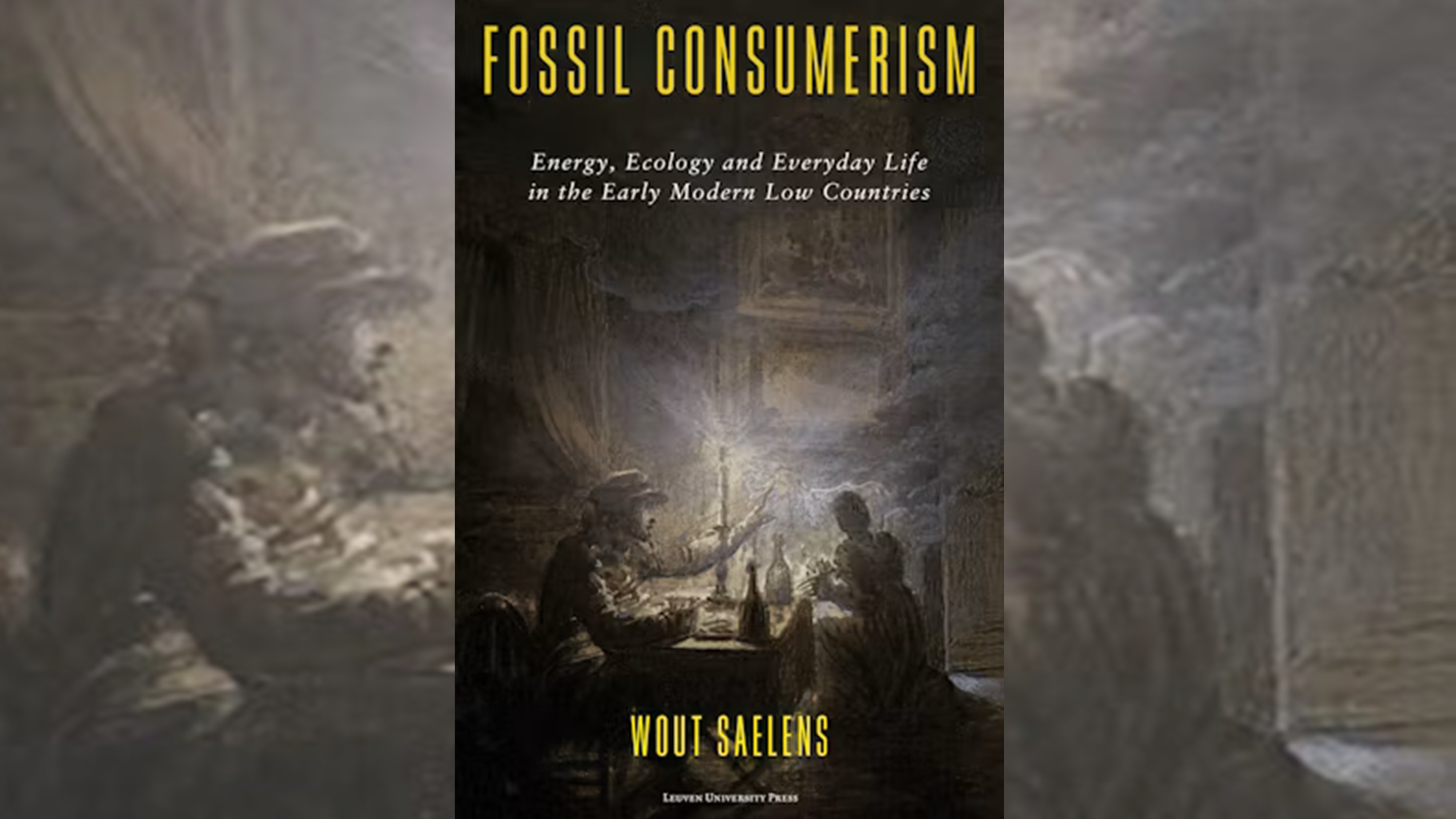
A Review of Fossil Consumerism. Energy, Ecology and Everyday Life in the Early Modern Low Countries.
By Paul Warde
The first part of the title of Wout Saelens’ latest book, Fossil Consumerism: Energy, Ecology and Everyday Life in the Early Modern Low Countries, is a clear reference to Andreas Malm’s Fossil Capital that appeared in 2016. Malm’s book posited that the origins of contemporary climate change could be found in the application of steam power in British textile mills in the middle of the nineteenth century, an outcome he argued arose not as a natural result of the technological development of engines but the determination of capitalists to better control and extract more profit from their workforces. It received a wide and positive reception among leftist historians—unapologetically Marxist, still grounded in the labor theory of value and asserting that the traditional culprit was, after all, responsible for newfound ills. We lived not so much in the Anthropocene as the Capitalocene. Malm’s book could usefully be compared with histories of the rise of oil and “petro-cultures” that stressed the planning of American cities and suburbia and the subsidization of the oil industry as factors that prevented consumers making different energy choices and locking them into an economy driving environmental destruction that was not their fault. These histories and Malm’s work share a desire to identify a culprit for the woes of the modern condition and a high degree of certainty about who is to blame.
The title of Saelens’ book tells us that we are getting something different. Perhaps the preferences of myriad consumers really are the issue. Instead of pointing to the Victorian capitalist in his stove-pipe hat, he argues that “by the end of the early modern period, private consumers had learned the modern lesson of compromising the health of the planet for their own comfort.” The origin myth of climate change is pushed back into the later eighteenth century and elaborated in a study of household energy use in two Low Countries cities, Leiden and Ghent. Leiden habitually used peat as a fuel, while Ghent switched from wood towards coal use after 1750. Both peat and coal are considered fossil fuels by Saelens, and given that a transition towards fossil fuel use only happened in one of the cities, he argues that the “revolution” associated with higher expectations of comfort and increased use cannot have been driven by the properties of the fuels themselves but a cultural shift: the rise of a “bourgeois domestic culture.”
While Fossil Capital and Fossil Consumerism appear to offer competing explanations of the origins of extensive fossil fuel use, they have much in common. Both came out of the authors’ respective PhD projects, claiming, in what to most readers will appear rather niche topics, they have found the key that unlocks the origins of modern climate change. They both call fossil energy a “fetish,” employing Marx’s idea of the commodity as a fetish that disguises its true nature: where for Malm it creates an imaginary based around fossil fuels as a source of employment and wealth, for Saelens the fetish is fossil energy as a source of comfort that disguises the pollution and labor (largely done by women) necessary to keep the home warm and clean. At the heart of the fetish idea is a critique of the moral implications of the specialization of labor. It is not hard to see how the buyer of a commodity may not have a very good idea (or wish to have one) of the product’s origins. It is perhaps harder to give credence to the idea that the person who enjoys a warm room is entirely unaware of the work being done in their own home.
Fossil capital and Fossil consumerism have something else in common: a style of argumentation that insists everyone else has got it wrong. Saelens offers his thesis as being, “Contrary to the established views that fossil energy mattered only in the cycle of production…” We might call this the neo-classical theory of academic labor—the value of a work is based on its relative scarcity, and a work becomes more important the more that everyone else has missed the point. Malm’s work received relatively little attention from economic historians, because his argument that capitalists like to profit from what they do largely accorded, in fact, with what they already thought and drew heavily on their work; and also because the British cotton textile industry only ever took a small share of national coal consumption and could not in itself account for an energy transition that had already largely taken place. Saelens’ plea for more research on consumers is certainly warranted. Nevertheless, previous authors’ arguments that changes in technology, for example, were a necessary condition of the rise of fossil fuels, in no way means that they thought it was the only condition. This is to read their works, one might say, in a “neoclassical” way, when in fact such authors largely saw change as a process of complex “feedback” (to use Tony Wrigley’s term) among various factors that become mutually reinforcing over time. Consumer practices and attitudes are one of these, among many, and nearly all early modern historians have recognized that the rise of fossil fuel use in Britain was primarily found among ordinary households—as occasionally Saelens does acknowledge. It is in this context that claims about discovering the “origins” of climate change can be put aside and Saelens’ work celebrated for what it is: a very interesting and enlightening study of everyday household fuel use in the urban Low Countries, which gives considerable material for reflection and comparison elsewhere.
The book has four substantial chapters following two introductory sections. The first of these chapters outlines the broad levels and forms of fuel consumption in the two case-study cities between the mid-seventeenth century and 1830, demonstrating rates of consumption not far off from modern levels, dominated by households, and producing equivalent amounts of pollution. The next chapter concerns the materiality and practices of this “energy revolution,” especially the rise of the mobile iron stove. For this and the rest of the book Saelens relies on a sample of 777 probate inventories listing people’s possessions on death (a sample that covers most levels of society but is clearly quantitatively skewed towards the rich). Dependence on peat, for example, is strikingly shown to be related to the popularity of foot warmers among Dutch women. Saelens demonstrates how the increased capacity to deliver heat and light throughout the home for the bourgeoisie is linked to the rise of a culture celebrating private comforts and sociability in rituals like tea drinking, and lighter interiors and clothes. The following chapter elaborates the theme of the fireplace’s association with health and happiness—but given that fireplaces produced soot and dirt—highlights rising attention to cleanliness too. The use of specific household items can be carefully traced through the rooms of the house, leading especially to the de-centering of the kitchen as a social space—at least among the well-to-do. Who did all the work to enable this change? The next chapter shows it was probably largely women who bore the burden. The fourth substantive chapter shows that the energy economy in the early modern Low Countries was very unequal, where much of the putative rise in consumption must have come from the relatively wealthy. Unsurprisingly, the latter were much more likely to own new-fangled gear and have larger stocks of fuel.
This is a short book, but it delivers a vivid and intriguing sense of early modern bourgeois life. Household energy use is largely dealt with in terms of leisure, and one might want more consideration of where and how the great bulk of the population worked and how this might have shaped fuel use, especially in a period of significant change after 1800. Saelens is dismissive of the idea that prices can largely explain fuel choices and foregrounds shifts in cultural expectations. He certainly shows that fuel use is never just “functional” but has “social qualities” too. Yet Leiden persistently consumed more fuel per person than Ghent—and fuel was a lot cheaper in the former. Ghent caught up after 1750 when it switched to coal and fuel prices fell (of course incomes must be part of the story too). Indeed Saelens’ evidence points to Leiden seeing a decline in per capital fuel use between the 1750s and 1810s, when prices there were rising, and there is no evidence that consumption was any higher than in the mid-seventeenth century until after 1850. So while bourgeois home energy practices were clearly changing from the late eighteenth century, it remains unclear, to this reviewer, whether this trend argues for some special causal linkage to the enduring level of fossil fuel use, whether in these cities or more widely. A longer book could perhaps have given more space to addressing different possible interpretations of the data.
Saelens offers his book as a riposte to what he calls the “neoclassical” reductionism of his predecessors. There is much to be learned from this clearly-written volume wedding quantitative and cultural approaches. In that spirit, the author’s core research is a fine and useful addition to an ongoing and ramifying field of work shared among the community of energy historians.
Paul Warde is Professor of Environmental History at the University of Cambridge. He has published numerous books and article on the theme of energy and environmental history, including Power to the People: Energy in Europe over the Past Five Centuries (2013), with Astrid Kander and Paolo Malanima, and The Invention of Sustainability (2018).
References
Malm, Andreas. 2016 Fossil Capital. The rise of Steam Power and the Roots of Global Warming. London: Verso.
Wrigley, E.A. 2015. Energy and the English Industrial Revolution. Cambridge: Cambridge University Press.
Fossil Consumerism. Energy, Ecology and Everyday Life in the Early Modern Low Countries
By Wout Saelens
Publisher: Leuven University Press
Paperback / 274 pages / 2026
ISBN 9789462705067
DOI: 10.11116/9789461667236
