
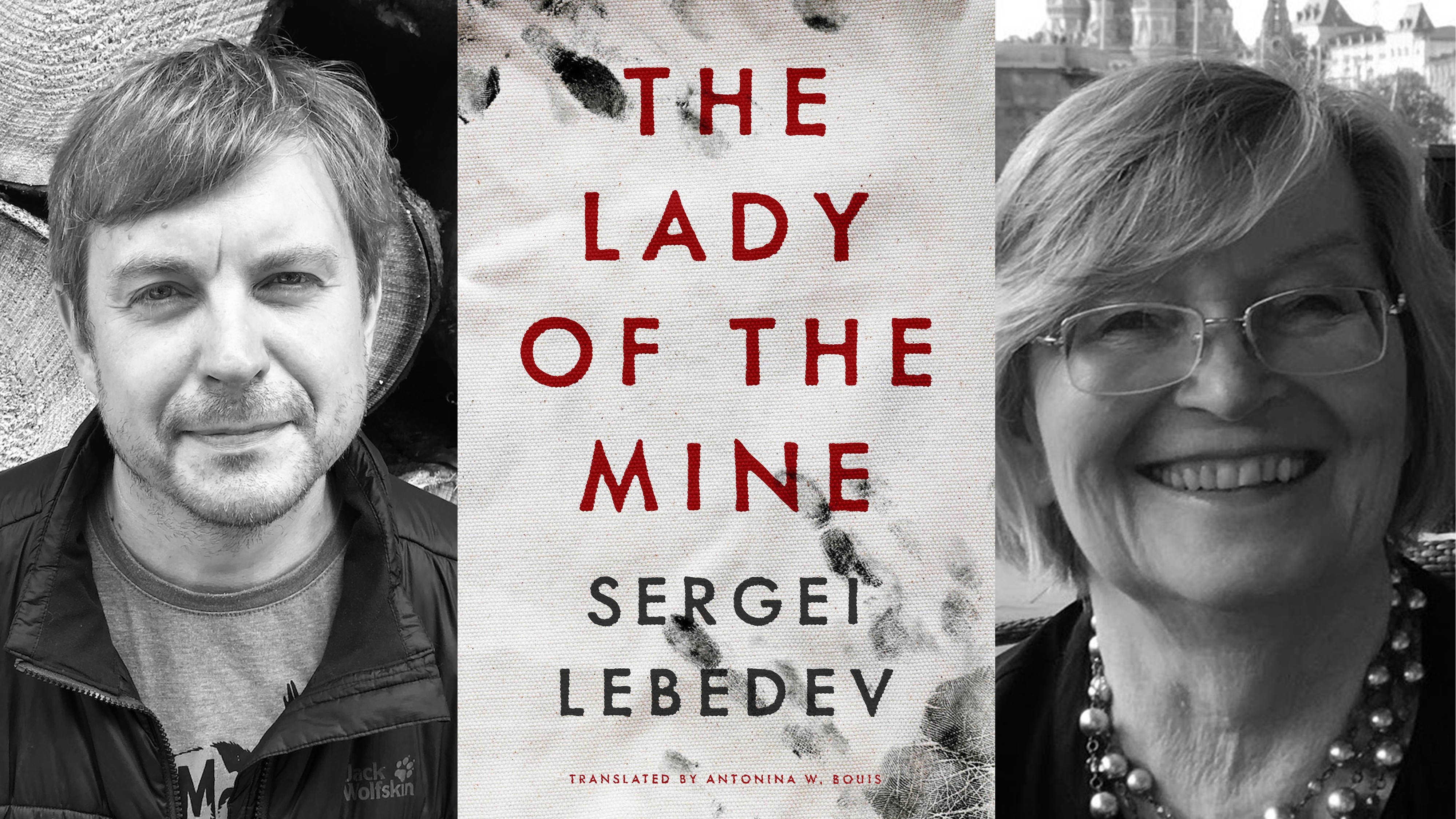
Translated from the Russian by Antonina W. Bouis.
The mystical laundress at the center of this novel is obsessed with purity. Her task is formidable as she stands guard over a sealed shaft at a Ukrainian coal mine that hides terrible truths. The bodies of dead Jews lying in its depths seem to attract still more present-day crimes. Acclaimed Russian author Sergei Lebedev portrays a ghostly realm riven by lust and fear just as the Kremlin invades the same part of Ukraine occupied by the Wehrmacht in World War II. Then corpses rain from the sky when a jetliner is shot down overhead, scattering luxury goods along with the mortal remains. Eerie coincidences and gruesome discoveries fill this riveting exploration of an uncanny place where the geography exudes violence, and where the sins of the past are never all that in the past. Lebedev, who has won international praise for his soul-searching prose and unflinching examination of history’s evils, shines light on the fault line where Nazism met Soviet communism, evolving into the new fascism of today’s Russia.
As the car drove him home from the Lubyanka, the general looked at the familiar Moscow streets, the Kremlin towers crowned with red stars across the river, and sensed with unusual clarity the capital’s power, which lay not in its architecture and monuments, but in the layers of the earth, in the embers of old fires. He suddenly realized that during all these years spent in Moscow, at the very throne, he wanted to return to the Marat settlement, to the Marat mine. Where he, a mining engineer by training, was in his element. Where he was left with unfinished business, an unsolved mystery, an unidentified enemy.
But he could have stayed there, Korol thought for the first time. He would now be a Ukrainian general. And corrected himself: no, he would not; he earned the rank of general in two wars against Chechnya; if he had sat around in Ukraine, he would be a colonel, at most. Korol was transferred to Moscow by order of the Union Committee, had been quickly pulled out of Donetsk in the fall of 1991, when the Ukrainian Committee had already been dissolved, when the archives had been gutted and evacuated. Of course, he could not have imagined then that he would never return, that Marat village and the mine would soon be abroad, in another country.
But he always felt their existence, their presence in the world. When he read about the accident in 1996 in the newspaper, he thought instinctively, “They must have touched the 3/4 shaft, the idiots.” He could see the Ostankino TV tower from his office window, all its five hundred and forty or however many meters, and thought, Shaft 3/4 shaft is deeper; you can lower the entire tower into it, and there would still be room. When he went down into the metro, he compared its depth, too.
He thought about what was in the shaft. The old borders had collapsed. Rubles with Ilyich on them became worthless, turned into candy wrappers. Coats of arms and flags were gone. Everything was new. Except for the Jews in the mine, under the plug. The eternal Jews: he repeated the old joke. Unchanging, like a gold reserve.
Today, when he got his first break, he ordered Semyon to take him to Shaft 3/4. The same road he’d taken thirty years ago from the regional office. Along the edge of the settlement, past the corner house of Marianna, the head of the mine laundry, the subject of the surveillance operation called “Snow White,” which he’d opened. He based it on the religious line, that she was a sectarian, because he could not write the truth in official papers.
However, it had begun with suspicions of religious illegality. Their informer, “Tatiana,” a neighbor, a cleaner at the ore department, told him that some ladies from out of town were coming to see the laundry chief, as if to visit, but were behaving conspiratorially. Korol wondered, couriers? Back then, they were looking all over the Donbas for a clandestine Baptist printing house. And this fit the bill: a corner house overlooking a country road, with a cellar. . . He identified the visitors.
Colleagues in their hometowns checked their records: both women had positive files, no relatives who had been arrested, no compromising data on them. They were also laundry managers. One from Karelia, the other from Siberia. From distant places, camp regions. Who the hell knew, maybe they met at some work event? At a seminar on machine washing? He sensed something strange about these visits. The ladies came from far away, not on a business trip, but at their own expense. Why? What’s so interesting here inMarat? The mine?
That’s when he started a surveillance case. Allegedly for illegal religious activity. He felt that maybe he was wrong in the letter of the instruction, but right in the spirit; there was something religious in Marianna, that is, supernatural. The surveillance team watched her. Correspondence was monitored, phone wiretapped. And nothing: all empty, all smooth, too smooth, as if she were a skillful scout who sensed the surveillance and lived so as not to give the slightest suspicion. She was a shock worker, awarded prizes, winning socialist competitions in laundry. Her mother was a military nurse, from a poor family, recipient of orders and medals, father unknown.
And he felt that Marianna was special, not like Soviet people. He thought that he discovered a new sect, where Marianna was like the Virgin Mary, some secret sisterhood, going back centuries. But what the hell was this sect? A washerwomen’s union? His colleagues would make him a laughingstock. And then he figured it out. During perestroika, they decided to erect a monument in the small Siberian town where one of the visitors came from, and Ogonyok had a big article about it. There was an NKVD execution site on the riverbank, thousands and thousands of people buried there, in a pit, an excavation. Here, there was a mine shaft. And Marianna, “Snow White,” as he dubbed her, was here. She was connected to it somehow. But how? And how to prove this connection? How to figure out what it was?
He did not dig up anything, and the miners’ strikes began; he had to shut down the surveillance on her, so as not to distract the operational forces. The general had already given instructions to find that file in the archives. He was sure it had survived. He himself had taken care of it thirty years ago, transferred it to special storage. However, he did not have time to take it back to Moscow. Sometimes he recalled it as one recalls love letters to a woman who did not reciprocate your feelings: with resentment and jealousy.
And now, delaying the pleasure, he imagined how he would lay out this file before Marianna. Would give her time to read it. Page after page. And he would ask her: Who are you? And if she didn’t answer, well . . .
Back then, in Soviet times, he could have summoned her for a preventive conversation, pressured her. He could have arrested her, tortured her with interrogations, threatened her. But he was sure in advance that she would endure, as many others had endured. But now. . . Now he could send her to the basement. To the basement of a long-closed sports center, where people quickly learn to answer questions. Now any secret was as accessible as a highway whore. And that’s why he was in no hurry; a confession happens only once. Sure, you could set up a video camera, play the tape afterward. But it’s celluloid, ersatz, it won’t replace the live feeling: shame, despair, with which a stubborn person timidly begins to speak.
Sergei Lebedev was born in Moscow in 1981 and worked for seven years on geological expeditions in northern Russia and Central Asia. Lebedev is a poet, essayist, and journalist. His novels have been translated into twenty three languages and have received great acclaim in the English-speaking world. The New York Review of Books has hailed Lebedev as “the best of Russia’s younger generation of writers.” He has been awarded the Prix Montluc Résistance et Liberté and currently lives in Germany.
Antonina W. Bouis is one of the leading translators of Russian literature working today. She has translated over eighty works from authors such as Yevgeny Yevtushenko, Mikhail Bulgakov, Andrei Sakharov, Sergei Dovlatov, and Arkady and Boris Strugatsky. Bouis, previously executive director of the Soros Foundation in the former USSR, lives in New York City.
This excerpt from THE LADY OF THE MINE is published by permission of New Vessel Press. Copyright © 2024 Sergei Lebedev. Translation copyright © 2025 Antonina W. Bouis.
First published as Белая дама by Sergei Lebedev, 2024 (Meduza).
Photo credits: Sergei Lebedev @ Jane Lezina; Antonina W. Bouis @ New Vessel Press.
