
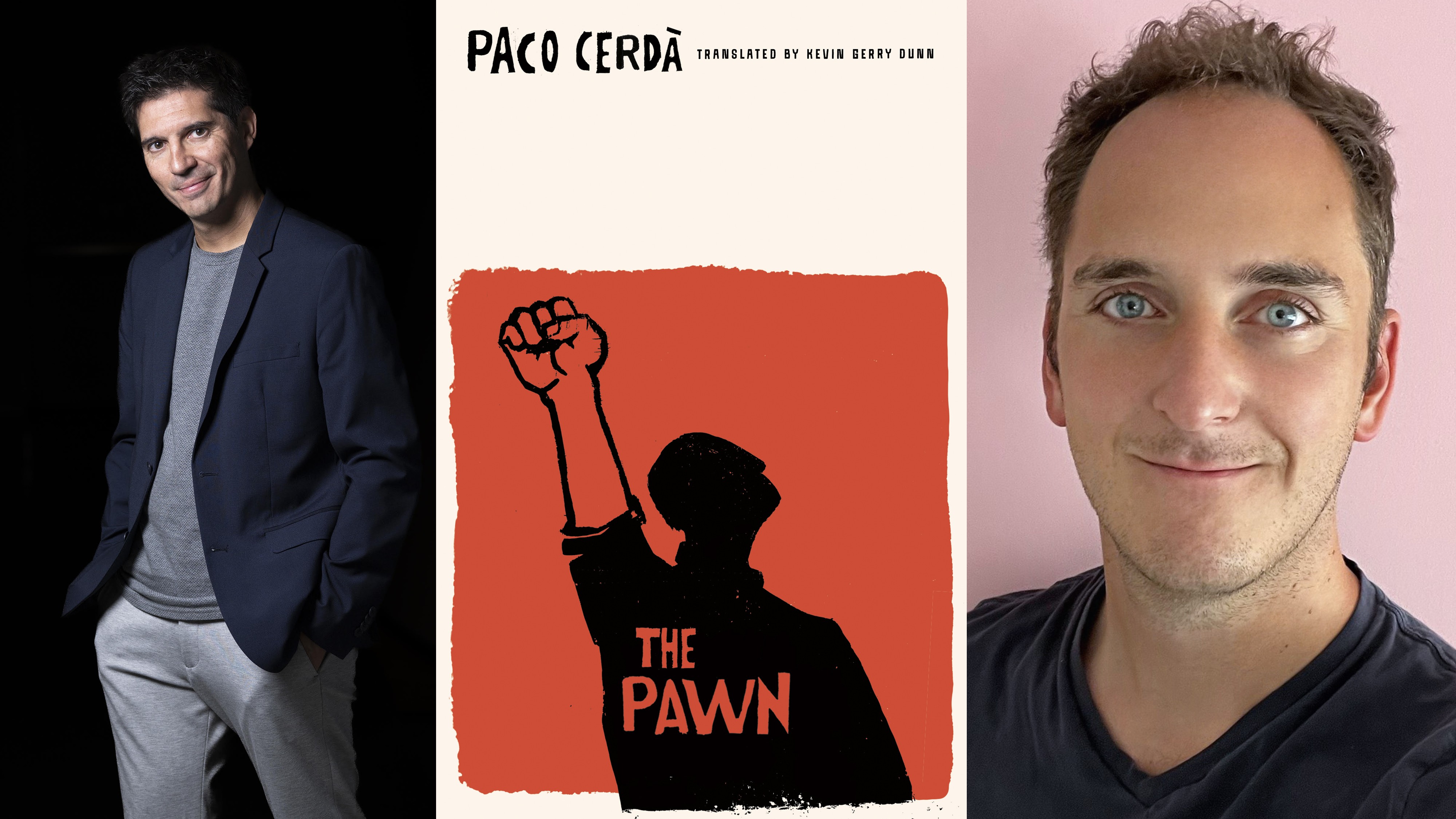
Translated from the Spanish by Kevin Gerry Dunn.
Stockholm, 1962. Spain’s first chess grandmaster, Arturito Pomar, faces off against eighteen-year-old American prodigy Bobby Fischer in a match destined for legend, celebrated more for its symbolism than for its outcome. Shuttling across decades and between the United States, Spain, the Soviet Union, and beyond, The Pawn chronicles the contentious careers of the two chess masters, expertly examining the geopolitical anxieties of the 1960s that went on to shape not just the lives of these men, but the modern world.
♗b2 ♚c6
By now there’s not a shred of childhood to be found in Arturito, except that diminutive “-ito” at the end of his name. At age twenty, the child prodigy is neither a child nor a prodigy.
The fever has died down. After he appeared as a precocious national champion in that photo with Franco, the media’s interest in him dropped abruptly—some would say cruelly. Where formerly he had been lavished with excessive praise and heroic attributes, whole newspaper pages and generous coverage on the radio and in propaganda reels, now there is just silence, the occasional insinuation of cheating, and terse dispatches crammed between articles on equestrianism and pigeon shooting. Chess has returned to its natural journalistic habitat: the margins. Every day can’t be Christmas; the circus only comes to town on Sundays.
A question hovers.
In 1946, at the peak of Arturito’s fame, a book entitled Over Fifty Games with Masters was released. It included a prologue and commentary by Manuel de Agustín, a chess enthusiast at the Marca sports newspaper, who helped craft and disseminate the legend of Arturito, which had captivated the paper’s director and its readers from his first appearance on the front page. The book concluded with a question that, in the heat of Arturo-mania, was ubiquitous: Will Pomar reach the apex of world chess? Who knows. He could become a genius or a notable figure in global contests. And if things go poorly, he’ll be a fleeting but bright meteor that sets the skies ablaze before burning out into oblivion.
It’s a little early to answer the question definitively. He’s only twenty. The game must go on.
On February 8, 1952, Pomar goes to Havana. It’s not his first time crossing the Atlantic. In 1949 he completed a five-month tour of Argentina: Mar del Plata, Santa Fe, Rosario. Back then he was a rising star, a player with no real limits. Now he is headed for Cuba. The reason is simple: in 1950s Spain, a chess player doesn’t have the luxury of living entirely from competition. Exhibitions pay better than championships. So, after coming in last at the Bad Pyrmont Zonal Tournament in 1951 and thereby falling off the train to the World Championship, Pomar decides it’s time to travel to the Americas and capitalize on the aftershock of his early fame. He visits Havana, New York, Los Angeles, some fly-over states, Tampa, Puerto Rico, Dominican Republic, Curaçao, Caracas, Maracaibo, San Salvador, Guatemala, Colombia, Panama, Costa Rica, Nicaragua, Illinois, Texas, Tampa again, Los Angeles again, and New Orleans. He participates in ten tournaments with worthy opponents like Reshevsky, Najdorf, Gligorić, Eliskases, Rossolimo, Evans, Steiner, Bisguier, and Santasiere; he completes three hundred sessions of simultaneous gameplay against dozens of players at once; he plays over ten thousand games in all modalities: classic games, speed games, blind-folded games, simultaneous games, timed simultaneous games, games with a handicap. Then, after a tour of the Americas that lasts two years, seven months, and one day, and after a journey of mental burnout and unexpected consequences, Arturo Pomar returns to Madrid, now half bald, on September 9, 1954.
But he didn’t have to.
On his journey, Arturito was offered political asylum and Mexican citizenship, which he declined; he was offered U.S. citizenship, which he declined. He said he couldn’t spend so much time away from home. An answer befitting a pawn.
On the other hand, his home, his country, his nation, his team, dealt with matters without a shred of poetry or passion. They dealt with it through the cold logic of bureaucracy.
In 1949, when Arturito traveled to Argentina without giving prior notice, he was censured by the Spanish Chess Federation. He was barred from competing in the national championship that year. According to Jeroni Bergas, one cannot discount the regime’s fear that Pomar could leave Spain for good, as so many other Spaniards did when they saw their prospects diminished by the war and Francoism.
Now their control over him takes another form, a funnier, shiftier one. Pomar has run afoul of Spain’s conscription laws.
Arturito, the nation’s pride and joy in the previous decade, the child who was shamelessly exploited by the regime, who flew the Spanish flag all around London, is subject to military disciplinary action for failure to appear at a conscription center. In the Official Bulletin of the Province of Madrid, on December 7, 1953, a military judge gives him twenty days to appear or else be declared in absentia, an insubordinate, a rebel. Which carries a prison sentence. A detail: the official bulletin, a soulless garbage disposal that flattens everyone and everything with its aseptic and neutral tone, does not refer to this potential insubordinate as a chess player, national champion, child prodigy, whiz kid, star of propaganda reels, bearer of the Cross of the Civil Order of Alfonso X, or the teenager who had an audience with Franco in El Caudillo’s palace. None of those facts, which had been so useful on prior occasions, are mentioned. Here and now, he is Arturo Pomar Salamanca, son of Juan and Francisca, of Palma de Mallorca, age twenty-one. Period.
But he won’t be declared in absentia. Pomar had been completing his military service at the General Captaincy of Madrid when he requested leave to travel to Cuba, though his absence was far longer than had been authorized, and a serious offense. Still, there are no reprisals. He is saved by a former Galician chess champion and Spanish semifinalist who is currently second-in-command at the Central General Staff headquartered at the same Captaincy where Arturo has been serving. That general, who years later would become Chief of Military Region VIII (Galicia), is Fermín Gutiérrez de Soto. Thus, the two-time national champion—a sports phenomenon who could have rebuilt his life in Mexico or the United States—returns to Spain anticipating greater fame, completes his military service, and swears allegiance to the flag. Like every other Spaniard. He is simply Arturo Pomar Salamanca, son of Juan and Francisca. And by this point, he is very nearly a rebel on home soil.
Paco Cerdà is a journalist and writer. He is the author of multiple award-winning books. The Pawn is the first book of his to be translated into English.
Kevin Gerry Dunn is a Spanish/English translator and a ghostwriter. His translations include The Tyranny of Flies by Elaine Vilar Madruga, Easy Reading by Cristina Morales, and works by Paul B. Preciado, María Bastarós, Daniela Tarazona, and Ousman Umar. He has received an English PEN Award, a PEN/Heim Grant, and a National Endowment for the Arts Fellowship.
This excerpt from THE PAWN is published by permission of Deep Vellum. Copyright © 2020 Paco Cerdà. Translation copyright © 2025 Kevin Gerry Dunn.
First published in 2020 as El peón by Pepitas de Calabaza ed., La Rioja, Spain.
