
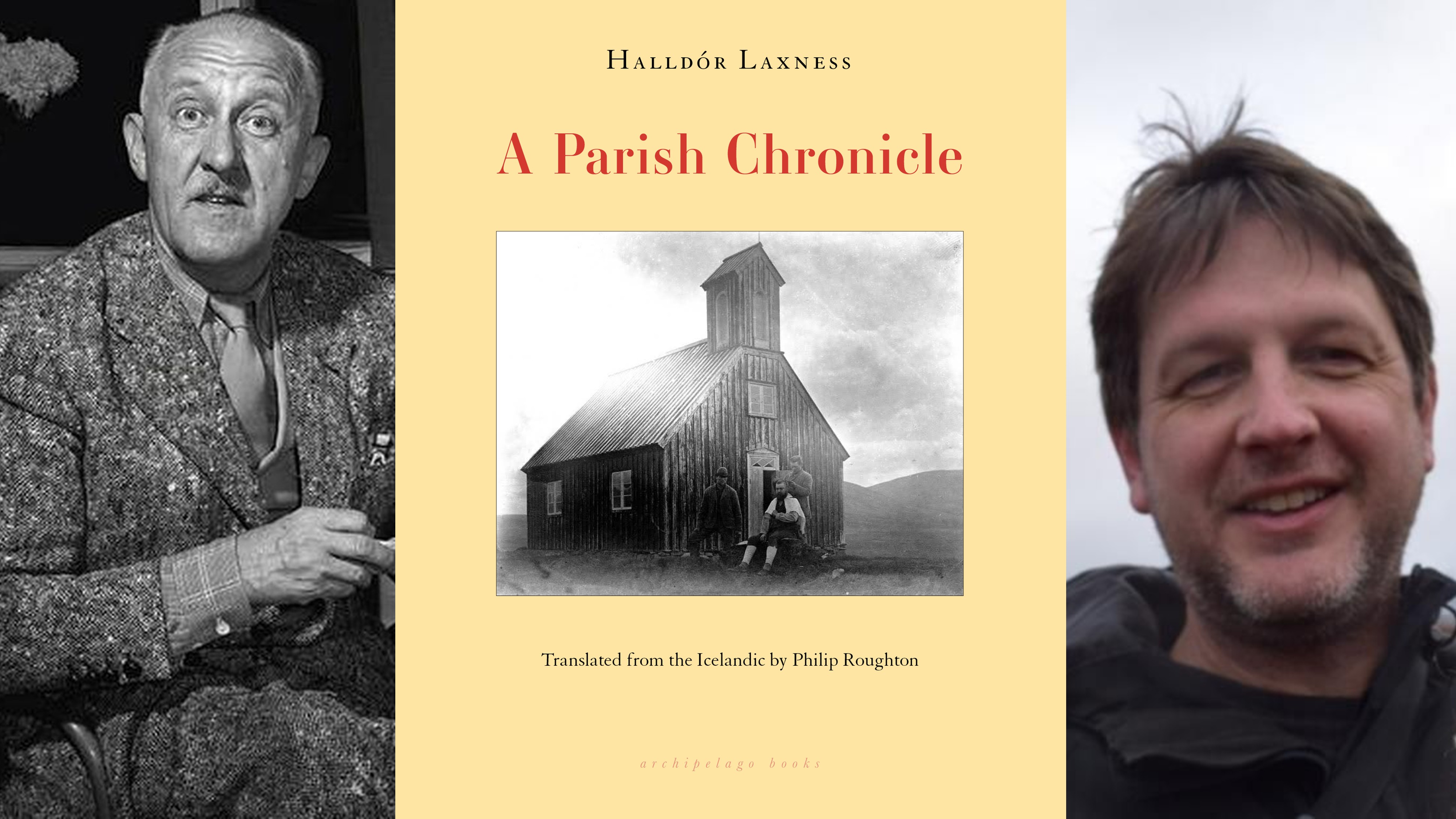
Translated from the Icelandic by Philip Roughton.
1882. In the still of morning, Ólafur sharpens his scythe on the bone-dry pavestones that separate his farmhouse from the rest of Mosfell Valley, where life revolves around sheep. The sound of his hammer rings out like a high-pitched bell over the tussocky fields. Across the valley, perched on a hill that hoards more sunshine than others, stands Mosfell Church. Nearby, the parish priest’s maid Gunna pours her “slosh,” a weak cup of coffee. Further afield in Reykjavík (“down south” as the locals say) the general assembly decides to revisit an old plan to cut costs by consolidating small parishes, and calls for the demolition of Mosfell. Yet today a church stands on that same hillside—its sharp steeple silhouetted against the clouds, its crown bell hanging to the left of the altar. In A Parish Chronicle, celebrated novelist Halldór Laxness combs through the minutest details of history—from the location of the ancient burial mound of national hero Egill Skallagrímsson down to the latter part of the 19th century, when weak-sighted Ólafur and bawdy farmhand Gunna will each play an unlikely role in the parish’s stubborn survival. An intimate ode to the way of life in Laxness’s home valley, and a shrewd commentary on how history bends to the quirks of certain individuals—A Parish Chronicle abounds with life.
Difficulty Unknown
It was rare to meet the Hrísbrú men when they weren’t in the
middle of farmwork, either going to the sheep sheds or coming
from them with moss in their beards, filling the hay crates, fixing
ropes at the storehouse door, maybe banging something together.
But their hands were never so tied that they didn’t have time
to natter with a traveler from Kjós about how it went for him
bringing back his sheep from the mountains, or to ask a person
from Borgarfjörður about the weather up there last year and the
year before that and the year before that; or a northerner how
the weather was there in the north during the Great Spring of
Feebleness twenty years ago, when the sheep here in the south
died from torpidity. The ups and downs of the country’s sheep
were discussed as one might normally discuss the circumstances
of better-placed people in society: unctuously and ceremoniously,
but perhaps not always with deep feeling. Sakes alive, how
smoky it is on Seltjarnarnes now! I say! Maybe they’re doing
some rendering, or boiling dogfish. Maybe their oil has caught
fire. What’s that rancid stench coming from the Mosfell priests
now? Hardly hung lumpfish, for great men like them; you don’t
suppose they got their hands on a whale, those devils?
They never walked straight and never bent-backed, but there
was no denying that they stooped slightly at the knees. Their
dogs were generally harmless and lay on the pavestones outside
the front door with piss-bored expressions, watching passersby.
It was only when Farmer Ólafur sicced them on the priest’s
sheep that they transformed, like the swine spoken of in Holy
Scripture. These men spent an inordinately long time going and
looking after their sheep, even taking into account their rather
laggardly gaits. While herding, they might sit down on a mossy
tussock in the middle of Mosfell Heath and start tearing into
a rock-hard cod’s head, which is one of the most complicated
challenges in Iceland, so much so that now only five people in
the country are thought capable of it, and so time-consuming
that whoever does it is hungry again by the time he stands up
from the table.
It’s a wonder that men so unadept at walking should spend
their lives competing in a long-distance race with swiftly bound–
ing sheep. But incredible as it may seem, those stiff-legged men,
only moderately sharp-sighted and prone to congestion, always
had it better in the race against those lightning-fast creatures,
which was, I think, because they always moved so slowly that the
sheep lost interest in the game; partly also because although the sheep
is stubborn, these men were a sight stubborner. They never
lost patience even if one of those creatures ran away from them
up a scree-covered mountainside, mad with fright. They never
talked about it being difficult; for them, the concept “difficult”
didn’t exist. It might be added that wise authors consider it a
superstition sprung from incapacity that there are such things
as difficult tasks; tasks are difficult only if they’re done by the
wrong methods. Although they couldn’t see well, no sheep ever
escaped them on the mountain; instead, they all returned to the
valley without showing any signs of fatigue or feeling out of
breath. They were incapable of hurrying, or of being late.
Now that the haymaking had begun, the men of Hrísbrú
could be seen in their homefield at the time of day when no
one else was up and about apart from one or two milkmen,
who set off shortly after midnight on their journeys south with
a wagonload of milk cans. It was never clear to me whether
they’d just gotten up, or hadn’t gone to bed. The Hrísbrú men
hardly moved, or so it looked, no doubt because the field was
so tussocky, unsuitable for those used to swinging away at the
grass with their scythes. It was strange to see those bearded men
toiling there at three o’clock in the morning, almost motionless
in the grass, hunched over their scythes, perhaps asleep. The
outcome, though, was that that tussock patch was left close-
mown and the Hrísbrú household never lacked hay. I still
remember them sharpening their scythes out in the field shortly
after midnight. For that job, the scythe’s cutting edge had to be
thinned in order to hone it better; the edge was flattened with
a blacksmith’s hammer on an anvil. The anvil was thrust into
a tussock, which the hammerer sat astride. The hammering
rang out like a rather high-pitched bell, carrying well even to
distant places in the still of the night. The peal of metal striking
metal was most welcome to the newly woken thrushes, which
rooted for earthworms in the scythe tracks of those men while
the grass was still damp. This is the music you remember when
you live to be a hundred.
Halldór Laxness (1902-1998) is the undisputed master of modern Icelandic fiction. He was awarded the Nobel Prize in Literature in 1955 “for his vivid epic power which has renewed the great narrative art of Iceland.” His body of work includes novels, essays, poems, plays, stories, and memoirs: more than sixty books in all. His works available in English include Independent People, The Fish Can Sing, World Light, Under the Glacier, Iceland’s Bell, and Paradise Reclaimed.
Philip Roughton has translated the work of Halldór Laxness, Jón Kalman Stefánsson, Kristín Marja Baldursdóttir and many others. He has twice been awarded the American-Scandinavian Foundation Translation Prize for his rendering of Laxness’s work, in 2001 for Iceland’s Bell and again in 2015 for Wayward Heroes. He also received the 2016 Oxford-Weidenfeld Prize for his translation of Jón Kalman Stefánsson’s The Heart of Man. He lives in Iceland.
This excerpt of A PARISH CHRONICLE is published by permission of Archipelago Books. Copyright © The Estate of Halldór Laxness. Translation copyright © Philip Roughton, 2026.
First published as Innansveitarkronika, 1970.
Photos: Courtesy of Archipelago Books.
