
By Dino Bozonelos and Daniel Vecchio
Contemporary pilgrimage has been understood mostly through European Catholic frameworks, with the Camino de Santiago in Europe functioning as an archetype and fostering Eurocentric definitions of pilgrimage across diverse religious contexts, often obscuring alternative forms of pilgrimage and limiting scholarly interpretation. These definitions, focused on the movement of religious travelers in search of the sacred in holy sites associated with relics, idols, or images, exclude practices in which sacred objects themselves travel to devotees’ familiar spaces. Thus, this study decenters pilgrimage by challenging the dominance of the Camino—or path—trope and its emphasis on the devotees’ journey toward a fixed sacred center. Instead, we analyze the movement of religious images using two cases outside Europe: the Santo Niño de Atocha and Our Lady of Guadalupe in Mexico. Can pilgrimage occur without physical travel by the devotee? We argue that it can, in that religious images themselves become pilgrims while also acquiring political significance. Foregrounding believers’ motivation—spiritual obligation, devotion, communal belonging, or purification—rather than movement, we recognize traveling religious items as legitimate forms of pilgrimage, prompting an inclusive reconceptualization and theoretically robust understanding of pilgrimage across cultural and geopolitical contexts beyond Europe.
Decentering the Camino in Pilgrimage Studies
The concept of decentering is rooted in the decolonization literature, which involves the efforts by scholars, researchers, teachers, and on occasion policymakers to rethink assumptions regarding European—or “Western”—ways of acting and knowing. It originally referred to the wholesale political change brought upon by anticolonial revolutions by people living in colonized territories within European empires (Betts 2012). These successful movements led to the creation of over a hundred new nation-states in the middle decades of the twentieth century, involving large swaths of the African and Asian continents. These new countries were in turn admitted to international organizations and started participating fully in global affairs, albeit with some reservations, as the Cold War struggle between the US and the former Soviet Union dominated international relations.
Yet even though these new countries decolonized politically, other aspects of their societies did not, and many citizens there did not experience any improvement in their economic status with independence. Economic relationships that existed beforehand continued, and the persistent disparity in wealth and standard of living between those who had been colonized and those living in the “metropoles” of the ex-colonial powers remained also apparent. In addition, scholars have pointed to the colonization of the mind; for example, recently decolonized peoples no longer expressed their thoughts in their indigenous languages (Ngũgĩ 1986; Ashcroft, Griffiths, and Tiffin 1989) but in the language of the ex-colonizer. Thus, the struggle to decenter Europe has been ongoing since.
This effort has extended to the study of religion, a process Bender et al. (2013) have analyzed in an extensive edited volume on the subject. Indeed, these scholars advocate for the “provincialization” of both Europe and the US, advancing that European and American understandings of religion should not be generalized in considering other understandings of religious phenomena. However, notions about the self, particularly in relation to the community, the existence or development of religious pluralism, or approaches to modernity, have been mostly operationalized using European and American measures. In the same way that context matters and the meaning of pluralism varies across societies, notions about secularism too vary. These variations are evident within Europe itself where, especially in parts of Northern Europe, secularism developed largely through widespread indifference towards religion, with many individuals neither identifying with nor actively practicing a religion. In other cases, secularization has been pursued more deliberately through state action, as seen in France, Belgium, Albania, and, in earlier periods, Turkey, where governments have taken explicit steps to limit the role of or exclude religion from public life.
Nevertheless, the importance of Christian grammar and syntax in the formation and curation of modern European identities should not be understated, even with the growth of secularism on the continent. Christian cathedrals still dominate European skylines, and in many European countries the calendar still centers on Christian holidays. Christian imagery in literature, architecture, and public monuments also creates a cultural heritage that is unmistakable (Mặcelaru 2025). This cultural heritage was subsequently imposed upon Indigenous peoples throughout European empires, often at the expense of local religious and cultural traditions. Thus, decolonization often involved a process of “wilful forgetting” by postcolonial states, where rupture with the old European political system provided an opportunity to begin anew and/or reclaim heritage (Bogaerts and Raben 2012). Still, escaping Eurocentric models of social and capital relations have proven difficult, and religion is a great example of a lingering duality—European and Indigenous—that has never been fully resolved (Barreto and Sirvent 2019). For example, in Mexican society, Indigenous spiritual practices became embedded into European Catholicism as the local Nahua (or Aztecs) resisted religious colonization (Gutiérrez 2019).
Pilgrimage has become an important part of contemporary religious expression, particularly as travel and tourism infrastructure have dramatically improved. Pilgrimage can be an expected part of one’s religious obligations, as seen in Islam or Hinduism (Olsen and Timothy 2022). Pilgrimage activities include meditating, praying, or performing religious rituals. Devout pilgrims travel to offer worship or veneration to the sacred, often with the desire to leave behind the secular. However, pilgrimage differs from mere religious tourism, as the goals of a religious tourist center upon the quest for knowledge rather than spiritual transformation (Jackowski and Smith 1992). The term “religious tourism” is thus reserved to describe forms of travel whose primary structure is religiously inflected visitation and acquaintance with sacred places (Raj and Morpeth 2007). However, religious tourism can also yield genuine spiritual benefit or transformation. Therefore, the line between tourist and pilgrim is often porous—admitting this liminal boundary, scholarship has increasingly recognize hybrid figures such as the tourist-pilgrim (Roszak 2023). There are moments where the self-identified tourist abandons that identity and becomes the pilgrim. A better basis on which to distinguish one from the other then is the primary intention of the individual: the religious tourist aims principally at acquaintance with and interpretation of the sacred site, whereas the pilgrim aims principally at ritual participation, transformation, and comportment before the sacred.
Recently, literature on pilgrimage has focused on the journey itself, rather than the destination. Much of the focus has been on Catholic pilgrimages, such as the Camino de Santiago—the Way of St. James—to the Cathedral of St. James, which terminates in Compostela, Spain. However, this shift is also evident in contemporary Protestantism, even if pilgrimage has not been a significant feature there over the last 500 years (Seaton 2022). Broadly speaking, walking pilgrimages have gained currency, with the European Holy Grail Route and the Way of St. Olav being most relevant (Fidgeon 2018; Jørgensen 2020). Given this context, the process of decentering pilgrimage turns this discourse on its head since it ultimately rests on the premise that religious travel involves not the travel of the pilgrim to the sacred but instead that of the sacred to the pilgrim.
Outside of Europe, the Camino’s emphasis on the journey—a European Catholic approach to pilgrimage—has been replicated, rooted in Marian apparitions, as exemplified in the case of Our Lady of Guadelupe in Mexico City. David Blackbourne (1994) notes that an intimate connection exists between Marian apparitions and pilgrimage, even when not sanctioned by the Church. For example, in the 1876 Marpingen case, three young girls claimed to see apparitions of the Virgin Mary, leading to mass pilgrimage to the village where the apparitions took place (Blackbourne 1994). The process by which the faithful travel to sites where the sacred is disclosed has been repeated throughout the European colonial empires, where the sites of Marian apparitions have become pilgrimage sites. The Catholic sanctuary of Our Lady of La Vang in Vietnam is another non-European example of this process, where a major pilgrimage route to the sanctuary has emerged, supported by the Vietnamese government (Lee and Cho 2025).
To date, little has been written regarding the decentering of pilgrimage. One researcher worth mentioning is Dominic Pasura (2023), who argues that modern pilgrimage studies is “underpinned by modernist assumptions of an autonomous, rational, and self-transparent subject who seeks to distance the self from forms of collective belonging and solidarity” (82). Pasura contrasts the Western view that pilgrimages are nothing more than individualistic experiences detached from the pilgrims’ moral community with the way Africans understand pilgrimage as a space of relationality. In addition, he posits that any research into religion and mobility has been almost wholly perceived through a Western lens. The fact that pilgrimages in African societies rarely fit the Eurocentric model dominating the pilgrimage studies discourse explains the dearth of research in this area.
The Camino Trope: Place-Based Pilgrimage and Embodied Practice
The discussion on decentering and decolonizing has applications in pilgrimage studies. In his critical analysis of the field, Simon Coleman (2021) suggests that a polythetic classification should be employed for pilgrimage. In such an approach, an activity is defined by its features, but these features do not necessarily form an essential core; rather, they help scholars understand similarities. For example, while a pilgrimage markedly involves the movement of people, a polythetic understanding of pilgrimage proposes that this movement is not an essentialist feature, even though it may dominate contemporary expressions of pilgrimage. Ironically, even though pilgrimage studies have benefited from multidisciplinarity, which naturally lends itself to broad articulations of pilgrimage, the default in the English-speaking literature has been to de-differentiate pilgrimage through a singular Anglophone understanding of religious travel that often omits the multiplicity of meanings embedded in various religions and traditions. In addition, the concept of religion itself has been defined through Euro-American modes of framing that limit what a religion should encompass. Tomoko Masuzawa (2005) notes how in the nineteenth century the representation of the so-called “great religions” of the world—Christianity, Hinduism, Buddhism, Islam, Judaism, and sometimes Confucianism, Taoism, and Shintoism—developed in a discourse of “othering,” where each religion and grouping of religious/spiritual practices were articulated using Western European, and by extension Western, Christian language during the colonial expansion.
Aside from focusing on the Camino, Coleman further explores two additional concepts closely associated with pilgrimage: communitas and contestation. For him, all three are tropes that have come to influence how scholars research pilgrimage. First, communitas is the most widespread concept in the field—the most “entextualized.” It involves the shared sense of feeling amongst people who go through an experience together. Second, contestation, while not considered to oppose communitas, suggests that viewing pilgrimage as a site for journeyers to develop a sense of belonging is spurious. As such travel is polymorphic, friction is inevitable, and the energy that emanates from such friction can lead to tension. Third, the Camino—or “path”—trope moves the concept of a ritualized center and instead places the emphasis on the journey itself, even though the end point of the path at the Cathedral of St. James in Compostela, Spain represents its culmination.
The Camino trope has thus become an accepted and actively articulated narrative in contemporary pilgrimage studies. “The Camino has become regarded increasingly as a ‘prototypical’ pilgrimage, particularly by those previously largely unfamiliar with pilgrimage” (Coleman 2021, 123). The focus is on the infrastructure found along the path, walkability, and the authenticity of the journeyers’ experience. It is less about finding spiritual fulfillment and more about escaping from the mundane. “More significant is the ritual grammar that links the activity of walking with the possibility of gaining relief from emotional baggage” (Coleman 2021, 124). This is hardly how pilgrimage was understood historically.
Latino Migrant Communities in the US and the Imágenes Peregrinas
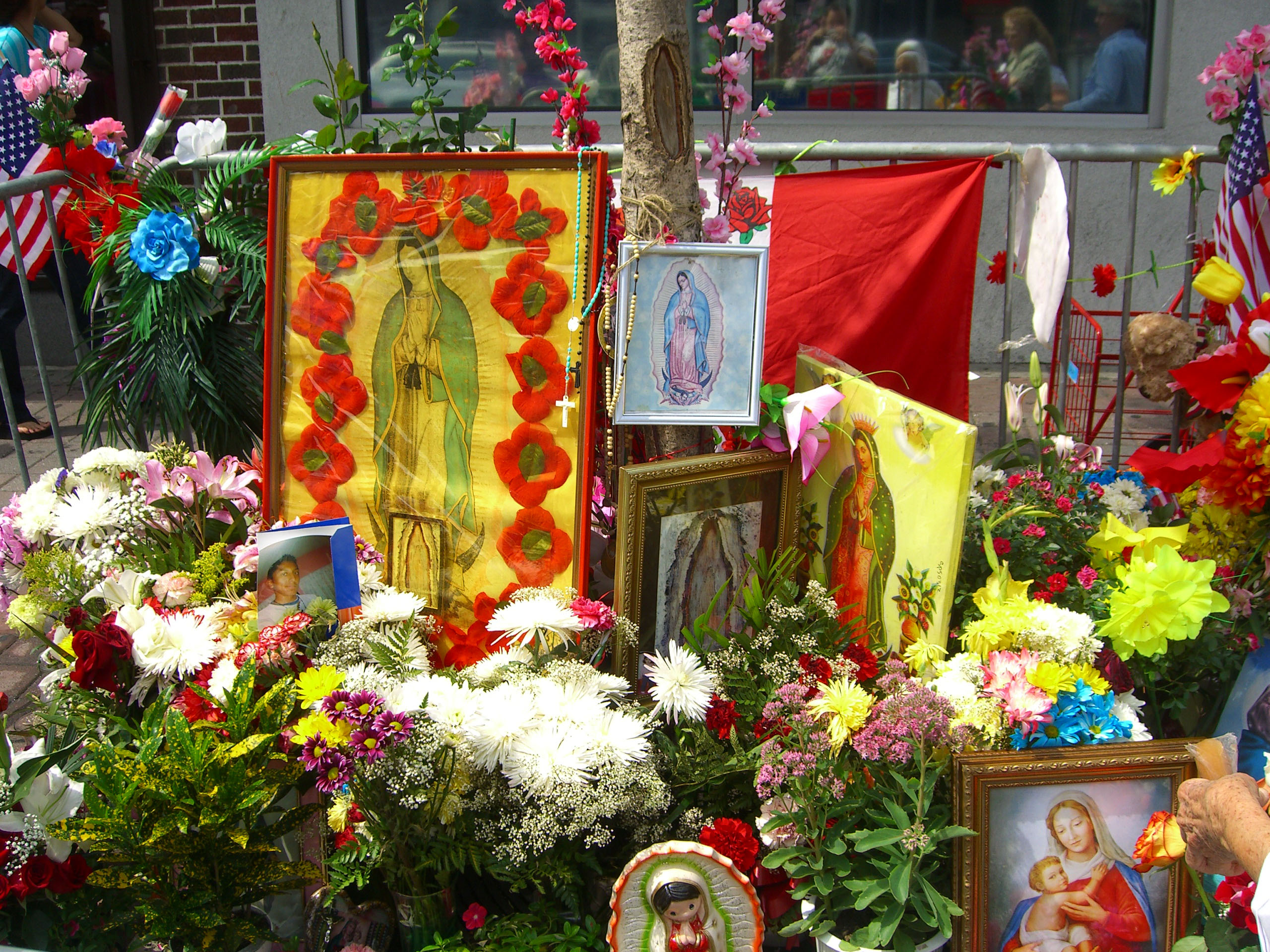
Imágenes peregrinas—or pilgrim images—are official replicas of esteemed images of nationally and regionally significant shrines and sanctuaries (see Scheper Hughes and Vargas 2013, 1). They are not primary relics but are considered relics in a derivative sense. These images are made of various physical media, including wood, cement, plaster, or porcelain. They are not objects journeyers merely acquire at the end of a pilgrimage but mobile representations of the sacred that act as co-pilgrims, as they are held by pilgrims on the move. This movement generates a multi-focal decentering of pilgrimage—away from the fixed shrine, the human-as-pilgrim, and the sacred terminus as the center of pilgrimage. Such decentering may necessarily take place during politically turbulent times, which can delineate new geographies of potential religious travel. Hence, these holy objects—or “images”—provide a concrete pattern highlighting how pilgrimage is not simply reducible to the trap of the “Camino trope,” which focuses on travel more than on transformation and flirts with religious tourism (explaining why the Camino has become a trendy topic amongst secular tourists on social media)
Indeed, those who visit traveling images are not best described as religious tourists. Rather, they are more adequately understood as pilgrims, since their dominant intention is spiritual transformation through an encounter with the sacred. They seek a liminal passage from the profane into a sacred mode of life and to return from that encounter with their religious expectations fulfilled. From a Catholic perspective, this goal may be understood in terms of sacramental mediation or the sacramentality of place and encounter for the believer; yet it remains a place of encounter that welcomes “…the guest, the stranger, the immigrant, the refugee, those of other religions, non-believers” (Pontifical Council for the Pastoral Care of Migrants and Itinerant People 1999).
In the US, religious images travel with migrants and help sustain their linkages with their origin communities and parishes (Scheper Hughes and Vargas 2013, 2) in a context in which US immigration and border enforcement actions have hindered many migrants from making pilgrimage to holy sites back in their home countries. Examples of popular pilgrimage sites for Mexican migrants include Plateros in the state of Zacatecas, where the Santo Niño de Atocha is enthroned in the local church (Scheper Hughes and Vargas 2013). Here, the Christ child is seated on a golden throne, dressed as a pilgrim, holding a basket of bread. As Mexican diasporic Catholic communities in the US have been unable to travel to the Santo Niño, a resin doll replica has traveled north instead. It is the parish priest who organizes and arranges the travel of the replica, which is said to be in the “…protective arms of the priest-escort.” Not only do the faithful in the US now have the opportunity to see their beloved statue where they are, but the statue’s travel holds a special significance in itself, as it recreates the journey that many of these migrants have made themselves on their way to the United States. This common passage reinforces the attachment that many migrants have to the Santo Niño de Atocha, as “…he also has the green card” (3). Shinji Hirai (2008), in his ethnographic study on migrant communities and their reception of traveling images, further explains that the church receiving such holy objects in the US assists in incorporating the migrant community into the life of the local parish, extending the community beyond the rigid borders imposed by geopolitics.
A second context offering a striking example of pilgrimage decentering through sacred objects sent forth from one community to another is found in the Carrera Antorcha Guadalupana (Abuzeid 2025), or the Torch Run of the Devotees of The Guadalupan Lady. Here, runners carry a torch from the Basilica of Our Lady of Guadalupe in Mexico City to St. Patrick’s Cathedral in New York City. One of the run’s US organizers, Luis Garcia, an undocumented immigrant and DACA beneficiary (the Deferred Action for Childhood Arrivals protects from deportation an undocumented immigrant who entered the country as a child), is unable to travel to Mexico—his home country—to visit the Basilica and venerate the Virgin. Yet, through participating in the run on the US side of the border, he is nonetheless able to, as he expresses it, “travel with the Virgin” (Abuzeid 2025).
These annual runs center on Our Lady of Guadalupe, who appeared to Saint Juan Diego, an Indigenous man. According to the tradition, the Lady left her miraculous image on the Saint’s tilma, or cactus fiber cloak, which was presented to the presiding Bishop of that time. This miraculous image is an important event in the history of Catholicism in Mexico. The pilgrimage to the site of the image ranks among the most popular for Catholics, as La Virgen Morena (the “Brown-Skinned Virgin”) appears as the great cosmic woman described in Apocalypse 12. The tilma is not only seen as a vindicatory miracle of the apparition of Juan Diego, but it is also understood as preserving the Nahua (Aztecan) iconographic mode in which she first appeared (Arredondo Sevilla 2025, 411), contributing to the adoption of Catholicism by Indigenous populations although it was seen as a foreign religion by many. The apparition and associated image allowed the Indigenous communities of Mexico to adapt a religion imported from Europe as their own faith. Thus, Our Lady of Guadalupe changes the grammar from traditional European heritage centered upon depictions of a European Virgin to a decentered syntax of a new Mestizo culture.
In these two examples of traveling sacred objects, we observe the pattern that Victor Turner terms “existential communitas.” What emerges “is a normative communitas that constitutes the characteristic social bond among pilgrims and between pilgrims and those who offer them help and hospitality on their holy journey” (Turner 1973, 194). Turner gestures to characters such as King Stephen of Hungary, who ensured the safe passage of pilgrims to Jerusalem. In contemporary America, traveling priests and local parishes function within this existential communitas as modern “Knights Hospitallers,”—an order of knights tasked with protecting pilgrims—as they seek to secure the spiritual benefits of pilgrimage for DACA beneficiaries and migrant workers while safeguarding them from law enforcement action (Abuzeid 2025; Hirai 2008). Decentering pilgrimage in order to grant safety to the devoted is, of course, not to erode the significance of pilgrimage, but to reconfigure it within the political, economic, and environmental context in which pilgrims find themselves. In this regard, the image (or statue) and what it represents become a moving center and helper, participating directly in Turner’s “existential communitas” by journeying to migrant communities. Indeed, many of those who have already undertaken a great journey to reach the United States have found pilgrimage back to Latin America prohibitive not just for economic reasons but owing to an uncertain political climate. In this uncertainty, the shorter drive to a local parish brings into sharper relief the differences between the religious tourist, motivated by the quest for knowledge, and the pilgrim—a difference grounded more in intentions and devotions than mileage. Thus, centers of pilgrimage are relocated close by, not merely by translating images and relics from one city or shrine to another but by conferring something of a “migrant status” to the object itself.
There are important antecedents to this reconfiguring of pilgrimage. Kathyrn Barush (2023, 2) recalls Felix Fabri, a Dominican friar who composed Die Sionpilger, “a pilgrimage-by-proxy in the form of a day-to-day guidebook to Santiago de Compostela, Jerusalem, and Rome,” so that cloistered nuns might experience the spiritual benefits of pilgrimage without breaking their vows. Barush also draws attention to objects such as souvenirs, contact-relics (third class relics), and replicas, noting that “another positive impact of these ‘transferred’ pilgrimages is that they can engender a sense of community and belonging among immigrants and their descendants” (2023, 232). Barush, in developing the theme of reinvented or “translated” pilgrimage, recognizes that an “embodied experience” can be transferred through such objects from one site to the next (ibid, 231). The re-imagining of pilgrimage was also apparent for the many pilgrims who sought to transcend the typical Camino-style pilgrimage during the COVID-19 pandemic. Even when the world shut down, the pilgrim would not be denied (Castronuovo 2023). Just like the immigrant communities that find themselves in a geopolitical reality that prevents traditional pilgrimage, the spiritual benefits of virtual pilgrimage and backyard caminos became popular.
The pilgrimages around Our Lady of Guadalupe and the Santo Niño de Atocha, among countless others, demonstrate that the essence of pilgrimage is not captured in a particular destination, often fashionable, journey, but that it is bound up by the intentions, sacrifices, and memories of the local pilgrim. Transitions of place still occur, though for the believers, the pilgrimage occasions not merely the appearance of images but also that of the holy men and women whom these images represent and who travel to a new center, i.e., communities in which the Latin American diaspora lives in the US. These case studies show that pilgrimage need not be defined by long-distance movement of the pilgrim to a fixed shrine but by a patterned encounter with sacred presence involving devotion, ritual, sacrifice, communitas, and transformation. In a diaspora setting, that pattern may be mediated by mobile sacred objects that relocate the center without dissolving it.
When reversing the pilgrimage, the center is thus moved with the community itself, as that is the place to which the object is sent. The sacred is drawn to and dwells among its members, becoming not a pilgrimage center but a center of pilgrims. As we have argued, this is especially poignant among migrant communities in the US that have had to put on hold their relationship with their home communities because they are unable to travel back. As Claudia Liebelt, Gabriele Shenar, and Pnina Werbner (2016, 33) argue, “[t]o overcome and transcend this sense of rupture, …migrants recast the moral geography of diaspora by becoming religious pilgrims.” We extend their argument here by incorporating the decentering of pilgrimage and the notion of “subjectively transformative forms of movement” through the imágenes peregrinas that are experienced as pilgrims among the pilgrims.
An Overwrought Metaphor for a European Ideal?
Perhaps one might argue that we are overextending a metaphor in order to compensate for communities in rupture. On this view, we are merely offering a consoling redescription: “yes, you too are pilgrims,” while quietly assuming that the traditional mode of performing pilgrimage remains the more authentic form. But that objection grants us too much power. As Lawrence Cunningham and John Kelsay (2022, 30) note, the sacred is, to some extent, beyond human volitional control. Whether an object is sacred is not for anyone to decide, even if human mediation plays some role in how sacred presence is interpreted or received. The same applies to pilgrimage. As we have seen, the spiritual benefits associated with pilgrimage, much like the yearning for a sacrament not yet received, may arise apart from the traditional form. This was true not only during the Middle Ages in Europe, as numerous examples attest, but also during the COVID-19 pandemic where virtual or imaginative pilgrimages became an expectation overnight. The contemporary forms of these pilgrimages serve as a catalyst for an embodied experience, even within one’s own home, or neighborhood (Barush 2021).
Statues, relics, and other sacred items have always traveled, but framing the itinerant religious object within the context of decentering pilgrimage, as we propose, provides a fresh perspective on what constitutes pilgrimage. Imágenes peregrinas represent such itinerant holy objects, and in some cases both the object and the devotee share in the identity of what it means to be pilgrim. Moreover, migrant communities in the US testify to the felt presence of those they venerate. It is therefore not a great leap to suggest that the sacred may be present in the movement of representative images, just as the ark of the covenant signified divine presence in the time of David (2 Samuel 6). We, therefore, resist the claim that such language is merely poetic, even as the sacred forces us into such expression. That language is also phenomenological and numinous—an effort to describe devotion as it is actually lived. Is the devotion less real when the image is on the move and comes to the pilgrims? Is the transformation any less authentic? Once the Camino trope and its romanticism of distance are set aside, the slag of wanderlust scooped off, what remains are pilgrims in a strange land, accompanied by the sacred rather than abandoned by it. Nor does this approach abandon Turner’s claim that the center is “out there.” Rather, following Coleman, it challenges an overly rigid, almost Newtonian absolutism of place. The question is not whether the sacred remains elsewhere but whether it may also dwell among migrants without ceasing to be sacred.
Dino Bozonelos earned his PhD in Political Science from the University of California, Riverside. He is currently a lecturer in the Department of Political Science and Global Affairs at California State University, San Marcos and Professor of Political Science at Victor Valley College. He co-edited The Politics of Religious Tourism, and his research focuses on global issues including geopolitics, religious tourism and pilgrimage, and the intersection of religion and politics.
Daniel Vecchio holds a PhD in Philosophy from Marquette University and an MA in Philosophy from Boston College. He is Associate Professor of Philosophy and Religious Studies at Victor Valley College, in Victorville, California. His primary area of research is in the philosophy of religion, with an emphasis on “Classical Theism.”
References
Abuzeid, Amira. 2025. “Runners Carry Torch from Mexico to New York Praying for Immigrants, Honoring Our Lady.” National Catholic Register, October 29, 2025. https://www.ncregister.com/cna/runners-carry-torch-from-mexico-to-new-york-praying-for-immigrants-honoring-our-lady.
Arredondo Sevilla, Jorge. 2025. “Aztec Interpretations of the Sacred Tilma: A Nahua Iconographical Reading of Our Lady of Guadalupe.” International Journal of Latin American Religions 9: 393–423. https://doi.org/10.1007/s41603-025-00306-8.
Ashcroft, Bill, Gareth Griffiths, and Helen Tiffin. 1989. The Empire Writes Back: Theory and Practice in Post-Colonial Literatures. London: Routledge.
Barreto Raimundo, and Roberto Sirvent. 2019. “Introduction.” In Decolonial Christianities: Latinx and Latin American Perspectives, edited by Raimundo Barreto and Roberto Sirvent, 1-21. Cham: Springer Verlag.
Barush, Kathryn R. 2021. Imaging Pilgrimage: Art as Embodied Experience. London: Bloomsbury Visual Arts.
Bender, Courtney, Wendy Cadge, Peggy Levitt, and David Smilde. 2013. “Introduction.” In Religion on the Edge: De-centering and Re-centering the Sociology of Religion, edited by Courtney Bender, Wendy Cadge, Peggy Levitt, and David Smilde, 1–20. New York: Oxford University Press.
Betts, Raymond F. 2012. “Decolonization: A Brief History of the Word.” In Beyond Empire and Nation: The Decolonization of African and Asian Societies, 1930s–1960s, edited by Els Bogaerts and Remco Raben, 23–38. Leiden: KITLV Press.
Blackbourn, David. 1994. Marpingen: Apparitions of the Virgin Mary in Nineteenth-Century Germany. New York: A. A. Knopf.
Bogaerts, Els and Remco Raben. 2012. “Beyond Empire and Nation.” In Beyond Empire and Nation: Decolonizing Societies in Africa and Asia, 1930s-1970s, edited by Els Bogaerts and Remco Raben, 7-21. Leiden, Netherlands: KITLV Press.
Bozonelos, Dino. 2023. “Bringing the State Back into Religious Tourism: Institutional Logics and Religious Tourism Governance.” In The Politics of Religious Tourism, edited by Dino Bozonelos and Polyxeni Moira, 57–68. Wallingford, UK: CAB International.
Castronuovo, Valentina. 2023. “Closure of Sacred Sites and Autonomous Organization of Religious Ritual: Re-Thinking the Geography of Sacred Space, Policies and Restrictions in Europe in the Age of COVID-19.” In The Politics of Religious Tourism, edited by Dino Bozonelos and Polyxeni Moira, 159–171. Wallingford, UK: CAB International.
Coleman, Simon. 2021. Powers of Pilgrimage: Religion in a World of Movement. New York: New York University Press.
Cunningham, Lawrence S., and John Kelsay. 2012. The Sacred Quest: An Invitation to the Study of Religion. 6th ed. Boston: Pearson.
Fidgeon, Paul R. 2018. “The Holy Grail Route: Mystic Routes and Activities to Improve Local Tourism.” In Religious Pilgrimage Routes and Trails: Sustainable Development and Management, edited by Daniel H. Olsen and Anna Trono. Wallingford, UK: CAB International.
Gutiérrez, Verónica A. 2019. “Indigenous Christianities: Ritual, Resilience, and Resistance among the Nahuas in Sixteenth-Century Mexico.” In Decolonial Christianities : Latinx and Latin American Perspectives, edited by Raimundo Barreto, Roberto Sirvent, 107–127. Cham, Switzerland, Palgrave Macmillan.
Hirai, Shinji. 2008. “La Virgen de la Asunción viaja a California: Migrantes mexicanos y construcción de circuitos simbólicos y emocionales transnacionales.” e-misférica 5 (1). Hemispheric Institute of Performance and Politics. https://hemisphericinstitute.org/es/emisferica-5-1-traveling/5-1-review-essays/la-virgen-de-la-asuncion-viaja-a-california-migrantes-mexicanos-y-construccion-de-circuitos-simbolicos-y-emocionales-transnacionales.html.
Jackowski, Antoni, and Smith Valerie L. 1992. “Polish Pilgrim-Tourists.” Annals of Tourism Research. 19(1): 92-106. https://doi.org/10.1016/0160-7383(92)90109-3
Jørgensen, Nanna Natalia, John Eade, Ekeland, and Catherine A.N. Lorentzen. 2020. “The Processes, Effects and Therapeutics of Pilgrimage Walking the St. Olav Way,” International Journal of Religious Tourism and Pilgrimage, 8(1): 33-50. https://arrow.tudublin.ie/ijrtp/vol8/iss1/6
Lee, Younghee and Cho, Hyo Dan. 2025. “Visitor Experience Model at the Marian Shrine of La Vang,” International Journal of Religious Tourism and Pilgrimage, 13(1), 15-33. https://doi.org/10.21427/accc-9x23b
Liebelt, Claudia, Gabriele Shenar, and Pnina Werbner. 2016. “Migration, Diaspora, and Religious Pilgrimage in Comparative Perspective: Sacred Geographies and Ethical Landscapes.” Diaspora: A Journal of Transnational Studies 19 (1): 32–50. https://doi.org/10.3138/diaspora.19.1.03.
Mặcelaru Marcel, 2025. “Christianity and the Search for a Cohesive European Identity: Toward a Public Theology of Memory, Ethics, and Encounter.” Research Association for Interdisciplinary Studies (RAIS) Conference Proceedings, 155-169. DOI: 10.5281/zenodo.16219319
Masuzawa, Tomoko. 2005. The Invention of World Religions; or, How European Universalism Was Preserved in the Language of Pluralism. Chicago: University of Chicago Press.
Ngũgĩ wa Thiong’o. 1986. Decolonising the Mind: The Politics of Language in African Literature. London: James Currey; Nairobi: Heinemann Kenya; Portsmouth, NH: Heinemann; Harare: Zimbabwe Publishing House.
Olsen, Daniel H., Dallen J. Timothy. 2022. “Investigating the Intersections Between Religion, Spirituality, and Tourism.” In The Routledge Handbook of Religious and Spiritual Tourism, edited by Daniel H. Olsen and Dallen J. Timothy, 1-13. New York: Routledge.
Pasura, Dominic. 2023. “De-Centring Pilgrimage Studies: Understanding Neo-Pentecostal Journeys and Pilgrimage in Africa.” Journal of Contemporary Religion 38 (1): 79–96. https://doi.org/10.1080/13537903.2023.2170575.
Piva, Elisa, Stefania Cerutti, and Razaq Raj. 2019. “Managing the Sacred: A Governance Perspective for Religious Tourism Destinations.” In Managing Religious Tourism, edited by Maureen Griffiths and Peter Wiltshier, 10–21. Wallingford, UK: CABI.
Pontifical Council for the Pastoral Care of Migrants and Itinerant People. 1999. “The Shrine: Memory, Presence and Prophecy of the Living God.” Vatican, May 8, 1999. https://www.vatican.va/roman_curia/pontifical_councils/migrants/documents/rc_pc_migrants_doc_19990525_shrine_en.html.
Raj, Razaq, and Nigel D. Morpeth, eds. 2007. Religious Tourism and Pilgrimage Festivals Management: An International Perspective. Wallingford, UK: CABI.
Rhodes, R. A. W. 1997. Understanding Governance: Policy Networks, Governance, Reflexivity, and Accountability. Buckingham: Open University Press.
Roszak, Piotr. 2023. “From Tourist to Pilgrim: Theological and Pastoral Challenges in the Context of the Camino de Santiago.” Pastoral Psychol 72: 647–657. https://doi.org/10.1007/s11089-023-01099-3
Scheper Hughes, Jennifer, and Daisy Vargas. 2014. “Traveling Image of the Holy Child of Atocha (Santo Niño de Atocha), Plateros, Mexico.” Object narrative. Conversations: An Online Journal of the Center for the Study of Material and Visual Cultures of Religion. https://doi.org/10.22332/con.obj.2014.35.
Seaton, Tony. 2022. “Pilgrimages, Journeys, and Outings: the Historical Mobilities of Religious Praxis.” In The Routledge Handbook of Religious and Spiritual Tourism, edited by Daniel H. Olsen and Dallen J. Timothy, 17-35. Wallingford, UK: CABI.
Turner, Victor. 1973. “The Center out There: Pilgrim’s Goal.” History of Religions 12 (3): 191–230. http://www.jstor.org/stable/1062024.
Photo: © Luigi Novi / Wikimedia Commons. Licensed under the Creative Commons Attribution 3.0 Unported license.
