
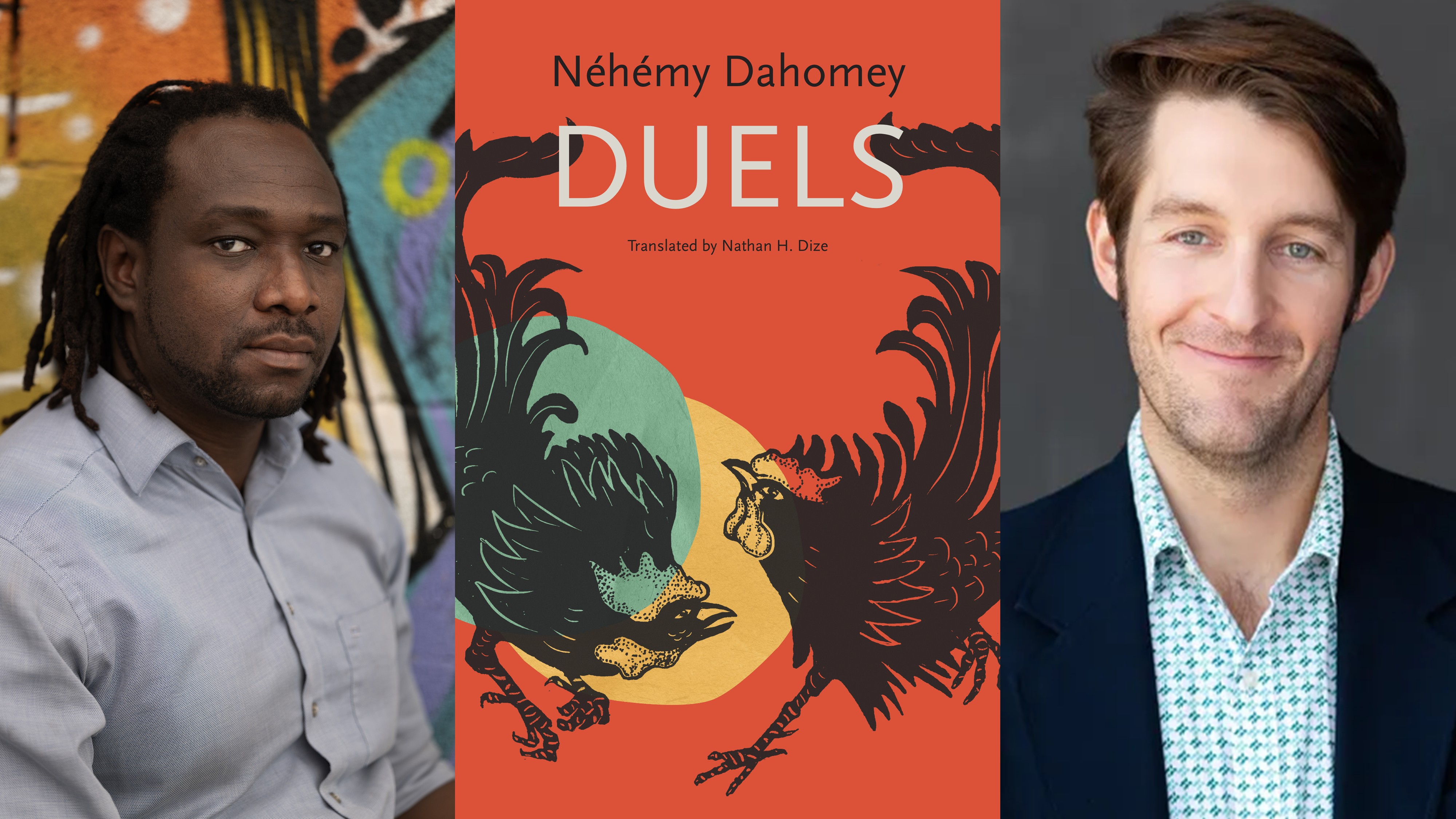
Translated from the French by Nathan H. Dize.
Set in 1842, this novel foregrounds a Haiti that is grappling with the weight of an onerous debt imposed by France, forcing its citizens to pay reparations to French colonists in exchange for diplomatic recognition of the first Black republic of the Americas. In the town of Boën, a prosperous notary, Ludovic Possible, decides to take a bold step to secure the future of his community. He opens a schoolhouse where local children can learn both artisanal skills and the essential ability to read and write. For Ludovic, education represents the best chance for the people of Boën to rise above their hardships and build a prosperous future—especially for Aïda, a quiet and enigmatic girl whose mother’s marvellous stories captivate him.
The tranquillity of Boën is soon shattered, however, by a series of duels that pit families, neighbours, and even animals against each other. As tensions rise, Ludovic’s vision for a better future is threatened by the escalating violence. In Duels, Néhémy Dahomey introduces readers to a rich and unforgettable cast of characters—Aïda, Ludovic, Balthazar Possible, Pépé the Tempest, and many others—who find themselves at the crossroads of a nation on the brink of transformative change.
It was the thirty-eighth year of independence, or 1842 for the rest of the world. Sixteen years ago, the government in Port-au-Prince, then Port-Républicain, the titular capital of the Island of Haiti, Kiskeya or Boyo, from north to south, from east to west, had agreed to a financial debt to the country of France, following the implacable logic of paying recompense for its bygone servitude, including land and personal property.
Since then, with this aim in mind, the very fine Jean-Pierre Boyer, the mulatto President-for-life of the entire Island of Haiti under the title of the Supreme Leader of the Nation, imposed drastic taxes on farmers, from north to south, from east to west —taxes that were often higher than the farmers’ annual revenue. With such a ruinous system in place, the country not only reduced what folks call the independence debt but also ensured lasting poverty for generations to come. In order to sustain itself to carry out ambitious projects, to support industrialization, the Central Government drafted citizens into days of unpaid labour whenever it pleased. The corvée meant working your fingers to the bone all day long in exchange for a meagre survival diet at the worksite. Some willingly accepted, most of them soldiers. Others, pressured by armed troops, ultimately submitted. There comes a time when intimidation no longer holds. When military pressure is protracted, it cracks from within. When abductions multiply across the country, you witness state dignitaries, urged on by their wives, ally themselves with popular movements, marching in Port-au-Prince and promising to sever the head and the neck from the President of the Republic’s shoulders.
urban fantasy of returning to nature. After years of peasant life with Timoléon, after three miscarriages and the loss of two children, Bérénice had not lost hope of reversing the colonial order—that is, the end of mulatto rule—without replacing it with some God-knows-what Black aristocracy. For the time being, her contribution to this future world of love and peace, free of domination and ethnic strife, was limited to cajoling an excessively exuberant companion, wishing to bear him more sweet children, and, above all, spreading the good word of education and science wherever the opportunity arose. This is why Ludovic Possible had once found in her a solid ally for his own educational efforts.
*
Bérénice and Timoléon lived a stone’s throw from Papa Possible. All they had to do was exit the notary’s front yard, take a few steps to their left, pass the mango trees no one ever touched, and walk past the little path on the right bordered by sugarcane that led to Tapage Market. Further down, to the right, two coconut palms were rooted inside the yard of the two liveliest political minds in the entire plain. Thanks to this proximity, the notary
did not solely have a schoolhouse and children to occupy his time. Bérénice managed the house, brought order to the day, and furnished a sense of presence to all around her. It was she, for example, who suggested involving certain parents in the children’s instruction.
The same geographical propinquity also explained why Timoléon Jean-Baptiste never skipped a round of dominoes on Thursday evenings.The complicity that was established between these men eventually subsumed the tensions that had once seemed essential to Timoléon’s vision of the world. When Ludovic lived far away, he was merely profiting from the labour of lowly peasants. Now that he was present in the flesh and alliances could be forged, the personal took precedence over the political.
Meanwhile, in these long rainy days, as we withdraw into ourselves, we set our demons free: the bourgeoisie and the people share the same dread. They endure the same troubled sleep and ultimately dream of the same gigantic rooster scratching at the door, waiting for us to fall back into slumber, scratching again and again, until the final rude awakening.
Néhémy Dahomey, born in Port-au-Prince, is a writer, poet, and philosopher based in Paris. He is the author of Mots épars, Emmuré, Rapatriés, and Combats, the original French edition of Duels.
Nathan H. Dize is an assistant professor of French at Washington University in Saint Louis and a scholar of French Caribbean literature. He is the translator of The Immortals by Makenzy Orcel, I Am Alive by Kettly Mars, and Antoine of Gommiers by Lyonel Trouillot.
This excerpt from DUELS is published by permission of Seagull Books. Copyright © 2021 Néhémy Dahomey. Translation copyright © 2025 Nathan H. Dize.
First published as Combats, by Néhémy Pierre-Dahomey, 2021 (Editions du Seuil).
Photo: Néhémy Dahomey © Bénédicte Roscot.
