
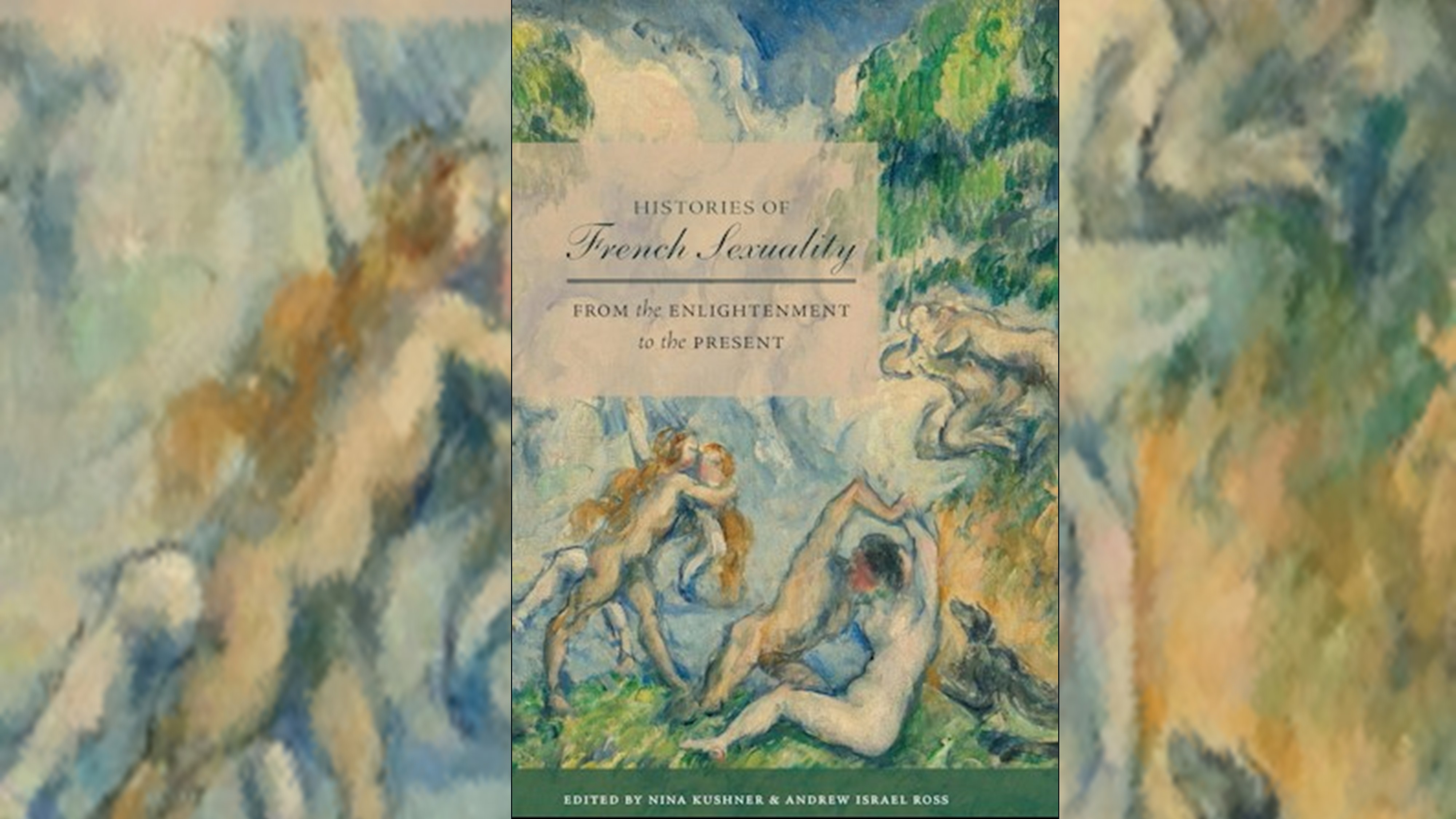
A Review of Histories of French Sexuality: From the Enlightenment to the Present.
By Heidi Hein-Kircher
From a historical perspective, gender orders interact in particular with the formation of different systems of rule and the modern state. This entanglement is expressed in social practices, standardization, and medialization processes. In fact, gender-related research topics have been examined from a sexuality-historical perspective since Dagmar Herzog’s seminal synthesis on “Sexuality in Europe: A Twentieth-Century History” (2011). Questions of dynastic rule, migration, the development of the economy and religions, and the understanding of war and peace can indeed be examined by focusing on power structures and relations, as well as (institutionalized) gender inequality, thereby offering important insights.
The history of sexuality has thus become an essential category of historical analysis. While Michel Foucault’s Histoire de la sexualité (1976) has become a central source of inspiration for the development of the history of sexuality, it is all the more astonishing that, in contrast to the Anglo-American history that provided its impetus, French history began to be explicitly examined from a gender perspective comparatively late and that researchers trained in the Anglo-Saxon research tradition have advanced the field, as the contributors to Histories of French Sexuality: From the Enlightenment to the Present show. Nina Kushner and Andrew Israel Ross, the volume’s editors, define the history of sexuality in terms of three interwoven, expansive, and interlocking levels of past activity. First, they consider how bodies have been sexed, i.e., how bodies have been gendered and sexual difference defined, as well as how bodies have been defined as sexually desiring entities, and how they have ultimately become objects of observation and control. A second level concerns the study of sexual practices and experiences, as well as emotions, and how these relate to the formation and experience of sexual subjectivities and identities and communities. Finally, the third level concerns the historical development of sexual narratives, representations, and discourses. The aim here is to show how sexuality is produced, enacted, and lived by individuals and communities. The editors’ goal is to explore the vibrancy of this broad field of research and link it to various other historical approaches—for example, colonial, knowledge, media, social, and medical history. Furthermore, the editors seek to show that historical narratives can be reassessed and readjusted through a sexual history perspective.
Arranged chronologically, the chapters are linked methodologically and conceptually; the eleven essays in Histories of French Sexuality address central themes in French history. The contributors reflect different approaches and explain how a historical perspective on sexuality reorients interpretations of the respective epochs they are working on. In sum, the chapters come to five main threads during the twentieth century: First, it becomes clear that the Enlightenment was the central turning point in the development of subjectivities and thus also in the understanding of sexuality. For example, claims to individual sexual freedom and state control competed with each other during that time, and even this tension was experienced in the French Atlantic colonies, although the core idea of imperial rule was to regulate interracial sexual contact. Contrary to the idea that cross-cultural sexual relations should lead to peaceful imperial rule, such relations developed through rape, slavery, and genocide of the dominated peoples. As well, this tension must be considered as key to attitudes toward the value of pleasure. Especially during the Enlightenment, sexual pleasure was promoted by physicians and demographers as a source of personal fulfillment and natural morality. Marriage was therefore seen as an antidote to destructive individualism, which would shape laws and policies on family, gender, and sex work in France until the Fifth Republic.
Second, the relationship between law and society has been important. The question of how the female body has been placed at the center of legal debates in France in the twentieth century seems to be key to understanding “French sexualities.” For example, Nina Kushner debates the treatment of women accused of extramarital sexual relations and demonstrates that marital sexuality became a legal category through legal studies and the construction of a (good) reputation. Law has been the basis for policing bodies; only then could the category of “unchaste women” emerge. Moreover, only through the intersection of law, legal strategy, and public engagement has the legal conception of female bodies formed the common understandings of menstruation and procreation.
Third, the legal debates also influenced the public space importantly. Already, the so-called Hausmannization of Paris, the urban redevelopment of the city in the middle of the nineteenth century, brought consequences for the intersection of legal conceptions and those of urban space. A well-ordered urban society was to be created through the surveillance and repression of homosexual behavior in public. Prostitution has played an important role in the creation and maintenance of “public order,” as the example of Bordeaux shows, particularly when sex work, as in Bordeaux’s red-light district, was considered an important source of income and was therefore able to circumvent the city’s efforts to control it.
The fourth important thematic thread is the relationship between gender and citizenship, which finally led to a democratization of society. Already in the Third Republic (1870-1940), women tried to achieve greater political and social freedom, although double standards and ambivalent attitudes still shaped gendered morality and norms. While images of masculinity and notions of honor prevented wives from knowing about sexually transmitted diseases, discourses about the healthy nation made it necessary to talk about them. Another double standard becomes clear when we look at the French colonies, where members of the Parisian bourgeoisie tried (in the discussed case, unsuccessfully) to restrict the sexual rights of white women.
The fifth thread reveals the relationship between consumer culture and the role of the mass media. For example, a 1950s women’s advice magazine and its efforts to break the taboo on premarital sex became a public site for negotiating sexual permissiveness already a decade before the “sexual revolution,” while attempts of lesbian women still failed to build their own community through Minitel, an early French online service in the 1980s.
To sum up, the volume’s sexual-historical perspective therefore allows us to read the development of modernity as an era of evolving aspirations for freedom and thus to understand freedom of choice over one’s own body, which culminates in the perception of postmodernity as an era particularly focused on individuality. Histories of French Sexuality allows us to trace this development through case studies at the micro level. It is precisely this productive interweaving of micro and bottom-up perspectives that should provide the impetus for further studies examining Europe as a whole and from a comparative perspective.
Heidi Hein-Kircher is Director of the Martin Opitz Library (Herne) and Professor for German History and Culture in Eastern Europe. From 2003 to 2024, she was head of the department “Academic Forum” at the Herder-Institute for Historical Research on East Central Europe and a member of the Leibniz-Association in Marburg (Germany). ORCID: 000-0003-3455-5410.
References
Foucault, Michel. 1976. Histoire de la sexualité. Paris: Gallimard.
Herzog, Dagmar. 2011. Sexuality in Europe. A Twentieth Century History. Cambridge: Cambridge University Press.
Histories of French Sexuality: From the Enlightenment to the Present
Edited by Nina Kushner and Andrew Israel Ross
Publisher: University of Nebraska Press
Hardcover / 360 pages / 2023
ISBN 9781496214010
