
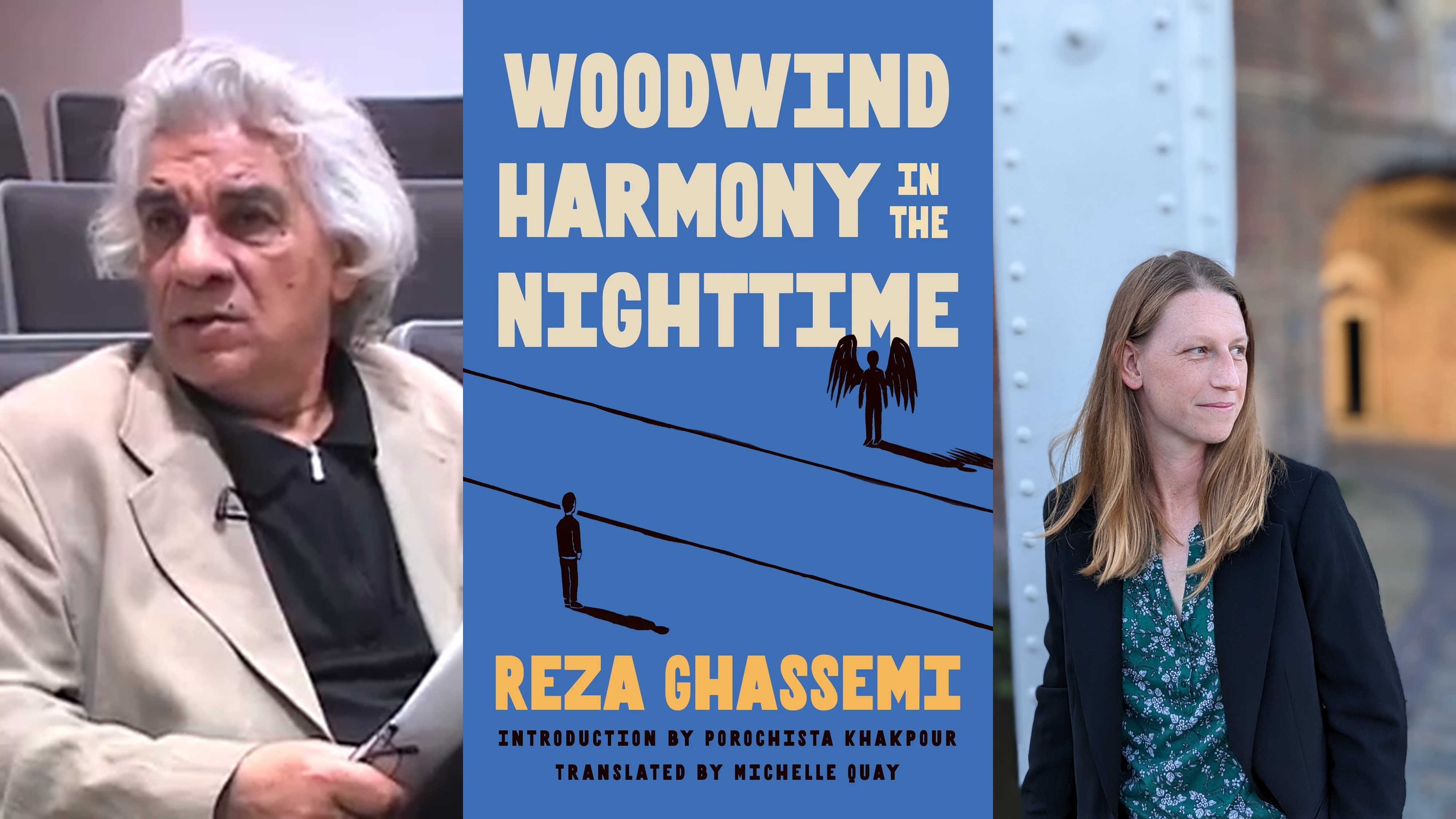
Translated from the Persian by Michelle Quay.
Iranian exile Yadollah is barely scraping by in 1990s Paris. He lives in a run-down attic apartment with his friend Seyyed, and his girlfriend Ra’na. It’s an all too common situation—their apartment building houses a cast of eccentric neighbors, most of them fellow down-on-their-luck exiles from all over the world. When a mysterious new neighbor arrives on the scene, a man who ominously goes by the name of Prophet, Yadollah and his friends’ world is turned upside down.
Yadollah suddenly finds himself confronted by the Islamic angels of death, and realizes that he must untangle the mystery of his own murder, which occurred at some unknown point after Prophet’s arrival. Suspenseful, yet darkly humorous, Woodwind Harmony In The Nighttime explores the trauma of displacement, and challenges readers to piece together the story of a life shattered by exile.
The cross of the Saint-Paul Saint-Louis Church stood directly opposite my window. Its clock struck one-thirty in the morning. And I, who had thought I would finally finish the portrait of Érik François Schmidt that night, was now lying tired and anxious on my bed, bringing what little remained of that harrowing night to a close by considering several riddles that were tangled up with each other like a ball of yarn with no end. The only discernible lead was so useless that with the first tug, it came free from the rest. No matter where I began, I kept coming to the same conclusion that the key to solving this mystery was, unfortunately, that same solitary lead. I had to figure out who Mehdi was.
Of my fellow Iranians living on this floor, the only person who was absent (besides Ali, who either wasn’t there that night, or was there but didn’t come out of his room) was a young man named Fereydoon, whose room was directly across from mine. His neighbor to the right was Seyyed and to the left was Bénédicte. Fereydoon and Prophet moved into this floor around the same time, thanks to Kalantar’s maneuverings. With my arrival (which was orchestrated by the many efforts of Seyyed), the balance of power in the battle between Seyyed and Kalantar had temporarily shifted in favor of Seyyed. Kalantar, who had felt isolated for some time, finally saw his chance to swing the war his way, first by luring Fereydoon and Prophet to this floor, and second, by traveling home and marrying a tough, hardy woman. That’s how the long hallway on our rudderless planet-ship abruptly transformed into the arena of slippers, pajamas, bowls of traditional aash-e reshte noodle soup, and debates over democracy, which took place at night in Fereydoon or Kalantar’s rooms, and sometimes got heated when others joined in. Little by little, our conversations were infused with the smell of sautéed onions, laying the groundwork for future catastrophes. Fereydoon was a polite young man I saw around more often than Prophet because our rooms were right across from each other. He was extremely kind, and whenever we ran into each other, he always offered to do something for me or help me out, especially around the house, since he was well-versed in carpentry, construction, and plumbing. It was obvious from his sturdy work clothes and specialized tools that he made his living that way. Though he had offered to help me over a hundred times, now that I actually needed him, he was nowhere to be found.
Logically, Kalantar must have known who Mehdi was. However, despite the dangers that it entailed, I preferred to ask Prophet himself rather than Kalantar, whom I considered to be responsible, in a way, for everything that had happened.
I decided to go that very evening and knock on Prophet’s door for the first time. The strange events of that night notwithstanding, his nature had been an enigma for me from the very beginning. He’d never participated in the discussions of the young liberals, other than once or twice just after he arrived. He mostly stayed in his room and more often than not, other people went to see him, especially Fereydoon. I asked myself, “He doesn’t work, so how does he eat? He’s not the type to get all wrapped up in his thoughts, so what does he stay up all night doing?”
The only clues that allowed me to sketch a vague outline of his personality were the unpleasant sound of him clearing his throat (which he did every few minutes), the occasional sound of his wooden bed tapping against the wall (which could be an indication he had sat down or stood up), and the intermittent sound of something like a glass marble falling on the floor. Although this was an odd, unrecognizable sound, there was an even stranger sound, which you could hear a lot of the time, usually around midnight, which sounded like someone was dusting the walls with a broom. At first I thought he was painting, but when it didn’t let up, I wondered, “How long could it possibly take to paint a room that’s ten by ten meters?”
Now, all these bizarre, nebulous signs, combined with my unanswered questions, were whirling around in my mind like a tornado, tormenting me. I couldn’t figure out why Prophet had held a knife to Seyyed’s throat, who Mehdi was, or what the relationship was between these two things, but at least one thing was obvious: someone had accused Prophet of being gay. And although the relationship between this fact and the other two questions was impossible to discern, with a little bit of conjecture, you could conclude that this proud, traditional young man had flown off the handle when an unseemly accusation was made against him, and he wanted to repair is stained reputation. In that case, who had made the accusation? Seyyed? Why was he looking for Mehdi, then? Could it have been me? If so, why did he go after Seyyed?
Reza Ghassemi is an Iranian musician, playwright, and novelist. His plays, which won prestigious awards in Iran, were banned after the Islamic Revolution. He has since lived in exile in France, where he has pursued his career as a musician and writer with more freedom. In 2002, he was awarded the Golshiri Literary Award for Best First Novel—Iran’s most important literary prize—for Woodwind Harmony in the Nighttime.
Michelle Quay is a scholar, researcher and translator of Persian literature. She teaches Persian language and literature, in addition to Iranian cinema and culture, at Brown University in Providence, RI. She holds a PhD in medieval Persian literature from the University of Cambridge, where she studied as a Gates Scholar. She is co-editor of The Routledge Handbook of Persian Literary Translation (2022) and has collaborated on scholarly translations of medieval Persian rhetoric manuals as a postdoctoral researcher. Meanwhile, her contemporary literary translation work has appeared in Kenyon Review, Words Without Borders, World Literature Today, Asymptote, Two Lines Press, and elsewhere. She was the inaugural winner of the Mo Habib Translation Prize for Persian literature in 2023.
Photo Reza Ghassemi: VOA Farsi, Public domain, via Wikimedia Commons
