
By Metehan Tekinırk
This is part of a special issue sponsored by the World Society Foundation: A Role for Europe in the Global Arena.
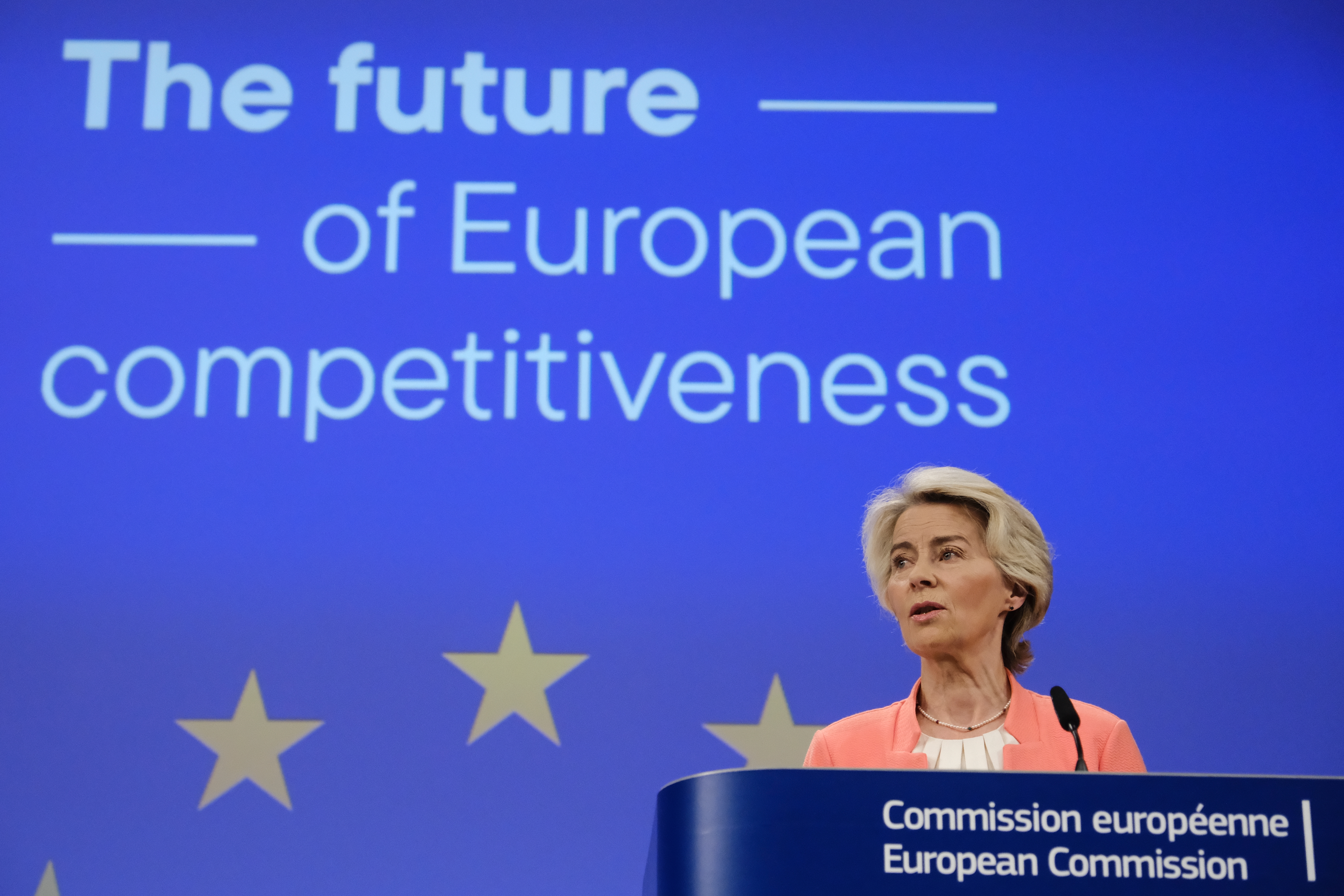
This article posits that the European Union (EU) is facing what may prove to be its most formidable test yet and that the significance of problems plaguing Europe presents sufficient reason to question whether the EU can preserve its appeal, performance, and role in the world. I offer a basic analytical framework centered on great power politics and geopolitical shifts, arguing that most of the challenges facing Europe are closely related to strategic competition between great powers and geopolitical change and uncertainty. More specifically, the article first highlights how great power competition is fundamentally altering the post-1945 world order and how the US, China, and Russia are positioning themselves in this context, conceptualizing geopolitical change as driven primarily by Chinese ascent, American reevaluation of the traditional transatlantic relationship and free trade, and Russian attempts to capitalize on the gradual disengagement of the US from European security. It then explains how some of the most important structural challenges facing Europe—namely in the areas of macroeconomics, energy, and technology—are connected to these international developments, before evaluating external challenges directly involving Russia and the US and also acknowledging domestic challenges. The resulting picture accentuates the difficulty the EU might have in addressing multiple significant issues at once, potential risks and complications, and how time is not on Europe’s side in critical aspects such as demographic decline and growing gaps in technology and innovation. Finally, I explain that the EU cannot afford to compromise its fundamental promises to its member states and citizens if it is to maintain its ideational appeal and political stability.
Looking back at the history of the European integration project, the present moment might well represent the most challenging episode yet. Problems confront Europe on many fronts, and the multitude and magnitude of issues provide sufficient reason to question whether the European Union (EU) can retain its economic competitiveness, political stability, and normative and ideational appeal going forward. Even the sovereign debt crisis of the 2010s, which threatened the future of the monetary union, and the mass migration episode triggered by the Arab uprisings and conflicts in Syria and Iraq, which compounded the crisis of mainstream European political parties, took place under fundamental circumstances that were arguably more favorable than today’s status quo. The current setting is defined not only by the simultaneity of many different challenges but also by the uncomfortable fact that some of the most pressing of these challenges are either intractable in the short term or likely to reinforce each other and/or exacerbate over time.
Although some of these challenges, such as the sustained rise of anti-system parties, are largely homegrown, at least at first glance, Europe’s predicament is closely tied to profound shifts unfolding in the international system since the 2000s, which have accelerated and become far more visible over the past decade. Operating in an increasingly volatile international climate not only makes internal challenges more formidable for Europe but also enables potential complications, thereby intensifying the pressure it faces.
Much of the situation can be better understood with a great power politics perspective. Centered more specifically on the questions of (1) how hegemonic competition is fundamentally reshaping the post-1945 institutional and normative framework known as the rules-based or liberal international order (LIO) and (2) how great powers are positioning themselves vis-à-vis competition, a power politics framework provides an analytical foundation upon which an understanding of most of Europe’s issues can be anchored. Unfortunately, at least for the European gaze, such a perspective also highlights how Europe is becoming more tangential to global centers of power, at least compared to its formerly dominant status for much of modernity; or to put it in more straightforward terms, a continent in decline, especially in the longue durée.
The New Hierarchy of Power Relations: Europe Vis-à-Vis Institutional and Geopolitical Change
It was not too long ago that the EU was seen by many as the power bloc of the future. As late as 2002, Immanuel Wallerstein characterized the EU as an ascending power in his work on hegemonic cycles, predicting that after the—already declining—United States, the contenders for (economic) hegemony would be Japan and the EU (Wallerstein 2002, 358; also see 1984, 104). To be fair to the great political-economic sociologist, he was not the only observer making such projections, and the part of his analysis about the decline of American hegemony was sound. As early as the 1970s, scholars wrote on the notion of American decline (for an early analysis rooted in a domestic and sociological perspective, see Hacker 1970; for more geopolitically oriented analyses, see Gilpin 1975, Hopkins and Wallerstein 1979; Modelski 1987; Kennedy 1987; 432–35, 526–30). Writing about the “end of the American era” around the same time as Wallerstein, Charles Kupchan (2002) similarly predicted a rising EU, arguing that an integrating Europe, whose economic totality already rivaled America’s, would likely challenge American primacy. Later, liberal theorist Andrew Moravcsik (2009, 405) strongly rejected the notion of European decline, similarly arguing that Europe would foreseeably remain “the only other superpower besides the United States” and assessing the EU as the “world’s second military power and pre-eminent civilian power,” as well as a rising power (for another optimistic perspective, see Leonard 2005).
With the advantage of hindsight, most of these projections appear to have overestimated the EU’s economic and military capabilities and severely underestimated the manufacturing and technological capabilities of China. While the unipolar moment characterized by the virtually unchallenged supremacy of the US following the disintegration of the USSR indeed proved to be temporary, as Charles Krauthammer (1990, 23–27) predicted, the post-unipolar world order is not characterized by a bipolar distribution wherein the EU rivals American power. Instead it features a kind of multipolarity where American power is challenged primarily by an ambitious and increasingly capable China and where rules-based limits imposed on the use of force are defied by Russia—reverting “to the old…ways” and seeking opportunities “to flex its imperial muscles” (Greenfeld 2016, xiv). The main economic challenge to the US did not come primarily from Japan, as projected (e.g., Prestowitz 1988, Thurow 1992, Wallerstein 2002). While Japan is still one of the largest economies in the world, given a relative loss of dynamism, it is no longer the extraordinary, ascending economic power that it was from the 1970s to the 1990s. Growing at a much higher rate, China’s economy overtook Japan’s in 2010. The astonishing rise of China has caught many international relations scholars by surprise, forcing the West “to discover China” at last (Greenfeld 2016, xiv). It is this “tectonic change” in the “political geography” of great power politics (ibid.) and its mirror image—the relative decline of US hegemony (Tekinırk 2020)—that sit at the core of the “dramatic global shifts” of our time (Öniş 2017, 19) and some of Europe’s most pressing challenges, for example, in trade and technology.
The contemporary setting, in sum, is fundamentally defined by the relative decline of established powers, namely the US and advanced capitalist countries of the West (e.g., G7) that dominated the first decades of the neoliberal phase of globalization (Öniş 2017). Germany’s “share of global GDP has nearly halved from 8.5 per cent in 1995 to 4.3 per cent in 2023,” for instance, while “over the same period, Japan’s share has collapsed from 17.9 per cent to 4.0 per cent” (Institute for Economics & Peace 2026, 2). The current global climate is also defined by a rapidly shifting international order, which is post-hegemonic (Öniş 2017), as noted, and also post-liberal in the sense that it lacks an overriding set of paradigms predominantly shaping global governance (Kutlay and Öniş 2020).
The Great Recession was a major catalyst that gave further impetus to this ongoing reorganization in the global hierarchy of power relations and probably also accelerated the shifts in the international order. Indeed, the 2008 global financial crisis represents a watershed in the political economy and history of capitalism (Öniş and Kutlay 2019, 228). For one, it was the most devastating crisis of capitalism since the Great Depression. Perhaps more importantly, however, it was a cataclysm erupting at and emanating from the very core of the capitalist system. Contrary to previous crises of neoliberal globalization that manifested themselves primarily in the context of (semi)peripheral economies and emerging powers (e.g., Mexico 1994–95, Asian financial crisis 1997–98, Russia 1998, Brazil 1998–99, Argentina 1998–2002, Turkey 2000–2001), the Great Recession erupted “at the center of global capitalism” (ibid.). It originated from the dominant economic power—the US—and spread “to Europe with devastating consequences, especially for the latter” (Öniş 2017, 20).
To return to the optimistic perspectives above, one could also say that many of them were driven by the analysts’ resounding belief in the ideational and normative appeal of the EU. Besides devastating economic consequences, the Great Recession also had significant adverse impact on the broader appeal of the EU and liberal democratic arrangements (Tekinırk 2020), especially for third countries and developing regions (Öniş 2017; Öniş and Kutlay 2019), which saw more reasons to question the virtues and utility of the Western model.
Many of Europe’s current challenges and the EU’s fading prospects must be contextualized against this background. The growing isolationist tendencies in US foreign policy under the Trump administrations, ensuing fissures in the transatlantic relationship, and the emboldening of Russia cannot be understood independently of the relative decline of American power in the face of mounting challenges that highlight to US policymakers a need to fend off Chinese competitiveness in critical areas such as technology, trade, rare earth minerals, and geopolitical influence. I therefore adopt a broad understanding of geopolitical change to inform my analytical framework: American reevaluation of the transatlantic relationship (and free trade) and disengagement from European defense (Tekinırk 2025), Russian drive towards expansion, and growing Chinese geopolitical and economic influence around the world.
Structural Challenges: Economy, Energy, Technology, and Demographics
It is not an exaggeration to argue that Europe never fully recovered economically from the Great Recession in the grand scheme of things. Of course, there was a certain degree of economic recovery in the mid-2010s, but the United States fared better than Europe in terms of overall economic performance (Öniş 2017, 20). Indeed, despite certain exceptional cases like Poland, the economic dynamism of which has transformed a post-communist economic setting to a developed market in recent years (Reuters 2026a), Europe’s recent economic trajectory is characterized by weak growth and stagnation, with which the COVID-19 pandemic did not help. Although the pandemic eventually subsided, the very economic model that Europe relied on for long is now facing critical disruptions.
In many ways, the low growth characterizing the European economy and the competitiveness problem of the EU are structurally rooted. One only needs to compare the foundations upon which Europe proved to be a successful economic entity some time ago with today’s realities to come to this conclusion or take cues from the likes of Mario Draghi and Emmanuel Macron. As the EU’s internal reports (including the Draghi report on European competitiveness, which I will return to below) and official documents acknowledge, going forward, “Europe will no longer be able to rely on many of the factors that have supported growth in the past: strong external demand driven by an open global trade system, access to cheap and abundant fossil fuel energy, and the ‘peace dividend’ provided by a period of relative geopolitical stability, which allowed EU governments to spend on other priorities” (EUR-Lex 2025, 1).
Take Germany, the longtime locomotive of European growth, for example, which is “massively hemorrhaging economic substance like never before” according to German business associations (quoted in Kinkartz 2025). The German business model essentially relied on a handful of core factors: cheap energy, provided externally by Russia for the most part (fossil fuels) and partly generated by nuclear powerplants (electricity); high-value exports to large foreign markets (most importantly to China); and the aforementioned peace dividend that kept defense spending at minimal levels. None of these factors are currently present. After the invasion of Ukraine, EU sanctions on Russia and the termination of Germany’s oil pipeline exemption effectively stopped Germany’s import of Russian coal and crude oil. In addition, the Russian pipeline bringing liquid natural gas to Germany was closed. Nuclear energy was also phased out after the Fukushima disaster. Moreover, Germany’s key export items have lost ground in China ever since Chinese manufacturers made major strides in the electric vehicle (EV) and premium EV markets. As Deutsche Bundesbank (2023) notes, German automakers used to sell more than one-third of their vehicles in China: at its peak in 2020/21, China accounted for roughly 43 percent of Audi’s, 34 percent of BMW’s, and 38 percent of Mercedes-Benz’s global sales (PwC 2025, 22). Such manufacturers are now facing increased competition from the likes of Li Auto, Nio, and AITO (PR Newswire 2026), which is contributing to “collapsing demand” for foreign luxury brands in China (Amann and Steitz 2026). Further, Chinese EVs are also steadily growing their presence in Europe, reported to have “doubled their overall share of car sales in Europe to 6%” in 2025 (Larrañaga and Parodi 2026), which is happening mostly “at the cost of German [manufacturers]” (PwC 2026, 3).
The signs of adversity are before our eyes: Volkswagen (VW), the largest company in the EU and the biggest automaker in the world (by revenue) (Fortune 2026), is already facing the most severe crisis in its 89-year-long history. The German auto giant is in financial dire straits, and its board plans to cut 100,000 jobs (15 percent of VW’s workforce) and end production at four German plants over the coming years (Meredith 2026a). Europe’s largest automobile manufacturer already shed a substantial part of its workforce, citing US tariffs and intensifying Chinese competition as the core reasons behind these radical measures (Meredith 2026b). With a heavy reliance on both China and the US, the VW Group (which owns or controls Audi, Porsche, Lamborghini, and Bentley, among others) “has been squeezed by drastic changes in both markets, including levies on US imports as well as a decline in China” (Amann and Seitz 2026). According to company accounts compiled by Reuters, profits from Volkswagen’s “China businesses and joint ventures – once the key drivers of the company’s results – have plunged more than 80% over the past decade” (ibid.). What the CEO of the VW Group calls “the biggest transformation in the history of the global automotive industry” (quoted in Horrell 2026) is therefore primarily driven by Chinese advances and US protectionism, the latter rising in response to the former. “Everyone is affected: by US tariffs, by the collapse of the Chinese market and massive price erosion there, by geopolitical conflicts such as those in the Persian Gulf, by ever-harder competition in Europe and by sweeping regulation” (ibid.).
As suggested above, Macron aptly summarized the broader economic conundrum in candid statements made during a visit to Madrid at the end of September: the old European model relying on cheap gas from Russia is “in crisis” (see the full transcript in Élysée 2026; also see Reuters 2026b). Further, “China has completely flooded the European market. For decades, we told ourselves: ‘Wonderful, China is a huge market for us Europeans. We need China.’ That is true. We transferred a great deal of technology, we sold a great deal, and we still do, to some extent.” But now, in Macron’s own words, “Europeans run a trade deficit with China of €1 billion every day” (quoted in Tastan Sevinc 2026).
Even judging by the Volkswagen example alone—which, to be clear, is not an isolated case (see Thyssenkrupp 2026, Investing.com 2026 on Bosch, BMW Group 2026, BASF 2026, for other examples of a broader trend)—it indeed seems like Europe is losing its engines of growth. But the timing makes it even worse: European growth is losing steam “at the very moment when [Europe] faces massive investment needs for modernising its economy, financing the green and digital transition, and ensuring its security” (EUR-Lex 2025, 2). Making the economic burden even heavier is the fact that Europe has not only “abruptly lost its most important supplier of energy” (European Commission 2025a, 5) and must cope with generally higher energy costs compared to competitors like the US or China, but it also has been committed to decarbonizing its economy, which will first bring about additional costs and disruptions before it delivers potential payoffs (European Central Bank 2025). The massive scale of investments required are compounded by security and innovation needs.
The economic bottlenecks, hence, run much deeper than trade and energy alone. Areas such as innovation, artificial intelligence (AI), startups and scaleups, and commercialization represent some of the other challenges facing European competitiveness. If AI is indeed the major development that will be the core driver of the next technological cycle, then Europe is already poorly positioned for the future: it is “weak in the emerging technologies that will drive future growth,” to quote the Draghi report (European Commission 2025a, 5). “For over two decades, Europe has not kept pace with other major economies, due to a persistent gap in productivity growth. The EU has fallen behind the US in advanced technologies, while China has caught up in many sectors, and is winning the race for leadership in certain new growth areas” (EUR-Lex 2025, 1).
The EU’s productivity is roughly 20 percent lower than that of the US (McAfeee 2026). This large productivity gap, according to the EU’s official competitiveness assessments, is largely explained by the lack of innovation and the tech sector. Indeed, “only four of the world’s top 50 tech companies” (European Commission 2025a, 5) and three of the 39 AI unicorns are European (Hoyos 2026). The gap in high-growth innovation is clearly visible across the business world, as du Chatinier (2025) highlights: no European company with a market capitalization above €100bn has been established in the past 50 years. “In contrast, the six US companies (Microsoft, Apple, NVIDIA, Alphabet (Google), Amazon, and Meta) with a value of above $1tn, all tech companies, were created in this same period.” The European bloc has “no global-scale companies in cloud computing, online advertising, mobile devices, or chip design” (McAfee 2026). As the “competitiveness compass” published by the European Commission sums up, “Europe is failing to translate its ideas into new, marketable technologies, and failing to integrate those technologies into its industrial base” (EUR-Lex 2025, 1).
According to the official diagnosis, expenditure in research and development (R&D) remains below target and “is too low to close the innovation gap” (EUR-Lex 2026, 1), which is one part of this problem. While the EU and the euro area have recently increased their R&D expenditures, “they both still lag behind global leaders in R&D intensity, with a rate of 2.1% of GDP in 2023, compared to 2.6% in China, 3.6% in the US, 3.4% in Japan, and 5% in South Korea” (European Commission – Economy and Finance 2025, 13).
An arguably bigger part of the problem, however, concerns capital markets and legal and procedural aspects of innovation. The US has integrated and high-risk capital markets; China has its own model of strategic capitalism that supports Chinese companies with subsidies that are eight times the average subsidies in the OECD, as Macron bemoans (Demócrata 2026a). Europe has neither integrated capital markets nor such high levels of state subsidies. For instance, according to a recent report by TechLeap, a public-private partnership that cooperates with the Dutch ministries of economic affairs and science, there are important differences between American and European capital markets that make the innovation and commercialization gap persist. Of the top one percent of deep-tech funds, eighteen sit in the US, while Europe has virtually none (TechLeap 2026, 16). In terms of cumulative capital deployed into deep-tech, the gap is smaller in smaller-size rounds; but on large-bet “rounds over €100M it widens to 4.6×” (TechLeap 2026, 6). Looking at start-up funding stages, “stage for stage, European [investment] rounds are ~4× smaller” (2026, 11).
While Europe has wealth and savings, European capital is simply not as integrated as American capital. The absence of fully integrated EU financial markets, according to the Impact Assessment Report of the European Commission (2026a, 14), has important implications, such as incentivizing companies to pursue exit strategies and initial public offerings (IPOs) outside the EU rather than in domestic financial markets. Relatively shallow and disintegrated, EU public markets offer lower liquidity than US exchanges, “which reduces the attractiveness of listing domestically” and explains why “European startups rarely pursue IPOs in the EU” (European Commission 2026a, 21). Many of the macroeconomic reports, conclusions, strategic plans, and agendas released by the official institutions of the EU in recent years treat capital markets as key to European competitiveness, innovation, and economies of scale, stressing the need for greater integration in capital markets and the strengthening of the venture capital scene (European Commission – Economy and Finance 2025, 1; European Commission – Directorate-General for Communication 2025). These factors are framed as crucial to the funding and scaling-up of startups—the keys to making “Europe a startup and scaleup powerhouse” (European Commission 2025b).
Further, setting aside capital, as an economic market, the EU is still fragmented compared to the US, especially in a legal sense. “The overarching problem that companies face in the EU,” in the language of the aforementioned impact assessment report, is “the fragmentation of rules across Member States” (European Commission 2026a, 8). Legal and bureaucratic fragmentation adds to regulatory complexity, which the European Commission (2025c) labels as one of the most harmful “barriers to the single market.” Similarly, the Single Market Strategy launched in 2025 underlines that “startups and scaleups need less fragmentation, fewer administrative burdens, as well as rules that are simpler and more supportive across the Single Market” (European Commission 2025b).
The underlying reality is that the EU, despite the political, economic, and monetary integration it has achieved, still represents a complex web of different rules and settings for business actors. Twenty-seven national legal systems with distinct corporate rules and technical procedures and “more than 60 available national legal forms for limited liability companies create a fragmented and complicated corporate landscape for companies” (European Commission 2026a, 8). Such divergence, reports conclude, “leads to legal uncertainty and to high information costs whereby founders (or legal or other professionals on their behalf) need to search, assess and compare information about different legal forms each time they set up a company in another Member State.” Over 80 percent of entrepreneurs consider “complexity of different company legal forms and procedures as a barrier to a large or very large extent” (ibid.).
As the Netherlands Enterprise Agency RVO (2026) cautions investors and entrepreneurs, each country has its own laws and regulations, or applies different professional and legal requirements, e.g., employment or licensing laws. And ultimately, marketing and information technologies, customer support, legal documentation, and contracts often need translation and localization to address national needs. At the end of the day, while the European Commission (2025d) identifies potentially resolvable issues such as the “lack of common standards,” “fragmented rules on packaging,” and “restrictive and diverging national services regulation,” its overarching strategy and plans to “create a more simple, seamless and strong European home market” will be easier said than done given national differences.
The simple assumption that the aggregate size of the European economy automatically makes the EU a rival of the US therefore overlooks such crucial details that pose friction points and/or imply vulnerabilities. There is potential: after all, Europe, with its excellent universities and research institutes, is surely not behind in research and science. It is also not poor by any stretch of the imagination. But it has practical challenges of “translat[ing]” research and “innovation into commercialisation” (European Commission 2025a, 6) and deploying various pockets of money and its budgets to create widespread prosperity.
To make matters more difficult and complex, these major challenges must be tackled during a time when demographic dynamics are becoming increasingly unfavorable. Fertility rates are particularly low in major European countries like Spain (1.1 live births per woman) and Italy (1.18) and important economic players like Germany (1.36) and Poland (1.14) (Eurostat 2026). With these figures falling well below the replacement level, Europe’s population is set to gradually shrink and age over the upcoming decades—a structural shift that will touch “every dimension of European life” (European Commission 2026b, 9). The old-age dependency ratio in the EU, “defined as the proportion of elderly individuals (aged 65 years or over) relative to the working-age population (people aged 20 to 64 years), has increased noticeably in the last 20 years.” In 2004, this ratio was at 26.8 percent (i.e., there were slightly fewer than four working-age adults per elderly person aged 65 years or over). In January 2024, this ratio was calculated to be 37.0 percent, “indicating that there were fewer than 3 working-age adults for every elderly person” (Eurostat 2025). As societies get older, the workforce-age population of Europe will continue to decrease, which will create additional challenges for the labor market, healthcare, social care systems, and of course, public finances (an aging population also spells trouble for military recruitment and defense, which is more important than ever, as the next section will discuss).
Like the European Commission’s third report on demographic transformation captures, this unfavorable demographic trend puts great pressures on public budgets and welfare states, “since a shrinking labour force means fewer workers contributing to tax revenues that fund” public services like pensions or long-term care (European Commission 2026b, 37). With the number of young people entering the workforce expected to decline (European Commission – Economy and Finance 2026) and large cohorts approaching retirement (Serrao 2026), labor constraints will continue to be an important weakness in Europe. European welfare systems, designed not only during a period of population growth, as the demographic report notes (European Commission 2026b, 30), but also at a time of sustained economic growth and democratic stability, will be at the forefront of this massive structural challenge, as Friedrich Merz, the German chancellor, put it bluntly in 2025 when he claimed that these systems “can no longer be financed” (quoted in Berry 2025).
Pension reform, which is already one of Europe’s most politically difficult issues (Serrao 2026) (e.g., provoking strikes and demonstrations in France and Belgium in 2023, current debates in Germany), can become even more contentious in the future. The aforementioned demographic report contemplates, for example, the idea of “enabling older people to remain active beyond the pensionable age” (“if they wish to”) (European Commission 2026b, 35). Seen as a measure that could potentially alleviate labor shortages and associated problems at a moment of desperation, such arrangements can in fact exacerbate mass discontent and undermine the European social bargain given the level of economic comfort and life trajectory Europeans have become accustomed to. In a continent the political-economic history of which has been largely shaped by the successes of the German model of social-market capitalism and social democratic institutions, the idea of having to work beyond a pensionable age, unlike previous generations of Europeans, may very well be perceived as antithetical to the European way of life and a sign of decline.
Low birth rates are also partly tied to high housing costs (Serrao 2026), and housing shortages constitute another issue area. Both housing shortages and prices in large European cities (e.g., Berlin, Paris, Barcelona, Amsterdam, Milan, Rome, Lisbon) complicate attracting younger workers and professionals to productive urban areas (see Council of the European Union – Analysis and Research Team 2025). Last but not least, migration, which can potentially counterbalance the adverse effects of population ageing and labor force contraction (and thereby offset some effects of demographic shifts) according to the European Commission (2026b, 24), is a very politically charged issue that can become even more explosive in the future.
In sum, structural challenges faced by the EU are manifold—economic stagnation, technology and productivity gaps, energy and labor constraints, population dynamics, and difficulties in housing markets. Overcoming these obstacles will require intensifying fiscal pressures, with additional investment needed in the areas of AI and technology, research and development, sustainable energy and climate change, industrial capacity, infrastructure, and housing.
External Challenges: Russian Aggression, American Disengagement, and Peripheral Instability
Another crucial area that will require additional spending is defense, at least until European deterrence against Russian expansionism can be strengthened. Countries such as Poland, Spain, Denmark, Belgium, the Netherlands, and Sweden have already made the largest increases in their defense spending in relative terms, based on 2021 prices (NATO Public Diplomacy Division 2025, 7–10). But propping up European security will necessitate even greater expenditures and coordinated measures, and as the previous section has outlined, that “funding must come from the same stagnant economies, constrained public budgets, and tax bases already supporting healthcare systems, pensions, and energy subsidies” (Hoyos 2026). Heightened defense needs therefore concern not only European security but also competitiveness and stability.
One key concept that necessarily comes up in discussions and assessments of European security is dependency, as I will return to below. Surely, Europe’s underinvestment in defense and overdependence on American security support and military power are not new—or news. Both have emerged out of the presence of American power in Western Europe in the wake of World War II and the Cold War. But the vulnerability is much newer, because “in a world of stable geopolitics, [Europe] had no reason to be concerned about rising dependencies on countries [it] expected to remain [its] friends” (European Commission 2025a, 5).
The crux of the American challenge to Europe is twofold. On the one hand, the second Trump administration marks a clear break from the traditional transatlantic relationship, exposing the aforementioned vulnerability. On the other, the US is deviating from certain tenets of the rules-based international order. The maintenance of a fairly open and predictable international trade environment, for instance, is now challenged by the return of aggressive tariffs as a geopolitical instrument. The condemnation of the forcible alteration of borders and deployment of coercion against state sovereignty or territorial integrity, a norm enshrined in the United Nations Charter, is making way to the idea that great powers have special security interests and/or zones of influence (e.g., Venezuela, Greenland; see Eurasia Group 2026).
Both disengagement from European defense and protectionism are ultimately American responses to the mounting costs of maintaining hegemony and the perceived need to prioritize meeting the challenge arising from China. These trends expose European fragility vis-à-vis shifting grounds and geopolitical risks. It is no surprise that some of Donald Trump’s most ambiguous signals regarding US commitment to the defense of NATO allies highlight conditionality, with allies expected to “fulfill their obligations to [the US]” (quoted in Ewing 2016), “pay [their] bills” (quoted in FitzGerald 2024), and “be there for” the US (Holland and Slattery 2026). Surely, NATO allies tried to address the current uncertainty about the role of the US and display unity during the NATO summit in Ankara on July 7–8 where they stressed “ironclad commitment to… collective defence under Article 5 of the Washington Treaty and to the transatlantic bond” (NATO 2026). But visible fractures in the alliance remain (Öniş 2026).
In this context of uncertain US engagement, Russia, which has a stake in European disunity and disorganization (particularly via its generally positive reception among the European radical right, see Klapsis 2015; Snegovaya 2022; Greene 2023), may interpret such mixed signals and the idea that great powers have designated spheres of influence as opportune conditions for its expansionism. Moreover, Europe needs more time to build effective deterrence against external threats and hybrid operations in particular, as the drone incursions into Polish airspace (2025) and the failed drone attack in Leipzig (August 2026) suggest (see Seif 2026 for the perspective of a member of the Bundestag).
Highlighting the economic dimension of European vulnerability is the fact that geopolitical change and dependencies are also crucial because of the negative feedback effects they may have on Europe’s economic standing. Hence, in its opening statements, the 2026 Annual Single Market and Competitiveness Report stresses “the need to strengthen the resilience of EU’s supply chains” against geopolitical volatility (EUR-Lex 2026, 1), echoed by the European Commission, also explicitly recognizing the “sweeping changes” in the international trade and global landscapes as factors “expos[ing] the vulnerabilities in Europe’s supply chains” (Eur-Lex 2026, 11). Similarly, the Draghi report paints a stark picture of Europe’s economic position as “particularly exposed,” given that it relies “on a handful of suppliers for critical raw materials, especially China” (European Commission 2025a, 7). More specifically:
Europe has extensive external dependencies, ranging from critical raw materials (CRMs) to advanced technologies. Many of these dependencies could become vulnerabilities in a situation where trade fragments along geopolitical lines. Around 40% of Europe’s imports are sourced from a small number of suppliers and difficult to substitute, and around half of these imports originate from countries with which it is not strategically aligned. As a result, Europe’s notional exposure to any ‘sudden stops’ in trade caused by geopolitical conflagration is high. (European Commission 2025a, 54)
Especially following the pandemic and the global chip shortage, Europe has already worked to address certain dependencies. For example, progress in the areas of hydrogen and batteries (European Commission – Internal Market, Industry, Entrepreneurship and SMEs 2022) is translating to growing capacity in the battery industry. These efforts are projected to “increase Europe’s strategic resilience and benefit adjacent sectors such as automotives by shortening supply chains” (European Commission 2025a, 47).
However, issues remain. First, there is the risk that “dependencies could be used to create an opportunity for coercion” (European Commission 2025a, 54). In addition, reducing these multi-faceted dependencies will be costly and necessitate substantial investments (European Commission 2025a, 55). For example, enhancing CRM security would require sizeable investments in mining domestically and abroad (e.g., in the processing, stockpiling, and recycling of critical materials). And strengthening the supply chain for semiconductors will be just as or even more costly. Further, “these investments will lead to Europe no longer buying from the most efficient supplier and may therefore increase cost pressures for the economy in the short term” (European Commission 2025a, 55). It is expected, however, that such precautions and measures will offer returns on investment down the path, and it is hoped that making the EU less vulnerable to external leverage could increase its decision-making autonomy (European Commission 2025a, 55).
The growing instability in the Middle East constitutes another external risk for Europe. While the Islamist regime in Iran has thus far proven to be resilient, large-scale violence and destabilization in the Middle East could potentially beget the next wave of refugees and asylum seekers at Europe’s borders. For instance, even before the latest escalations in Yemen, which the UN Special Envoy characterized as marking the return of large-scale conflict (United Nations – OSESGY 2026), a UN country report had projected that over 21 million Yemenis will need humanitarian assistance in 2026 (United Nations – Yemen 2026a). On 23 September, it was reported that more than 122,000 Yemenis had been internally displaced and that the World Health Organization was scaling up its emergency health operations in response to distress in the Yemeni healthcare system (United Nations – Yemen 2026b).
In brief, although structural challenges facing Europe are more certain and plentiful (and therefore more daunting) than security and geopolitical risks, the latter are also serious. Tackling both areas will be a difficult task for the EU.
Domestic Challenges: Anti-System Parties, Political Fragmentation, and the Lingering Question of European Leadership
Europe does not find any relief in the spheres of political stability and leadership dimensions, either. Germany, despite still carrying a lot of weight in the EU, is not properly equipped to provide political leadership to Europe for a number of reasons. Its professed strengths are in the economic and industrial areas, whereas the current situation in Europe demands greater military strength and security-oriented geopolitical leadership. Further, as explained, even Germany’s strengths are now objectively diminished. France has the ambition, robust military capabilities, and the highest number of military personnel after Turkey and Poland but is plagued by economic stagnation. It is also facing the possibility of a political earthquake in spring 2027, when presidential elections will be held and radical contenders on both the right and left will seriously challenge the political center (Germany is also seeing the erosion of its center). These weaknesses probably signal the expiration of the Franco-German “cooperative hegemony” model that first generated the drive towards integration after the 1980s before Germany came to the fore (Paterson 2008), leading the bloc well into the 2010s under the chancellorship of Angela Merkel (Tekinırk 2025).
Moreover, it appears that Germany will be increasingly preoccupied with pressing and potentially polarizing domestic matters and debates, such as the maintenance of its welfare state, industrial capacity, and fiscal health, or the possible reformation of its immigration and citizenship regime. Established actors within Germany’s political and institutional systems also continue to be fixated on the question of what to do with the sustained rise of Alternative für Deutschland (AfD), the “extreme right” designation of which could theoretically trigger legal action and sanctions in light of the “militant democracy” notion informing German political tradition and constitutional law (for technical considerations, see Bundesverfassungsgericht 2026; for conceptual and historical background, see Loewenstein 1937 and Tyulkina 2015, 13; for a recent perspective that cautions against banning the AfD and argues instead for a middle ground response, see Garton Ash 2026). Any legal measure against the likes of AfD in Germany or Marine Le Pen in France (whose reduced sentence will probably enable a presidential run in 2027, see Corbet, Leicester, and Petrequin 2026)—assuming that such measures are perceived as defensive maneuvers or portrayed as desperate attempts by a corrupt and/or morally bankrupt institutional and judicial system—carries the risk of strengthening the anti-establishment appeal of such contenders, as a comparative history of populism shows.
The case of the AfD is also a good opportunity to remember that there is a significant deal of variation among different parties in Europe when it comes to their level of commitment to European integration. The AfD’s co-leader, Alice Weidel, for instance, proposes leaving both the Eurozone and the Schengen area (“so that people like those from Ceuta cannot come here”) as her party looks poised to wrest away political power in elections scheduled for 2029 (quoted in Demócrata 2026b).
Even setting aside political cleavages centered on professed commitment to the EU versus Euroscepticism, there is a good deal of ideological fragmentation across Europe on specific policy issues as well. While the pro-EU bloc remains strong, the European Parliament that was elected in June 2024 is the most fragmented in decades (Hix, Kreilinger, and von Sydow 2026). When it comes to the possibility of a return to nuclear power, for instance, German center-right and radical right parties have a generally favorable stance, while center-left, radical left, and green parties oppose nuclear energy. On the issue of Russia, although the invasion of Ukraine has narrowed gaps, Poland and Baltic states naturally view Russia as an existential threat, while some other European actors advocate restoring economic relations and diplomacy with Russia. These do not mean that there can be no collective action, as both the pandemic and the Ukraine war have proven that European countries can work in concert. But whatever the new leadership model or structure of the EU may look like, it will have to take into consideration the various priorities and sensitivities of member states in different regions and under different circumstances (e.g., eastern European security, southern European economic issues, welfare states, etc.) for there to be greater cohesion.
Abundance of Problems, Dearth of Time
The number and significance of issues to be addressed in contemporary Europe, as well as their potential complications present an overwhelming adversity for the continent. This is not to say that the EU is approaching the brink of a spectacular failure or disintegration, or that there are no opportunities to offset or at least alleviate the plethora of challenges. The same geopolitical hurdles discussed above—trade wars and coercive diplomacy, for instance—are also prompting a major economic power with vast resources like Canada to pursue much closer relations and greater economic engagement with the EU. Indeed, growing cooperation between Canadians and Europeans can offer significant value in important areas such as mining and the procurement of rare earth elements and minerals (including lithium, nickel, zinc, and potash), other raw materials (e.g., timber, iron ore, limestone, etc.), energy (including but not limited to hydrogen, liquid natural gas, and uranium), batteries, broader trade, and new technologies. The respective assets and strengths of Canada and Europe can be complementary, supporting European attempts to revitalize Europe’s capabilities in the automotive and industrial machinery sectors or in propping up its productivity in defense and aerospace, for instance. Despite the potential of such a growing relationship, however, it would be useful to remember that the Canadian government stresses Canadian sovereignty and that EU “associate membership”—granted to Canada—is a political/rhetorical concept absent from EU treaties (moreover, certain EU treaty articles and precedents stress that membership is for “European” states). In addition, the idea of “like-minded” countries such as Australia and New Zealand following in Canada’s footsteps (quoted in Genovese and Tadeo 2026) can play into certain fears, as Matthijs (2026) notes, prompting candidate countries in the Balkans and peripheral Europe to ask why favored outsiders “should receive privileged access” whereas the former are expected to undertake painful reforms in hopes of being able to join the EU one day. Such disappointment or frustration could possibly weaken the appeal of the EU where it is arguably the strongest.
At the end of the day, very important questions concerning the economic and political stability, competitiveness, security, and future role of Europe remain unanswered. Will Europe be able to extend the required security expenditures to stimulate its manufacturing sector in a way that fuels the next cycle of growth, perhaps starting with core areas such as aerospace, electronics, and robotics? Would this approach ultimately also help civilian manufacturing and broader economic sectors thrive? Or will the heavy defense burden create additional pressures on tight budgets and public resources, deepening economic stagnation and threatening the European way of life and ideal? The latter question is absolutely critical. If productivity issues cannot be overcome and robust economic growth cannot be secured, especially before the labor supply faces further constraints, Europe may be “forced to choose” (European Commission 2025a, 5), in what might become a painful rendition of the classic “guns or butter” dilemma: it will not be able to position itself simultaneously as a leading bloc in new technologies, “a beacon of climate responsibility,” and a major independent player on a global scale. Instead, it will have to “scale back some, if not all, of [its] ambitions.” That, as Draghi concedes, marks an existential challenge. Ultimately, as a collective and cooperative project, the EU has historically rested on fundamental values and promises of shared prosperity, stability, peace, and liberal democracy. If it fails to provide Europeans with these qualities or resorts to disappointing tradeoffs, “it will have lost its reason for being” (European Commission 2025a, 5).
Metehan Tekinırk is Visiting Assistant Professor of Political Science at Colgate University. Prior to joining Colgate in 2023, he was Visiting Lecturer in Political Science and Sociology at Boston University, where he previously earned his MA and PhD degrees in political science after moving from his hometown, Istanbul. His research on democratic erosion and resilience, populism and populist authoritarianism, nationalism and national identities, and the international system has been published in outlets such as the German Journal of Comparative Politics, Populism, EuropeNow, and Politics, Religion & Ideology, among others.
References
Amann, Christina, Christoph Steitz. 2026. “Volkswagen crisis worsens with $11.5 billion profit warning, largely due to Porsche struggles,” Reuters, September 18. https://www.reuters.com/world/china/volkswagen-porsche-holding-cut-outlook-2026-09-18/
BASF. 2026. “Reporting Q2 2026.” July 29. https://www.basf.com/global/en/investors/calendar-and-publications/service-for-shareholders/faq/reporting-q2-2026#content-600306060-28872158
Berry, Alex. 2025. “German welfare state ‘can no longer be financed’—Merz,” Deutsche Welle. August 23. https://www.dw.com/en/german-welfare-state-can-no-longer-be-financed-merz/a-73742270
BMW Group. 2026. “BMW Group adjusts Guidance for 2026.” June 16. https://www.press.bmwgroup.com/global/article/detail/T0458585EN/bmw-group-adjusts-guidance-for-2026
Bundesverfassungsgericht [The Federal Constitutional Court of Germany]. 2026. “Proceedings for the prohibition of a political party.” https://www.bundesverfassungsgericht.de/EN/TheFederalConstitutionalCourt/TypesOfProceedings/ProceedingsForTheProhibitionOfAPoliticalParty/proceedingsfortheprohibitionofapoliticalparty.html
Corbet, Sylvie, John Leicester, and Samuel Petrequin. “Le Pen says she’ll run for French presidency next year despite court-ordered monitor,” AP News, July 7. https://apnews.com/article/france-le-pen-macron-bardella-verdict-election-dcd2a305d01a87f13f1d7c81dffeee90
Council of the European Union – Analysis and Research Team. 2025. “One roof, many realities: Europe’s complex housing crisis.” October 2025. https://www.consilium.europa.eu/media/4ockvv2e/2025_2082_art_housing_web.pdf
Demócrata. 2026a. “Macron warns of the risk of dependence on China and raises the EU’s trade deficit to 1 billion daily.” September 30. https://www.democrata.es/en/economy/macron-warns-of-the-risk-of-dependence-on-china-and-raises-the-eu-s-trade-deficit-to-1-billion-daily/
Demócrata. 2026b. “The leader of AfD proposes to end Schengen to avoid episodes like the one in Ceuta.” August 23. https://www.democrata.es/en/international/the-leader-of-afd-proposes-to-end-schengen-to-avoid-episodes-like-the-one-in-ceuta/
Deutsche Bundesbank. 2023. “Is Germany’s ‘business model’ at risk?” 5 June. https://www.bundesbank.de/en/press/speeches/is-germany-s-business-model-at-risk–908758
du Chatinier, Emma. 2025. “Europe is stuck in ‘mid-tech trap’,” EUPerspectives, August 20. https://euperspectives.eu/2025/08/europe-is-stuck-in-mid-tech-trap/
Élysée. 2026. “Visite d’État en Espagne.” September 30. https://www.elysee.fr/emmanuel-macron/2026/09/30/visite-detat-en-espagne
Eurasia Group. 2026. “Risk 3: The Donroe Doctrine,” Eurasia Group’s 2026 Top Risks Report. January 5. https://www.eurasiagroup.net/live-post/risk-3-the-donroe-doctrine#whitepaper
EUR-Lex. 2025. “A Competitiveness Compass for the EU.” Brussels. January 29. https://commission.europa.eu/document/download/10017eb1-4722-4333-add2-e0ed18105a34_en
EUR-Lex. 2026. “The 2026 Annual Single Market and Competitiveness Report.” Brussels. January 30. https://eur-lex.europa.eu/legal-content/EN/TXT/PDF/?uri=CELEX:52026DC0046
European Central Bank. 2025. “Green investment needs in the EU and their funding.” https://www.ecb.europa.eu/press/economic-bulletin/articles/2025/html/ecb.ebart202501_03~90ade39a4a.et.html
European Commission. 2025a. The future of European competitiveness: Part A | A competitiveness strategy for Europe. Luxembourg: Publications Office of the European Union. https://commission.europa.eu/topics/competitiveness/draghi-report_en#paragraph_47059
European Commission. 2025b. “Commission launches ambitious Strategy to make Europe a startup and scaleup powerhouse.” May 27. https://ec.europa.eu/commission/presscorner/detail/en/ip_25_1350
European Commission. 2025c. “Bringing down barriers to the single market to create opportunities for all.” May 21. https://commission.europa.eu/news-and-media/news/bringing-down-barriers-single-market-create-opportunities-all-2025-05-21_en
European Commission. 2025d. “A simpler Single Market to make companies choose Europe.” May 20. https://ec.europa.eu/commission/presscorner/detail/en/ip_25_1274
European Commission. 2026a. “Impact Assessment Report.” March 18. https://commission.europa.eu/document/download/38805451-8ffd-4512-8c46-fd76de0e9c9c_en?filename=Impact+assessment+report+for+EU+Inc+part+1.pdf
European Commission. 2026b. Demographic transformation in the EU: understanding change and adapting to its consequences. Luxembourg: Publications Office of the European Union. https://commission.europa.eu/system/files/2026-07/Demography_Report_2026.pdf
European Commission – Directorate-General for Communication. 2025. “Choose Europe for your startup and scaleup.” May 28. https://commission.europa.eu/news-and-media/news/choose-europe-your-startup-and-scaleup-2025-05-28_en
European Commission – Economy and Finance. 2025. 2026 European Macroeconomic Report. Institutional Paper 328, November 2025. Luxembourg: Publications Office of the European Union. https://economy-finance.ec.europa.eu/document/download/47430efe-c224-439c-aa3c-637d5fb7535c_en?filename=ip328_en.pdf
European Commission – Economy and Finance. 2026. “Is the EU’s labor market reaching a turning point?” May 21. https://economy-finance.ec.europa.eu/economic-forecast-and-surveys/economic-forecasts/spring-2026-economic-forecast-slowdown-growth-energy-shock-drives-inflation/eus-labour-market-reaching-turning-point_en
European Commission – Internal Market, Industry, Entrepreneurship and SMEs. 2022. “Commission presents an updated in-depth review of Europe’s strategic dependencies.” February 22. https://single-market-economy.ec.europa.eu/news/commission-presents-updated-depth-review-europes-strategic-dependencies-2022-02-23_en?prefLang=et
Eurostat. 2025. “OId-age dependency growing across EU regions.” October 1. https://ec.europa.eu/eurostat/web/products-eurostat-news/w/ddn-20251001-2
Eurostat. 2026. “EU fertility rate at 1.34 live births per woman in 2024.” March 6 https://ec.europa.eu/eurostat/web/products-eurostat-news/w/ddn-20260306-1
Ewing, Phil. 2016. “European Leaders Urge NATO Solidarity; Trump Sets Conditions, Should He Be Elected,” NPR, July 21. https://www.npr.org/sections/thetwo-way/2016/07/21/486943979/european-leaders-urge-nato-solidarity-trump-sets-conditions-should-he-be-elected
FitzGerald, James. 2024. “Trump says he would ‘encourage’ Russia to attack Nato allies who do not pay their bills,” BBC, February 11. https://www.bbc.com/news/world-us-canada-68266447
Fortune. 2026. “Fortune 500 Europe.” https://fortune.com/europe/ranking/fortune500-europe/2024/
Garton Ash, Timothy. 2026. “Here’s how Germany can defend its democracy. Banning the AfD isn’t the answer,” The Guardian, September 19. https://www.theguardian.com/commentisfree/2026/sep/19/germany-afd-banning-defend-democracy
Genovese, Vincenzo, and Maria Tadeo. 2026. “Australia and New Zealand could follow Canada into associated EU membership, Metsola tells Euronews.” September 17. https://www.euronews.com/2026/09/17/australia-and-new-zealand-could-follow-canada-into-associated-eu-membership-metsola-tells-
Gilpin, Robert. 1975. U.S. Power and the Multinational Corporation: The Political Economy of Foreign Direct Investment. New York: Basic Books.
Greene, Toby. 2023. “Natural allies? Varieties of attitudes towards the United States and Russia within the French and German radical right.” Nations and Nationalism, vol. 29, issue 4: pp. 1321–1337. https://doi.org/10.1111/nana.12957
Greenfeld, Liah. 2016. “Introduction – Collected Volume as an Experiment,” in Globalisation of Nationalism: The Motive-Force Behind Twenty-First Century Politics, ed. Liah Greenfeld, pp. xiii–xxviii. Colchester: ECPR Press.
Hacker, Andrew. 1970. The End of the American Era. New York: Atheneum.
Hix, Simon, Valentin Kreilinger, and Göran von Sydow. 2026. “The Centre Is Holding: Coalitions and Majorities in a Fragmented European Parliament.” Swedish Institute for European Policy Studies, publication 12epa. September. https://sieps.se/en/publications/2026/the-centre-is-holding
Holland, Steve, and Gram Slattery. 2026. “Trum says ‘we don’t have to be there for NATO’,” Investing.com. March 27. https://www.investing.com/news/world-news/trump-says-we-dont-have-to-be-there-for-nato-4586251
Hopkins, Terence K. and Immanuel Wallerstein [with the Research Working Group on Cyclical Rhythms and Secular Trends]. 1979. “Cyclical Rhythms and Secular Trends of the Capitalist World-Economy: Some Premises, Hypotheses and Questions.” Review (Fernand Braudel Center), vol. 2, no. 4: pp. 483–500.
Horrell, Paul. “VW’s in big trouble: 75 models set to be slashed, factories will close… and bye bye Seat,” BBC Top Gear, September 4. https://www.topgear.com/car-news/business/vws-big-trouble-75-models-set-be-slashed-factories-will-close-and-bye-bye-seat
Hoyos, Adriana. 2026. “Europe Feels Fine. That’s Exactly Why It Isn’t.” Insights – IE University. April 27. https://www.ie.edu/insights/articles/europe-feels-fine-thats-exactly-why-it-isnt/
Institute for Economics & Peace. 2026. The Great Fragmentation: The rise of Middle Powers in a fractured international order. Sydney. https://www.economicsandpeace.org/wp-content/uploads/2026/01/The-Great-Fragmentation-web.pdf
Investing.com. 2026. “Workers at German auto supplier Bosch call for EU action to stem job losses.” September 16. https://www.investing.com/news/stock-market-news/workers-at-german-auto-supplier-bosch-call-for-eu-action-to-stem-job-losses-4903269
Kennedy, Paul. 1987. The Rise and Fall of Great Powers. New York: Random House.
Kinkartz, Sabine. 2025. “German economy in crisis: What can the next government do?,” Deutsche Welle, January 28. https://www.dw.com/en/germany-economic-crisis-business-response-2025/a-71437667
Klapsis, Antonis. 2015. “An Unholy Alliance: The European Far Right and Putin’s Russia.” European View vol. 14, issue 1: p. 137. https://doi.org/10.1007/s12290-015-0359-1
Krauthammer, Charles. 1990. “The Unipolar Moment.” Foreign Affairs, vol. 70, no. 1, pp. 23–33. https://doi.org/10.2307/20044692.
Kupchan, Charles A. 2002. The End of the American Era: U.S. Foreign Policy and the Geopolitics of the Twenty-First Century. New York: Alfred A. Knopf.
Kutlay, Mustafa, and Ziya Öniş. 2020. “The New Age of Hybridity and Clash of Norms: China, BRICS and Challenges of Global Governance in a Post-Liberal International Order.” Alternatives: Global, Local, Political 45(3): pp. 123–142. https://doi.org/10.1177/0304375420921086.
Larrañaga, Javi West, and Alessandro Parodi. 2026. “Where Chinese automakers have gained the most ground in Europe,” Investing.com, February 11. https://www.investing.com/news/stock-market-news/where-chinese-automakers-have-gained-the-most-ground-in-europe-4499728
Leonard, Mark. 2005. Why Europe Will Run the 21st Century. London: Fourth Estate.
Loewenstein, Karl. 1937. “Militant Democracy and Fundamental Rights.” American Political Science Review, 31(3): pp. 417–432.
Matthijs, Matthias. 2026. “Membership Without Membership: What Can Europe Really Offer Canada?” Council on Foreign Relations. September 18. https://www.cfr.org/articles/membership-without-membership-what-can-europe-really-offer-canada
McAfee, Andrew. 2026. “Europe Can’t Get Out of Its Own Way.” Foreign Affairs, September 23. https://www.foreignaffairs.com/europe/europe-cant-get-out-its-own-way-andrew-mcAfee
Meredith, Sam. 2026a. “Volkswagen plans to cut 15% of its workforce and close four German plants, report says,” CNBC, June 26. https://www.cnbc.com/2026/06/26/volkswagen-vw-job-cuts-autos-germany.html
Meredith, Sam. 2026b. “Volkswagen warns planned cost cuts are not enough after 14% drop in first-quarter profit.” CNBC, April 30. https://www.cnbc.com/2026/04/30/volkswagen-q1-earnings-autos.html
Modelski, George. 1987. Long Cycles in World Politics. Seattle: University of Washington Press.
Moravcsik, Andrew. 2009. “Europe: The Quiet Superpower.” French Politics, vol. 7, no. 3/4: pp. 403–422.
NATO. 2026. “The Ankara Summit Declaration.” July 8. https://www.nato.int/en/about-us/official-texts-and-resources/official-texts/2026/07/08/the-ankara-summit-declaration
NATO Public Diplomacy Division. 2025. “Defence Expenditure of NATO Countries (2014-2025).” https://www.nato.int/content/dam/nato/webready/documents/finance/def-exp-2025-en.pdf
Netherlands Enterprise Agency RVO. 2026. “Starting a business abroad.” https://business.gov.nl/starting-your-business/starting-situations/starting-a-business-abroad/
Öniş, Ziya. 2017. “The Age of Anxiety: The Crisis of Liberal Democracy in a Post-Hegemonic Global Order.” The International Spectator 52(3): pp. 18–35. https://doi.org/10.1080/03932729.2017.1325133.
Öniş, Ziya. 2026. “NATO’s Ankara Summit: A Fragile Show of Unity Amid a Fragmented Western Alliance.” GlobalPanorama, July 16. https://www.globalpanorama.org/en/2026/07/natos-ankara-summit-a-fragile-show-of-unity-amid-a-fragmented-western-alliance-ziya-onis/
Öniş, Ziya, and Mustafa Kutlay. 2019. “Global Shifts and the Limits of the EU’s Transformative Power in the European Periphery: Comparative Perspectives from Hungary and Turkey.” Government and Opposition 54(2): pp. 226–253. https://doi.org/10.1017/gov.2017.16.
Paterson, William E., “Did France and Germany Lead Europe? A Retrospect,” in Leaderless Europe, ed. Jack Hayward. Online edition, Oxford Academic, 1 Sept. 2008). https://doi.org/10.1093/acprof:oso/9780199535026.003.0006
PR Newswire. 2026. “AITO Delivered Over 420,000 Vehicles in 2025, Topping China’s Luxury Brand Rankings.” February 3. https://www.prnewswire.com/apac/news-releases/aito-delivered-over-420-000-vehicles-in-2025–topping-chinas-luxury-brand-rankings-302677042.html
Prestowitz, Clyde V., Jr. 1988. Trading places: How we allowed Japan to take the lead. New York: Basic Books.
PwC. 2025. “PwC Autofacts® Market Update: Automotive industry outlook.” July 2025. https://www.pwc.com/kr/ko/insights/automotive-newsletter/samilpwc_autofacts_market-update_202507.pdf
PwC. 2026. “PwC Autofacts® Market Update: Automotive industry outlook.” March 2026. https://www.pwc.com/vn/en/publications/2026/autofacts-market-update-march-2026.pdf
Reuters. 2026a. “S&P Dow Jones Indices upgrades Poland to developed market status.” August 21. https://www.reuters.com/business/sp-dow-jones-indices-upgrades-poland-developed-market-status-2026-08-21/
Reuters. 2026b. “Spain, France align on welcoming UK back to EU, strengthening China trade defences.” September 30. https://www.reuters.com/world/china/spain-france-align-welcoming-uk-back-eu-strengthening-china-trade-defences-2026-09-30/
Seif, Detlef. 2026. “Leipzig Attack Is a Warning of the Drone Threat Against Europe,” The Wall Street Journal, September 9. https://www.wsj.com/opinion/leipzig-attack-is-a-warning-of-the-drone-threat-against-europe-ec883dce
Serrao, Marc Felix. 2026. “The West’s Demographic Math No Longer Holds Up,” Politico, August 8. https://www.politico.com/news/magazine/2026/08/08/europe-us-fertility-immigration-01029122
Snegovaya, Maria. 2022. “Fellow travelers or Trojan horses? Similarities across pro-Russian parties’ electorates in Europe.” Party Politics, 28(3): pp. 409–418. https://doi.org/10.1177/1354068821995813
Tastan Sevinc, Necva. 2026. “Macron urges Europe to protect industry, warns of growing dependence on China,” Anadolu Agency, September 30. https://www.aa.com.tr/en/europe/macron-urges-europe-to-protect-industry-warns-of-growing-dependence-on-china/4073727
TechLeap. 2026. “Report: Europe is falling behind in the global technology race.” June 9. https://ioplus.nl/en/posts/report-europe-is-falling-behind-in-the-global-technology-race
Tekinırk, Metehan. 2020. “Globalization, the Rhetoric of Nationalism, and the Resilience of Neo-liberalism,” in the Research Handbook on Nationalism, eds. Liah Greenfeld and Zeying Wu, pp. 215–229. London: Elgar.
Tekinırk, Metehan. 2025. “The War in Ukraine, the Transatlantic Relationship, and the Changing Defense Calculus of Europe.” GlobalEurope 1 (October 2025). https://globaleuropejournal.org/2025/10/the-war-in-ukraine-the-transatlantic-relationship-and-the-changing-defense-calculus-of-europe/
Thurow, Lester C. 1992. Head to Head: The Coming Economic Battle Among Japan, Europe, and America. New York: William Morrow.
Thyssenkrupp. 2026. “Capital Market Day: thyssenkrupp Steel reaffirms strategy and states medium-term ambition.” September 28. https://www.thyssenkrupp.com/en/press-detail/capital-market-day:-thyssenkrupp-steel-reaffirms-strategy-and-states-medium-term-ambition-95703
Tyulkina, Svetlana. 2015. Militant Democracy: Undemocratic political parties and beyond. New York: Routledge.
United Nations – OSESGY. 2026. “Briefing by the UN Special Envoy for Yemen, Hans Grundberg, to the Security Council.” September 10. https://osesgy.unmissions.org/en/news/briefing-by-the-un-special-envoy-for-yemen-hans-grundberg-to-the-security-council-2
United Nations – Yemen. 2026a. “UN Yemen Country Results Report 2025.” June 15. https://yemen.un.org/en/317368-un-yemen-country-results-report-2025
United Nations – Yemen. 2026b. “WHO scales up health response as escalating conflict deepens health needs in Yemen.” September 24. https://yemen.un.org/en/323279-who-scales-health-response-escalating-conflict-deepens-health-needs-yemen
Wallerstein, Immanuel. 1984. “The Three Instances of Hegemony in the History of the Capitalist World-Economy,” in Current Issues and Research in Macrosociology, ed. Gerhard Lenski, pp. 100–108, International Studies in Sociology and Social Anthropology, vol. 37. Leiden: E. J. Brill.
Wallerstein, Immanuel. 2002. “Three Hegemonies,” Two Hegemonies: Britain 1846–1914 and the United States 1941–2001, eds. Patrick K. O’Brien and Armand Clesse, pp. 357–361. Aldershot: Ashgate.
Photo: Alexandros Michailidis / Shutterstock.com
