
ISSUE 6 | August 2026
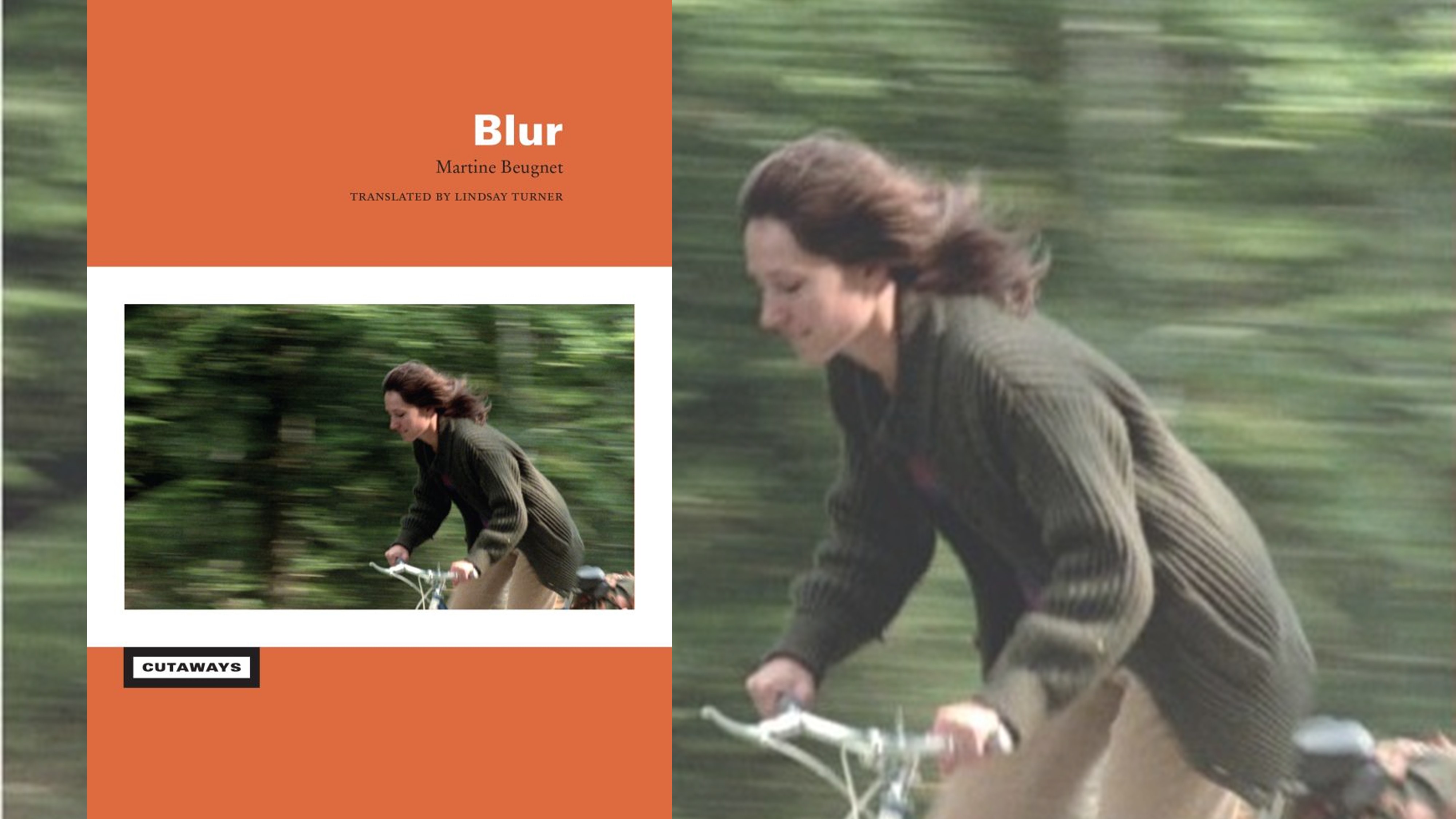
A Review of Blur.
By Jiarui Zhou
In contemporary visual culture, clarity has become a measure of technological progress. High-definition cinema and smartphone cameras promise increasingly precise images. Surveillance systems and facial recognition technologies connect visual detail with identification and control. Against this background, Martine Beugnet’s Blur raises a different set of questions: Does cinema require a clear image to render the world effectively? Has blur been too readily dismissed as technical failure or incomplete visual information?
Rethinking the Status of Blur
The most significant contribution of Blur consists in its recovery of blur from its conventional status as a photographic defect or decorative stylistic effect. Beugnet redefines it as a cinematic form whose perceptual force carries broader aesthetic and philosophical consequences. Her argument does not simply establish an opposition between blur and clarity. Instead, it emphasizes the changing and permeable relationship between them. Blur appears as a figure takes shape and may also appear as a clear image dissolves. It occupies an unstable threshold where visibility becomes uncertain, form loses its stability, and recognition is delayed. Blur therefore functions as a transitional state of perception rather than a fixed visual category.
Sharp images usually encourage viewers to identify the object rapidly and place it within an established system of meaning. Blur interrupts this process, leaving the image temporarily unresolved and shifting attention away from recognition towards a more affective mode of viewing. Beugnet’s argument challenges the assumption that clearer vision necessarily produces more reliable knowledge, since images also acquire value through their capacity to preserve experiences that resist complete naming or mastery.
The prologue begins with Beugnet’s experience of myopia and astigmatism. Vision emerges as an embodied activity whose limits are shaped by physiological and technological conditions. The final chapter returns to the effects of technological conditioning. Beugnet argues that cinema should preserve spaces in which perception can escape automated habits and remain capable of doubt. Although the book adopts a relatively free, essayistic structure, its central concern remains consistent throughout.
From Embodied Vision to Digital Technology
Rather than offering a linear history of cinema, Blur develops through a sequence of visual problems that reveal the instability of cinematic perception. The opening sections examine indistinction and the difficulty of defining blur as a stable category. Blur can arise at different stages of image production and circulation. Its material basis, therefore, depends on the conditions under which the image is formed and displayed.
Beugnet next examines atmospheric blur as a force that reorganizes cinematic space by weakening visual depth and disturbing the separation between figure and ground. As spatial orientation becomes uncertain, the landscape acquires a suspended quality that places material presence in tension with memory. From this atmospheric instability, Beugnet turns to focus as a more deliberate mechanism through which desire organizes visibility. In Vertigo (Alfred Hitchcock, 1958), Judy’s gradual appearance from a green haze as Madeleine reveals how Scottie’s fantasy depends on the camera’s production of a recognizable female figure. As her image comes into focus, the movement from blur to clarity stages desire as an effect of cinematic construction.
Where focus controls the emergence of a figure, motion blur shifts attention to the instability produced by movement. Modern transportation and mobile cinematography expand the visual field while allowing parts of the world to escape perception. Beugnet’s analysis of Jean-Luc Godard’s discontinuous slow motion demonstrates that reduced speed does not make the body fully legible. As slow motion exposes the instability concealed within bodily movement, blur prevents the body from settling into a fixed form and preserves its ongoing process of becoming.
The later chapters examine how blur gives cinematic form to unstable states of consciousness and to images that resist fixed boundaries. Superimposition and soft focus allow different temporal states to coexist within a single image, while an absent figure may return without acquiring complete presence. Blur allows the image itself to enter a state of reverie. It becomes particularly suited to melancholy and distraction because these states do not always possess a clear object. Michelangelo Antonioni’s Red Desert offers one of the book’s clearest demonstrations of this argument, as the boundaries between the human figure and the industrial landscape gradually dissolve. The image consequently moves towards a painterly form in which the subject can no longer be securely separated from its surroundings, allowing Beugnet to connect visual indistinction with the instability of subjecthood itself.
The book acquires particular contemporary relevance in its discussion of digital technology, where Beugnet shows that expanded technical capacity can coincide with increasing visual standardization. Although digital cameras enable new forms of blur, automated image correction often narrows the range of acceptable images. Through her readings of Agnès Varda and Jean-Luc Godard, Beugnet presents creative practice as a refusal of such automation, an argument crystallized in the final chapter, “Technology Has No Rules,” where uncertainty becomes a condition of technological invention.
Contributions to Film and Perception Studies
Blur expands the scope of formal film analysis by treating visual indeterminacy as a constitutive element of cinematic meaning rather than a secondary effect. Beugnet develops this argument through sustained attention to the material behavior of images and to how degrees of definition shape spectatorship. Because her concepts emerge from close readings of individual films, the book remains firmly grounded in textual analysis while also contributing to wider debates about perception and mediation.
The book also reconsiders the relationship between seeing and knowing by challenging the assumption that visual clarity guarantees epistemic certainty. Beugnet argues that blur can preserve experiences whose force depends on remaining only partially accessible, allowing memory to retain its affective charge and the represented subject to resist complete possession by the spectator’s gaze.
A further contribution concerns the relationship between vision and touch. As blur makes immediate recognition more difficult, the viewer becomes more sensitive to the material presence of the image. Beugnet describes this mode of viewing through the concept of the “tactile eye,” which presents cinematic perception as an embodied experience rather than a purely visual act. This emphasis reshapes cinematic perception as an embodied encounter in which images affect the spectator before they are fully interpreted. Blur therefore becomes a means of explaining how film form produces sensory knowledge without reducing viewing to an act of recognition.
The Political Limits of Blur
The book’s essayistic structure gives Beugnet considerable freedom to move across a wide range of examples and concepts, although this mobility sometimes weakens the distinctions on which her argument depends. Artistic defocusing can resemble compression artifacts or the visual uncertainty of military and surveillance imagery, yet each form emerges from a different relation to power. One may result from an aesthetic decision, whereas another may be produced by the systems that determine what can be seen and how it can be used. Their visual similarity therefore does not justify treating them as politically equivalent.
Beugnet persuasively identifies a perceptual continuity throughout these forms of blur, yet her analysis gives less attention to the unequal structures of power that govern their production and effects. As a result, the political distribution of diminished visibility remains unresolved, particularly where it strengthens institutional control while deepening the exclusion of already marginalized subjects. This limitation complicates the political implications of Beugnet’s argument, since the sensory openness she attributes to blur does not in itself confer a resistant politics. When indistinction obstructs evidence or withholds visibility from subjects who have historically struggled to gain entry to public representation, it may reinforce existing asymmetries of power. The political significance of blur therefore depends on the institutional structures that determine how it is produced and to what ends it is used.
Although Beugnet’s discussion of military imaging and operational images begins to confront this problem, its brevity leaves unresolved the gap between blur’s aesthetic potential and its political effects. An indistinct image may interrupt recognition, yet once incorporated into a military or surveillance apparatus, it can still function efficiently within a regime of control, a tension that warrants further research.
Furthermore, the book’s principal archive remains rooted in Euro-American avant-garde and auteur traditions, even though the inclusion of Kiyoshi Kurosawa and Hong Sangsoo extends its geographical reach. Blur may acquire different meanings in contexts where image quality is shaped by market circulation or infrastructural constraint. Such settings would bring questions of access and power more fully into view. Their absence does not weaken the book’s argument, but it identifies an important direction in which Beugnet’s framework could be tested and revised.
Rethinking Clarity as Cinema’s Visual Ideal
Blur transforms an apparently minor visual phenomenon into a major problem for film theory. Beugnet acknowledges the value of clarity while questioning its status as cinema’s dominant visual ideal. Cinematic power may emerge while a contour is still forming or while a figure begins to disappear. Such moments allow cinema to register embodied experience beyond the limits of immediate recognition.
The book may benefit from a more precise distinction between the forms of blur it examines, especially where questions of power become central. This limitation, however, does not reduce its theoretical significance. Returning to the question raised at the beginning of this review, Blur challenges the assumption that clarity should function as cinema’s only legitimate visual ideal. By tracing how indistinct images reshape perception, Beugnet invites readers to reassess the authority commonly granted to visual certainty.
Jiarui Zhou is a doctoral researcher at University College London. Her work broadly engages with film, gender, and visual culture, with a particular interest in contemporary Chinese cinema. She is also a curator whose work explores contemporary film culture through screenings and public programs.
Blur
By Martine Beugnet, translated by Lindsay Turner
Publisher: Fordham University Press
Paperback / 144 pages / 2026
ISBN 9781531511739
