
ISSUE 7 | October 2026
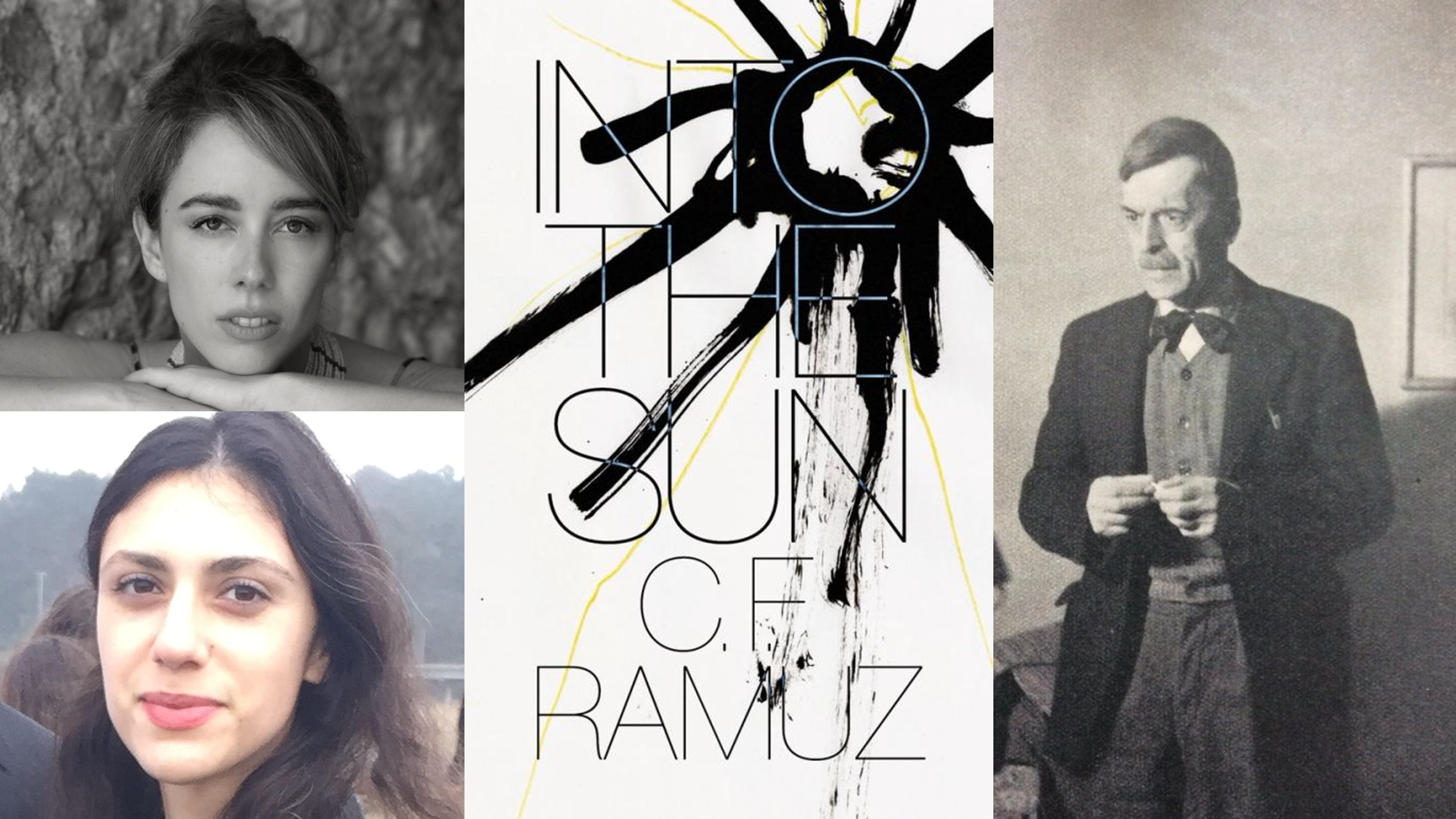
Translated from the French by Olivia Baes and Emma Ramadan.
It’s been a hot summer for a Swiss lakeside town—both bucolic and citylike, old-fashioned and up-to-date—when a “great message,” telegraphed from one continent to another, announces an “accident in the gravitational system.” Something has gone wrong with the axis of the Earth that will send our planet plunging into the sun: it’s the end of the world, though one hardly notices it, yet … “Thus all life will come to an end. The heat will rise. It will be excruciating for all living things … And yet nothing is visible for the moment.” For now the surface of the lake is as calm as can be, and the wine harvest promises to be sweet. Most flowers, however, have died. The stars grow bigger, and the sun turns from orange-red to red, and then to black-red. First comes denial: “The news is from America, you know what that means.” Then come first farewells: counting and naming beloved things—the rectangular meadows, the grapes on the vines, the lake. In its beauty the world is saying, “Look at me,” before it ends. The prophetic Into the Sun vividly voices the initial disbelief, the rejection of the increasingly obvious facts, and the suppression of the gnawing doubts. Ramuz describes denial, fear, melancholy, despair, reckless abandon, and a swift slide into anarchy. Everyone seeks relief in the lake while the sun drinks it up “as if through a straw.” Ramuz’s terrifyingly gripping scenario of a burning planet and the demise of humankind—now so fatefully on our horizon—is a stirring blast from the past, a truly hair-raising tour de force.
Meanwhile the cavalry and the machine gunners had been assembled. There was, here as elsewhere, in the early days, this military diversion. A word had passed from mouth to mouth: revolution; and now all anyone saw was that threat, which had come to the fore. There are those who have and those who do not: the latter, in the early days, seemed to have prevailed without difficulty. Freedom; yes, but how to grab hold of it? The noise hanging in the air hushed; listen! we hear nothing now, or just that they’re having fun. Today, a weekday, in those poor neighborhoods, it’s like a Sunday. All the cafés are full, and there are many people in the streets: a Sunday, like a Sunday, a national holiday,—as when there were holidays, as when there was still a calendar and holidays inscribed in that calendar. All these people in their Sunday clothes, all those Italian masons passing by arm in arm, the day laborers, their wives, their children, the families. The old people no one has seen for months because they don’t go out anymore,—and who were suddenly brought outside, and who were now helped to walk, some crippled, some paralyzed. The big women wearing faces full of makeup, their heads bare, their hair dyed yellow as was the fashion some twenty years ago, their feet in slippers, nothing but a blouse covering their bodies: it’s so hot out! We go to check the thermometer. Ah! That’s right! We had forgotten. And we quickly headed for the shade, and we headed for the fountains; and we headed for all kinds of shade and refreshments. At the Bras de Fer café, there is a big room for dancing: and so some were dancing, after dropping a ten-cent coin in the orchestrion. And in the other neighborhoods, the bourgeois neighborhoods, there too the most crucial thing had been forgotten, because the general mood was one of intense relief. Most men are made in such a way that they can only pay attention to the present moment, to trivialities; they like to be fooled. Few raise their eyes to the sky, few understand it. Few know even of its existence, that great mechanism there above, the star that is somewhat close, the star getting closer still.
Now they watched the cavalry squadrons passing by on their big horses, handsome boys from the countryside, their faces red under their nickel-plated shako chains, their muskets hanging from their saddles, their cartridge belts in bandoliers; and they watched the infantrymen standing on trucks, with their steel helmets painted gray,—as in Ancient Greece, thinks the middle school teacher, as in one of Homer’s songs, when they laid siege to Troy;—decidedly, society was standing firm. Then came the applause, the men lifting their hats, the women waving their hands,—among the muffled rumble of large reinforced tires, the large rubber and leather tires with their gleaming spikes.
On the square, all the pigeons flew away.
The helmeted heads and their shoulders were seen once more in front of the church-side fountain, with its scarlet geraniums and the column above;—they suddenly emerged from the shadows, entering that immense well of light that the eye was climbing, attempting to climb all the way to the opening up above, but could not . . .
Because it is 100° today beneath this blazing sky, we try to escape;—and so, more than ever, on all those paths descending to the lake, the infinite troop of swimmers.
Some, the moment they are undressed, run to the end of the diving platform and throw themselves in, headfirst. We hear the sound, we see the splash, we see rings form.
Many heads float like fishing bobbers on the water, with its lighter and darker patches.
There are perfectly smooth areas and then others where, for some strange reason (given that there is no wind) a fizzing of sorts appears, a gentle bubbling, like oil in a frying pan. The lack of waves, along with the heat, had made the moss abound. Here is the lake, the lake beside the city: the sun comes to drink, the sun slurps at its straw, with two lips the sun comes, steadily slurping: and so we see how the different species of algae have grown massively, rising from the depths in forests of great height, and careless swimmers trip over their peaks. Never such a drought, never such a heat: but never, either, had there been so much water. Never, as the regulars say, the anglers, the fishing netmen, the boaters; never, they said, never ever. In the early days, it had rapidly retreated, it had gone in reverse, having dropped several feet along the gently sloping shores, revealing a large strip,—and that had been the beginning. And the drought had continued; yet we could see that the waters were rising again, as if on a gentle impervious tide. The water had begun to bathe the walls of the quay it had abandoned, it had once again covered the large rim of sand, hard as cement, which it had left bare; it had pushed even further, going where it never had before, to the path bordering the shore, to the acacia bushes, to the weeping willows, sloshing into their trunks through holes,—rising, rising still, up to where? And, yes, it’s like a tide, but made by what moon? we ask ourselves. And then, suddenly, we understood. This same sun that takes, gives. The sun takes from one place; in another, it gives. It removes, but it supplies. And what had happened was, finally, that it had supplied more than it had removed, thanks to the enormous input from glaciers and the Rhône, the Rhône that was swollen, bloated and overflowing, which had become like milk. Over there, the input was still infinitely larger than what was borrowed, the whole mountain coming down through its torrents; and so, again: up to where? Up to where? the fishermen ask each other in their backlit boats, men who, in a string of black figures, look like telegraph alphabet symbols.
Here is the lake shore. Let us name everything here. Let us name only what is here. There are the fishing boats, not far from the large brown hangars of the Compagnie Générale de Navigation shipyards, black and white smokestacks looming over the rooftops, and in the background, the mountain the color of a grocery bag:—we climb back up to the city. In the irrigated meadow, the farmhand walks alongside a red horse bending its neck toward a ditch full of greasy water; a man, lying under a tree, arms crossed, looks dead. There are flies everywhere; there are barns with red doors. The strong smell of manure bars your way like a wall. Now the villas, the city commences. Rental properties spread out before you on all sides, soon meld together. The train station’s location is marked by smoke; we glimpse, higher up, the post office buildings and the banks.
Torpor, silence. It’s difficult to move. The few people who are out pause beneath trees, remove their hats, grab their handkerchiefs. There are hardly any children, only in the passageways between houses. An assembly has come together carrying fasces on the train station square. We keep climbing. Suddenly, we hear drums.
Place Saint-François, the same day, in the evening; it’s all they could find. They seem to still be having fun; it’s just one more diversion, a way to pass the time. They have formed a procession; in the front are the drums. Then men who are completely drunk, women shouting. The men hold on to each other to keep from falling. Around six; everyone goes to their windows. The shopkeepers step out on the sidewalks; many people join the parade.
A patrol on the other side of the square, however, takes swift action.
Arm in arm. The afternoon promenade continues; only now, they have left their neighborhoods, they have come to see how things are elsewhere; there has been some kind of progression.
They have started to sing “L’Internationale.”
They speak of epidemics breaking out. All the hospitals are full. Passersby are falling dead in the streets.
And then: “What is happening?”
And then, suddenly: “Ah! So it’s true!”
Charles Ferdinand Ramuz (1878-1947) is the preeminent Francophone Swiss writer of the twentieth century. Often set in remote Swiss villages, his many novels—enigmatic, mystical, apocalyptic—fascinated Céline, Gide, and Giono. Céline predicted that Ramuz would be among a handful of his contemporaries who were going to be read in the year 2000. He also wrote the libretto for his friend Stravinsky’s The Soldier’s Tale.
Olivia Baes translated C. F. Ramuz’s 1908 novel Jean-Luc persécuté.
Emma Ramadan is a literary translator based in Providence, Rhode Island. She is the recipient of a PEN/Heim grant, an NEA Translation Fellowship, and a Fulbright for her work on Ahmed Bouanani.
Excerpt from Into the Sun by C.F. Ramuz, translated by Olivia Baes and Emma Ramadan, translation copyright © 2025 by Olivia Baes and Emma Ramadan. Reprinted by permission of New Directions Publishing Corp.
First published as Présence de la mort by C.F. Ramuz, 1922 (Editions Georg); previously translated as The End of All Men (Pantheon Books, 1948).
Photo of C.F. Ramuz: Public domain.
